Latest Analysis and Commentary
by Bassam Tawil • April 24, 2024 at 5:00 am
The idea that Qatar has been acting as a mediator in the negotiations between Israel and Hamas is nothing short of laughable. Qatar has actually long been staunchly aligned with the Muslim Brotherhood organization, of which Hamas is an offshoot. The Muslim Brotherhood -- according to a hearing at the U.S. House Subcommittee on National Security on July 11, 2018 -- is a militant Islamist organization with affiliates in over 70 countries, including groups designated as terrorist organizations by the US. ""Qatar has huge influence over the Muslim Brotherhood's Palestinian affiliate, Hamas.... For too long, Doha has danced between its Islamist allies and its Western and Arab partners." — Hussein Ibish, a senior resident scholar at the Arab Gulf States Institute in Washington, The Atlantic, October 20, 2023 Qatar has a long history of supporting the Muslim Brotherhood and its radical terrorist offshoots.... Qatar has also provided political and financial support to Hamas. In 2008, Doha reportedly pledged $250 million to Hamas, one year after the terror group violently seized control of the Gaza Strip. In 2012, Qatari Emir Hamad bin Khalifa al-Thani became the first head of state to visit Gaza, pledging $400 million to Hamas. Since then, the Qatari government has continued to send money to Hamas. Qatar's goal is to keep Hamas in power. Qatar has no reason to care if thousands of Palestinians die in the Gaza Strip, so long as Hamas is permitted to continue ruling the coastal enclave.

The idea that Qatar has been acting as a mediator in the negotiations between Israel and Hamas is nothing short of laughable. Qatar has actually long been staunchly aligned with the Muslim Brotherhood organization, of which Hamas is an offshoot. Pictured: Hamas leader Khaled Mashaal meets with Qatar's then Crown Prince (today's Emir) Sheikh Tamim bin Hamad al-Thani at the Royal Palace in Amman, Jordan on January 29, 2012. (Photo by Khalil Mazraawi/AFP via Getty Images)
Recently, the rulers of Qatar demonstrated that they not only serve as gracious hosts to the leaders of the Palestinian Hamas terror group, but that they also have a sense of humor. The Gulf state's Prime Minister Mohammed bin Abdulrahman bin Jassim al-Thani announced during a press conference in Doha that his country is reassessing its role as a mediator between Israel and Hamas after facing criticism. "Qatar is in the process of a complete re-evaluation of its role," al-Thani said. "There is exploitation and abuse of the Qatari role," he said, adding that Qatar had been the victim of "point-scoring" by "politicians who are trying to conduct election campaigns by slighting the State of Qatar." Earlier, al-Thani said negotiations to secure the release of more than 130 remaining Israeli hostages, abducted by Hamas to the Gaza Strip on October 7, 2023, had stalled.
Continue Reading Article
by Lawrence Kadish • April 24, 2024 at 4:00 am

Today, at college campuses across our nation, there are Americans marching as Nazis and terrorist-supporters, shouting, "We're all Hamas." Pictured: An anti-Israel protest encampment on Columbia University campus on April 23, 2024, in New York City. (Photo by Stephanie Keith/Getty Images)
Before Hitler declared war on the United States in 1941, there were Nazis marching in our streets as Americans. Today, at college campuses across our nation, there are Americans marching as Nazis and terrorist-supporters, shouting, "We're all Hamas." Make no mistake about it. When student protestors burn the American flag and chant "Death to America" it has little to do with the Israeli military response to the murderous rampage by Hamas on October 7th and much to do with Iran's grand strategy of bringing death to the "Great Satan" through "useful idiots." Clearly, the protestors are outraged that Israelis have refused to be the mute, mutilated victims of the last Hamas outrage. After all, violent acts of anti-Semitism and Jew-killing are not supposed to come with a cost to its perpetrators. The "Death to America" crowd must be asking, "When did the Israelis change the rules?"
Continue Reading Article
by Howard Levitt • April 23, 2024 at 5:00 am
On the face of it, who can object to diversity, equity and inclusion? It is like objecting to Santa Claus. Unfortunately, these [DEI] workshops too often have been hijacked by radical ideologues who pitted races against each other. Who indeed is to blame for the wave of hatred toward Jews that is roiling Canadian workplaces, universities, unions, social media postings, even our streets and neighbourhoods? Who are the purveyors of antisemitism?

Who is to blame for the wave of hatred toward Jews that is roiling Canadian workplaces, universities, unions, social media postings, even our streets and neighbourhoods? Who are the purveyors of antisemitism? Pictured: Police guard Talmud Torah Elementary School in Montreal, Canada, as parents pick up their children, on November 9, 2023. Two Jewish schools in the city had been hit by gunfire overnight. (Photo by Mathiew Leiser/AFP via Getty Images)
Over the last several years, Canadian employers have increasingly brought in "diversity, equity, and inclusion" (DEI) trainers to rid their workforces of conscious, and even subconscious, racism. On the face of it, who can object to diversity, equity and inclusion? It is like objecting to Santa Claus. Unfortunately, these workshops too often have been hijacked by radical ideologues who pitted races against each other. The unhappy story of Richard Bilkszto, who committed suicide after alleging he was deemed a racist by one such trainer for observing that Canadians are not more racist than Americans, was simply the publicly exposed tip of that iceberg. I have had many Jewish clients, even before Oct. 7, complain about how Jews have been treated in these DEI seminars. To what extent has this radical training played a role in the sudden outpouring of antisemitism here?
Continue Reading Article
by Gordon G. Chang • April 22, 2024 at 5:00 am
China is swarming the waters of the Philippines, hoping to intimidate Manila into surrendering territory. US President Joe Biden and the State Department keep on issuing warnings, but Chinese President Xi Jinping continues to ignore them, suggesting deterrence is failing.... [R]ecently, China took Scarborough Shoal .... Washington then brokered an agreement for both sides to withdraw their craft, but only Manila complied. Beijing has been in firm control of Scarborough ever since. When Chinese leaders, generals and admirals saw Washington's failure to act, they began moving against Second Thomas Shoal and other Philippine reefs and islets in the South China Sea, went after Japan's islets in the East China Sea, and began reclaiming and militarizing features in the Spratly chain. Biden as vice president legitimized the worst elements in the Chinese political system by showing everyone that aggression works. Beijing has been waging proxy wars on three continents: Europe in Ukraine, Africa across its northern rim, and Asia in Israel and surrounding areas. Xi apparently now believes he is boss of the world. "Change is coming that hasn't happened in 100 years," the Chinese leader told Russian President Vladimir Putin after their 40th in-person chat, in Moscow on March 22 last year. "And we are driving this change together." Biden is now trying to reestablish deterrence. Britain and France desperately attempted to do that in late summer 1939 when they warned Germany that they would declare war if it invaded Poland. Then, German leaders did not believe the British and the French would in fact fight because for three years they had failed to make good on previous warnings.

China is swarming the waters of the Philippines, hoping to intimidate Manila into surrendering territory. On March 5, China wounded four Filipino sailors at Second Thomas Shoal, in the South China Sea. Unfortunately, the Biden administration's words and displays of solidarity with the Philippines have not impressed Chinese President Xi Jinping. His maritime militia, coast guard, and navy have stepped up aggressive tactics. Pictured: A China Coast Guard ship (top) sails dangerously close to Filipino fishermen aboard two wooden boats (center), as a Philippine Fisheries and Aquatic Resources inflatable boat observes, near the Scarborough Shoal, in the South China Sea, on February 16, 2024. (Photo by Ted Aljibe/ AFP/Getty Images)
Philippine's navy announced that, during the afternoon of April 15, it had observed 55 Chinese vessels in the West Philippine Sea, Manila's designation for the South China Sea. China is swarming the waters of the Philippines, hoping to intimidate Manila into surrendering territory. US President Joe Biden and the State Department keep on issuing warnings, but Chinese President Xi Jinping continues to ignore them, suggesting deterrence is failing and an incident leading to war could occur at any time. Of the craft spotted Monday, 48 were from China's maritime militia, six from the Chinese Coast Guard, and one was from the People's Liberation Army Navy. China's intrusions that day were spread across the South China Sea. Twenty-six of the vessels were spotted at Scarborough Shoal, six at Second Thomas Shoal, 20 near Pagasa Island, two near Panata Island, and the remaining one at Lawak Island.
Continue Reading Article
by John Eastman • April 21, 2024 at 5:00 am
What did the founders do? They committed an act of treason by signing the Declaration of Independence. They recognized at some point you have to take on the established regime when it is not only unjust, but when there is no lawful way to get it back on track. These matters frame our own nation. Texas had just filed its original action in the Supreme Court against Pennsylvania, Georgia, Wisconsin, and Michigan -- four swing states whose election officers had clearly violated election law in those states and with an impact that put Biden over the top in all four. In Georgia, the Secretary of State, Brad Raffensperger, signed a settlement agreement in March of 2020 in a suit that was filed by the Democratic Committee that essentially obliterated the signature verification process in Georgia. It made it virtually impossible to disqualify any ballots no matter how unlike the signature on the ballot was to the signature in the registration file. The most troubling aspect of it, to me, was that the law required that the signature match the registration signature. When Brad Raffensperger, who is not part of the legislature, unilaterally changed the rule from what the legislature had adopted by statute, that change was unconstitutional, not just illegal. Unilaterally, [the Secretary of the Commonwealth of Pennsylvania, Kathy Boockvar] got rid of a statute that election officials in Pennsylvania had been applying for 100 years to require signature verification. She then asked the Pennsylvania Supreme Court to approve what she had done....In other words, all of the statutory provisions that were designed to protect against fraud were obliterated in Pennsylvania. We ought not to be surprised if fraud walked through the door left open by the unconstitutional elimination of these statutes. To this day, there are 120,000 more votes that were cast in Pennsylvania than their records show voters who have cast votes. Think about that: 120,000 more votes than voters who cast votes. The margin in Pennsylvania was 80,000. Election officials in heavily Democrat counties [in Wisconsin] also set up drop boxes. They even set up what they called "human drop boxes" in Madison, which is the home of the University of Wisconsin. For two or three consecutive Saturdays before the election, they basically ran a ballot harvesting scheme at taxpayer expense with volunteers – whom I suspect were actually supporters of the Biden campaign -- working as "deputized" county clerks to go collect all these ballots, in violation of state law. A lot of these came in with the witness signatures, but the address not filled in. The county clerks were directed by the Secretary of State to fill the information in on their own. In other words, they were doctoring the evidence. They were doing Google searches to get the name, to fill in an address to validate ballots that were clearly illegal under Wisconsin law. All told, those couple of things combined, more than 200,000 ballots were affected in a state where the margin victory was just over 20,000. Then in Michigan, we had similar things going on. We probably all saw the video of election officials boarding up the canvassing center at TCF Center in Detroit so that people could not observe what was going on. There were hundreds of sworn affidavits about illegality in the conduct of that process in Detroit. The judge, without holding a hearing on a motion to dismiss, at which the allegations of the complaint are supposed to be taken as true, rejected all the sworn affidavits from all the witnesses who actually observed the illegality, and instead credited the government affidavit – without the government witness evening being subject to questioning on cross-examination. In those four states, and in Arizona and Nevada as well, there is no question that the illegality that occurred affected way more ballots than the certified margin of Joe Biden's victory in all of those states. It only took three of those six states -- any combination of three -- for Trump to have won the election. Well, first of all, that mantra....: "All the cases, all the courts ruled against Trump." First of all, that is not true. Most of the cases were rejected on very technical jurisdictional grounds, like a case brought by a voter, rather than the candidate himself. Individual voters do not have standing because they lack a particularized injury. Those were dismissed. There is no basis for claiming that there was anything wrong with the claims on the merits. It is just that the cases were not brought by the right people. There was one case where one of these illegal guidances from the Secretary of State was challenged before the election. The judge ruled that it was just a guidance, and that until we get to election day to find out if the law was actually violated, the case was not ripe -- and it got dismissed. Then the day after the election, when election officials actually violated the law, the case gets filed again, and the court says, "You can't wait until your guy loses and then bring the election challenge. It's barred by a doctrine called laches. This is the kind of stuff that the Trump legal team was dealing with in those 65 cases. Of the cases that actually reached the merits --there were fewer than a dozen of them, if I recall correctly -- Trump won three-fourths of them. You have never heard that in the "New York Times." The 65 Project was formed -- I think I've seen reported that they received a grant from a couple of George Soros-related organizations of $100 million -- to bring disbarment actions against all of the lawyers who were involved in any of those cases. The head of the organization gave an interview to Axios... and he said in his interview to Axios that the group's goal with respect to the Trump election lawyers is to "not only bring the grievances in the bar complaints, but shame them and make them toxic in their communities and in their firms" "in order to deter right-wing legal talent from signing on to any future GOP efforts" to challenge elections. Our system works, in part, because we have an adversarial system of justice that supports it. If groups like the 65 Project succeed in scaring off one side of these intense policy disputes or legal disputes, then we will not have an adversarial system of justice. We will not have elections that we can have any faith in, because if you do not have that kind of judicial check on illegality in the election, then bad actors will just do the illegality whenever they want, and we won't be able to do anything about Ultimately, we are the sovereign authority that tells the government which direction we want it to go, not the other way around. The issue of whether non-legislative actors in the state can alter election law consistent with the Constitution remains an open issue. It should not be an open issue. The Constitution is quite clear, but there was a news account at one point reporting that John Roberts had yelled at Alito and Thomas, who had insisted they needed to take these cases. They were just like Bush versus Gore. Roberts was reported to have said, "They're not like Bush versus Gore. If we do anything, they will burn down our cities." Which means the impact of what had gone on in the summer of 2020 in Portland and Kenosha and all these other places, had an impact on the Supreme Court declining to take these cases. What I have seen, and it pains me to say this, is that the level of corruption in our institutions, including our judicial institutions, is so pervasive now that it is troubling. Because many of these cases end up in the DC courts, I cannot imagine a stronger case for change of venue than those January 6th criminal defendants. It will cost a million, a million and a half to defend against those charges. The poor guy who entered a plea agreement and pleaded guilty..., one of the 19 defendants in Georgia, he is a bail bondsman for a living. If he gets a felony, he is not only in jail for a while, but he cannot do his trade, so they offer him a misdemeanor conviction and no jail time. He took it in a heartbeat. Otherwise, he is looking at a million to two million dollars in legal fees tied up in this internationally televised drama for nothing, and he was not in the position to undertake that. About electronic voting machines? There have been three audits. Antrim County, Michigan, and one of the leading critics of voting machines and their software is a guy named J. Alex Halderman, a professor of computer science and engineering at the University of Michigan. He testified as the expert in litigation down in Georgia in 2018 saying these machines are not secure. They sealed his testimony and it was only released in June. It just says, "These things are susceptible to fraud by all sorts of bad actors." One of the things we discover in that Antrim audits is that in fact, the vote logs that are supposed to be there had been deleted for 2020, not 2016, not 2012, they are still there, but 2020 had been deleted. They had a convention in Las Vegas, hired a bunch of geeks, computer geeks from around the country, to come to this convention and see who could hack into the machines and alter the vote codes quickest. It took people about 15 minutes. The notion that these things cannot be hacked is laughable. They have to be able to be opened if they need to be repaired. [I heard that from an MIT graduate at the time.] The question is, how to prove that they were hacked in this particular instance when they are destroying the evidence, and that is where we are. [W]e subsequently learned that despite [Former Attorney General William] Barr's public statement that US attorneys could investigate election illegality, anytime somebody did, he called him on the phone and order them not to. One of the FBI investigators who was actually getting to the bottom of this got a call that said, "Stand down." You have people out there saying, "Oh, we're investigating. Everything's fine," while behind the scenes ordering people not to do the investigation that would actually get to the bottom of it. I call it the uniparty. You can call it the deep state. You can call it the administrative state. You can call it the corrupt state, but it sees the MAGA movement as the biggest threat to its syndicators. It is going to do everything it can to destroy the people who are going to try and publicize what is going on. That is what we are dealing with, and we are $2 million in. One of the lawsuits that was filed against me by this guy down in North Carolina, I don't know why he picked me as the lead defendant, but other defendants are all billionaire oligarchs who are using their own wealth. That is the kind of nonsense I'm dealing with.

To this day, there are 120,000 more votes that were cast in Pennsylvania [in the 2020 election] than their records show voters who have cast votes. Think about that: 120,000 more votes than voters who cast votes. The margin in Pennsylvania was 80,000. (Image source: iStock)
I would like to discuss some of the illegalities that occurred in the 2020 election and the proposed constitutional remedies that we thought we could advance. I would also like to discuss the lawfare that is sweeping across the country and destroying not just the people that were involved in those efforts, but the very notion of our adversarial system of justice. This fight and the dangers from it are much bigger than what I am dealing with personally, or what the hundred or so Trump lawyers who have been targeted in this new lawfare effort are dealing with. It seems that there is something similar going on here, albeit to a much less lethal degree, than what we are seeing with the October 7th attack on Israel, as that, too, was an attack on the rule of law.
Continue Reading Article
by Amir Taheri • April 21, 2024 at 4:00 am
Khamenei reached the "something-must-be-done" point that all leaders who need to appear to be doing something but lack the courage to do anything reach. Everyone now knows that Tehran is capable of launching a tsunami of death by air against Israel and that there is no guarantee that Washington would be informed of all details in advance. The real winner in this dangerous game was the US, which re-establishes itself as the un-expendable power in the Middle East. Both Khamenei, who now depends on US to prevent an Israeli "revenge" attack, and Netanyahu, who dodged a deadly bullet, are now forced to listen to a third player that alone has the ability to make a difference.

The real winner in this dangerous game was the US, which re-establishes itself as the un-expendable power in the Middle East. Both Khamenei, who now depends on US to prevent an Israeli "revenge" attack, and Netanyahu, who dodged a deadly bullet, are now forced to listen to a third player that alone has the ability to make a difference. (Image source: iStock/Getty Images)
On April 1 when the Islamic Republic of Iran's consulate in Damascus was attacked by Israeli warplanes, the news could have been treated as a prank on All Fools' Day. Even though seven Iranian military personnel, including two senior commanders, were killed, there was no reason to treat the incident as different from similar operations over the past decades of hostility between the mullahs and the "Zionist entity". Since 1990, when the two protagonists intensified their enmity, a dozen Iranian generals have been assassinated by Israeli agents inside Iran or in Iranian bases in Syria or Lebanon. Israel also succeeded in "taking out" a number of prominent non-Iranian agents, including Lebanese Hezbollah's Imad Mughniyeh, a man far more important to Tehran than the "commanders" killed in Damascus. Israel was also responsible for the "elimination" of at least eight Iranian nuclear scientists and suspicious explosions in several military sites across the Islamic Republic.
Continue Reading Article
by Majid Rafizadeh • April 20, 2024 at 5:00 am
Article 2, paragraph 4 of the UN Charter explicitly prohibits the threat or use of force against the territorial integrity or political independence of any member state, making Iran's actions tantamount to an act of war. The US administration's call for Israel to refrain from responding to attacks while facing direct aggression is deeply troubling and raises significant questions about the principles of sovereignty and self-defense. In the face of relentless attacks on Israel, Washington is sending a dangerous message of encouragement, if not outright approval, to aggressors and undermining Israel's right to defend itself against existential threats. Where is any real threat or pressure being paced on Hamas, Qatar or Iran, all of whom initiated the conflict in the first place? As far one can tell, nothing is even being done to eliminate Iran's nuclear weapons program. If Iran had nuclear weapons, does anyone think it might hesitate to use them, even "just" as a means of coercion? The expectation that Israel should tolerate such attacks not only undermines the principles of self-defense and sovereignty but also erodes the longstanding partnership between the United States and Israel, sending a disconcerting message to the world about the strength of any US alliance in the face of adversity.
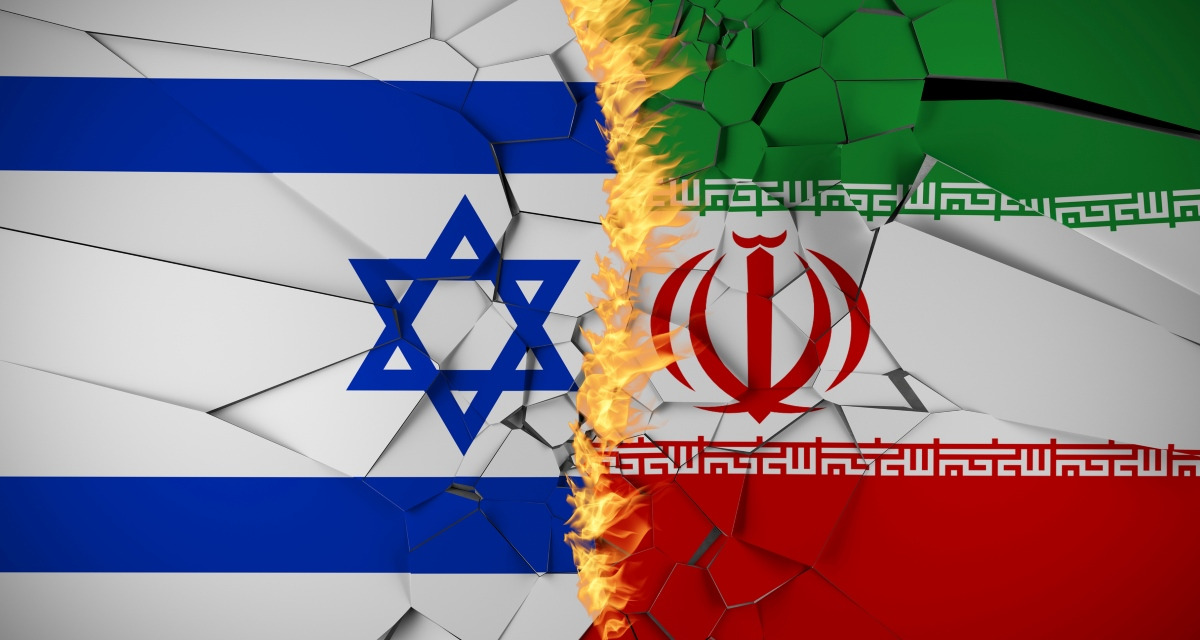
The expectation that Israel should tolerate attacks by Iran not only undermines the principles of self-defense and sovereignty but also erodes the longstanding partnership between the United States and Israel, sending a disconcerting message to the world about the strength of any US alliance in the face of adversity. (Image source: iStock/Getty Images)
Amid the relentless assaults from multiple adversaries -- Iran's regime, Qatar, Hezbollah, Hamas and the Houthis -- Israel finds itself surrounded by Iran's "ring of fire" on all fronts. These coordinated attacks, originating from both neighboring states and non-state actors, pose, as clearly intended, a threat to Israel's existence. In these dire circumstances, Israel looks to its longstanding ally, the United States, for crucial support and solidarity. However, the Biden administration's approach has left Israel feeling isolated and abandoned at a time when it most needs unwavering backing.
Continue Reading Article
by Lawrence Kadish • April 19, 2024 at 5:00 am

Pictured: A statue of Confucius in Suzhou, China. (Photo by iStock/Getty Images)
"Tsekung asked about government, and Confucius replied: 'People must have sufficient to eat; there must be a sufficient army; and there must be sufficient confidence of the people in the ruler.' 'If you are forced to give up one of these three objectives, what would you go without first?' asked Tsekung. Confucius said, 'I would go without the army first.' 'And if you were forced to go without one of the two remaining factors, what would you rather go without?' asked Tsekung again. 'I would rather go without sufficient food for the people. There have always been deaths in every generation since men lived, but a nation cannot exist without confidence in its ruler.'"
— From The Wisdom of China and India by Lin Yutang.*
Continue Reading Article
by Alan M. Dershowitz • April 18, 2024 at 5:00 am
Among the so-called innocent "civilians" who Hamas claims have been killed by Israel, there are thousands of guilty and complicit civilians without whose assistance Hamas could not have succeeded in their barbarisms. When Hamas provides its self-serving numbers of those allegedly killed by Israel, they refuse to distinguish between combatants and civilians. They certainly do not identify complicit "civilians," nor do they indicate how many were killed by the "friendly fire" of Hamas and other terrorist groups, whose rockets routinely misfire and land within Gaza. In a deliberate effort to mislead, Hamas instead purports to list the number of women and children who have been killed. But they include terrorists under the age of 19 as "children" and female terrorists as "women." All in all, the number of absolutely innocent Gazans — babies, children and adults who are not complicit in Hamas crimes — is a fraction of those claimed by Israel's enemies, including so-called human rights groups. It is time for a thorough and objective investigation of the actual status of all those allegedly killed by Israeli military actions. The results will show that Israel has achieved a remarkably low and unheard of ratio of combatants and complicit civilians to innocent civilians.

Some civilians in Gaza bear "a heavy responsibility for all these crimes committed by the government they have chosen themselves." Consider the Gazan civilians who followed the terrorists into Israel on October 7. These civilians captured a nurse named Nili Margalit and, after murdering other Israelis, abducted her to Gaza, where they displayed her to the "jubilant crowds" of civilians who cheered her kidnappers. Pictured: A Hamas terrorist and Palestinian civilian accomplices enter Kibbutz Be'eri to murder, rape, torture and abduct Jews, on October 7, 2023. (Image source: Kibbutz Be'eri security camera)
"The crimes committed by the Germans are horrible and one hears on every corner of the misery and losses they have intentionally brought over the peoples. The strangest thing is that even the better people among the Germans are not conscious of their heavy responsibility for all these crimes committed by the government they have chosen themselves, and that the outside world is rather inclined to forget about it." Those words were written by Albert Einstein on September 16, 1945, shortly after the end of World War II, in a letter I was fortunate enough to acquire. That letter could have been written to the so-called innocent adult civilians in Gaza. They too bear "a heavy responsibility for all these crimes committed by the government they have chosen themselves." They elected Hamas and, according to recent polls, continue to support it and would vote for those terrorists again.
Continue Reading Article
by Lawrence Kadish • April 17, 2024 at 1:39 pm
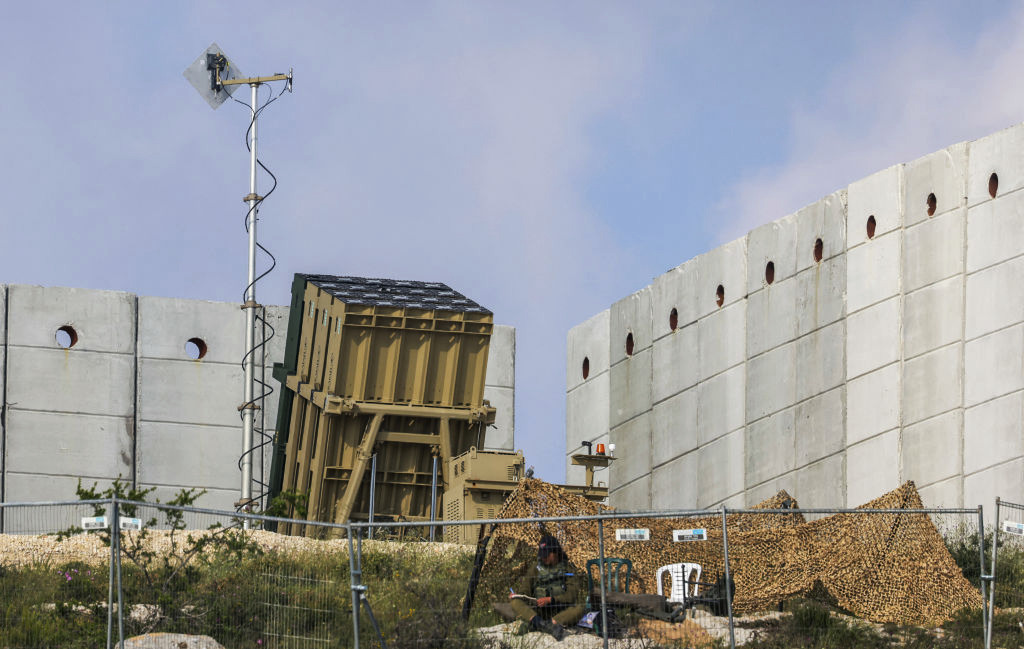
In the end, because of Israel's robust defense technology, Iran's recent drone and ballistic missile attack on Israel's urban centers was little more than a potentially deadly fireworks show. Pictured: A battery of the Iron Dome anti-missile defense system near Jerusalem on April 15, 2024. (Photo by Menahem Kahana/AFP via Getty Images)
In the end, because of Israel's robust defense technology, Iran's recent drone and ballistic missile attack on Israel's urban centers was little more than a potentially deadly fireworks show, reportedly choreographed by the United States, in coordination with Iran, "so that no one will be hurt and war with Israel will be avoided" -- apparently not with Israel. Make no mistake, though. Iran is capable and willing to engage in a far more strategic display of power in the Middle East.
Continue Reading Article
by Nils A. Haug • April 17, 2024 at 5:15 am
Not only are Jews under threat, but Christians and all "unbelievers" in the radical jihadist agenda as well. Although an "ostrich" mentality towards these genocidal objectives prevails among Western decision-makers, the reality is quite different: The driving ideology behind Hamas's murderous intent is exemplified by the "Doomsday Clock" located in Palestine Square, Tehran, Iran. Inaugurated by Supreme Leader Ayatollah Ali Khamenei in 2017, the clock counts down the time towards Israel's anticipated destruction in 2040, sixteen years from now. Iran's barrage of missiles and drones launched at Israel on April 13, 2024, was presumably another step toward fulfilling that destructive intent. Even though Iran remains essentially responsible for the actions of its agents, it has yet to suffer any consequences despite its direct attack on Israel on April 13-14. All the while, taking full advantage of US appeasement and unencumbered by meaningful sanctions, Iran races ahead with development of nuclear weapons for the sole purpose of eliminating Israel and, thereafter Jordan and ultimately the "Great Satan," the United States from the world map. On April 1, 2024, Abolfazl Bazargan, an Iranian international relations expert, made it clear, with a straight face, that "...for the purpose of bringing about peace - you have to create nuclear deterrence, even if only one (bomb)." Peace, however, seems to mean "after jihad has obliterated all opposition and established an Islamic Caliphate." This objective is couched in rational terms to appease West powers, the sympathetic world leaders, who might be persuaded that it is fair and right that Iran possess a nuclear weapon just as Israel, the US, UK, North Korea, and other nations possess such weapons. The underlying jihadist ideology of world hegemony is concealed under a veneer of rationalism, social justice, victimhood, and fairness. "It's a belief that goes a long way in explaining the dehumanization of the Jews: It's much easier to brutalize and slaughter, the way Hamas did on October 7, if you think that Jews are apes and pigs. In our rational Western way of thinking, all of this is unfathomable." — Idit Bar, expert on Islamism, Times of Israel, February 2, 2024. Refusing to directly confront Iran as the source of Middle Eastern terror -- and instead rely on diplomatic "conflict resolution" that enables Iran to buy time -- amounts to a form of appeasement. At this time, preparation for war is the best deterrence, especially in the current circumstances of a misguided faith in "talking." It was an attitude of pusillanimous appeasement by UK Prime Minister Neville Chamberlain of Nazi Germany in 1938, with the Munich Agreement, that directly resulted in Hitler's unrestrained march on neighbouring countries, thus inaugurating WW2. In like mode, US President Joe Biden's acolytes now appease Iran's Ayatollahs, an approach that commenced under President Barack Obama. Once again, the consequences for the West and the world at large will be horrendous.
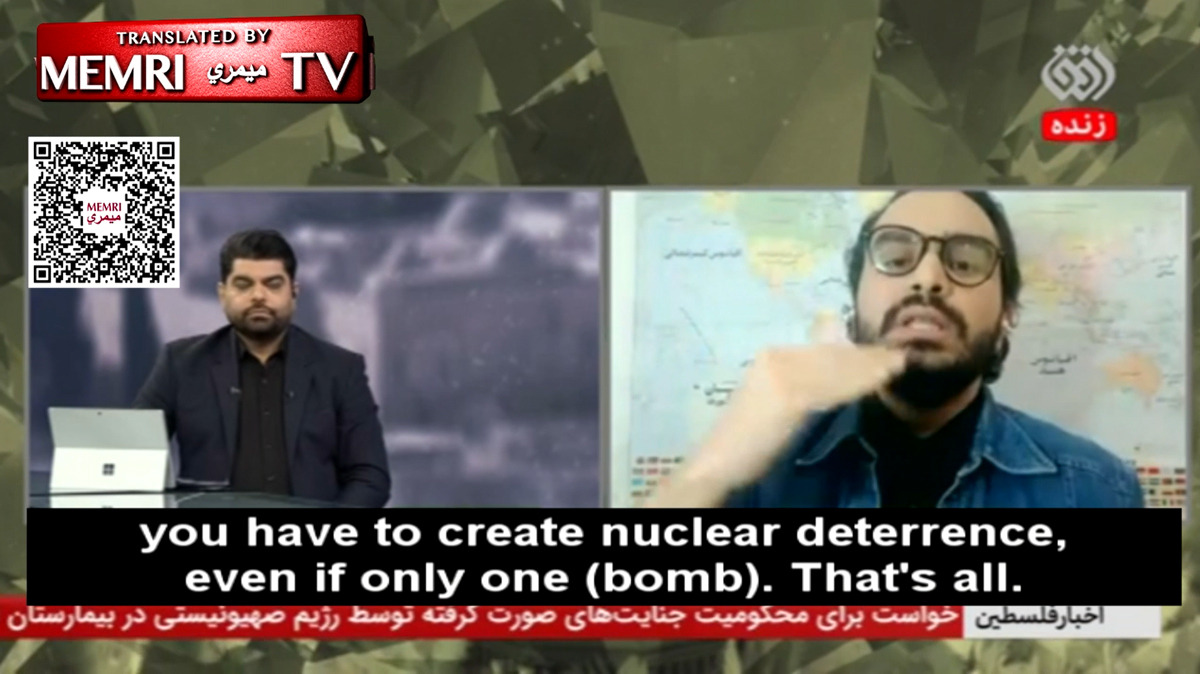
Abolfazl Bazargan, an Iranian international relations expert, recently said on Iran's Ofagh TV that "...for the purpose of bringing about peace - you have to create nuclear deterrence, even if only one (bomb)." Peace, however, seems to mean "after jihad has obliterated all opposition and established an Islamic Caliphate." (Image source: MEMRI)
On February 9, 2024, Imam Sheikh Abdul Salam Zoud at the Masjid As-Sunnah Lakemba in Sydney, Australia, made the following live-streamed pronouncement: "There is no solution other than Jihad which continues until Judgement Day. The Prophet Muhammad, the Righteous Caliphs – none of them conquered the world by peaceful means. They conquered it through Jihad. The goal of Jihad for the sake of Allah is not to kill people and take over their lands. Rather, the goal of Jihad is to remove obstacles before the spreading and rule of Islam."
Continue Reading Article
by Howard Levitt • April 17, 2024 at 4:00 am
Given their small numbers and the omnipresence of antisemitism, the Jewish community is reliant on protection from society: the courts, the legal system, the police and public sentiment itself. That is the social compact under which the community is able to thrive — and give back. But the social compact is now broken.... First, after Oct. 7, even before Israel invaded Gaza to root out Hamas, there were hate rallies.... It quickly became obvious that their targets were not Israelis, but Jews everywhere: in workplaces, unions, universities and on the street.... What is their goal? To intimidate the Jewish community, in the hope that it will capitulate and that its members will forfeit their identities as Jewish Canadians and perhaps even feel forced to leave. It is not just Jews who are under attack. Our entire civilization is threatened. The chants a short time ago to "shut down Christmas".... are deliberately targeting the functioning of society. [I]f there was a ceasefire now, Hamas would regroup and strengthen, as it has after every previous ceasefire, and would still run Gaza. The Israeli hostages would be stuck in Gaza indefinitely and Hamas would, as it keeps promising, repeat the Oct. 7 attacks a second, third and fourth time until Israel is eradicated.... If bad behaviour is permitted, it gets worse. It is not as if Hamas will somehow reform its ways: its 1988 charter has two main objectives, killing all Jews and the eradication of Israel.
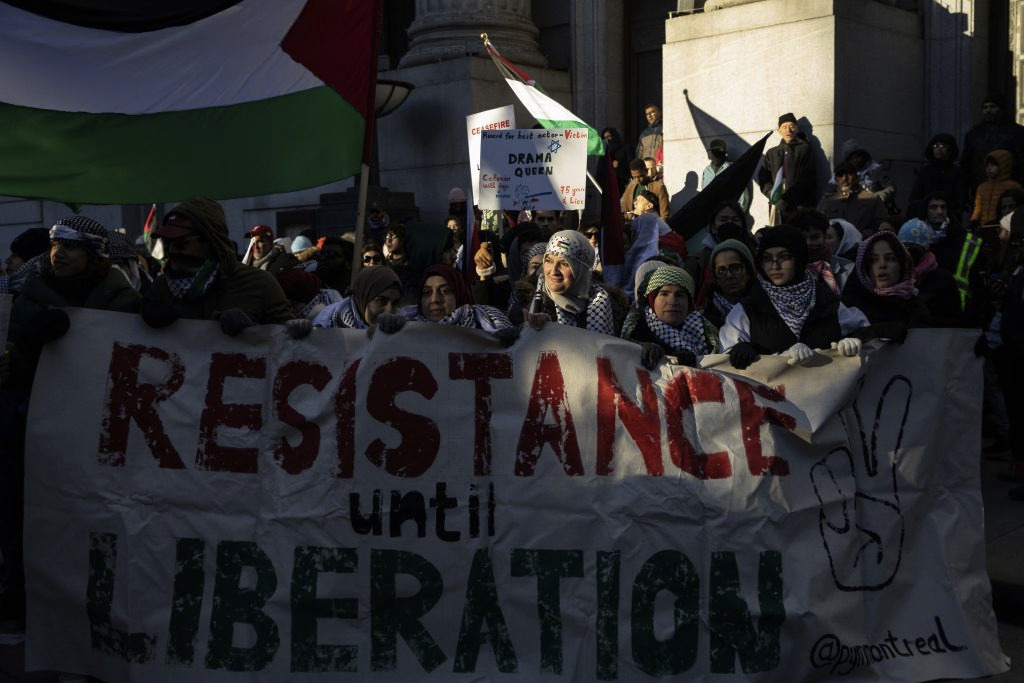
After Oct. 7, even before Israel invaded Gaza to root out Hamas, there were hate rallies in Canada. It quickly became obvious that their targets were not Israelis, but Jews everywhere: in workplaces, unions, universities and on the street. What is their goal? To intimidate the Jewish community, in the hope that it will capitulate and that its members will forfeit their identities as Jewish Canadians and perhaps even feel forced to leave. Pictured: Anti-Israel protesters in Montreal, Canada, on November 18, 2023. (Photo by Alexis Aubin/AFP via Getty Images)
There are very few Jews in the world. Not even one per cent of the world's population is Jewish. Not even 0.1 per cent. In fact, only about 15 million of the world's population of 8 billion people — less than 0.2 per cent — are Jewish. Canada has the fourth-largest population of world Jewry at 335,000, less than one per cent of our 39 million population, dramatically smaller than the Muslim population, now approaching two million. Canada's Jewish community has always taken pride in this country, contributing mightily in science, medicine, business and all forms of media and culture. It is part of Jewish upbringing to add value to the society in which one lives, which is perhaps why, despite the minuscule numbers, nearly 40 per cent of world chess champions have been Jewish and 22 per cent of Nobel Prize winners.
Continue Reading Article
by Bassam Tawil • April 16, 2024 at 5:00 am
Among the top 50 countries in which Christians were persecuted in 2023 were Yemen, Libya, Iran, Afghanistan, Iraq, Morocco, Qatar, Egypt, Turkey, and other Middle Eastern and Muslim-majority countries. Israel, needless to say, was not on the list. Despite these disturbing statistics, US television personality Tucker Carlson, in his interview with the Bethlehem pastor, chose to single out Israel, the only country where Christians feel safe and where their number is increasing every year. Carlson did not bother to ask the pastor about the persecuted Christians of Egypt. Carlson chose to interview Isaac, who has long history of promoting falsehoods about Israel and the Arab-Israeli conflict in his roles as pastor, academic dean of Bethlehem Bible College (a self-identified "Palestinian Christian Evangelical university college" that promotes a "Palestinian Christian theology"), and director of the "Christ at the Checkpoint" conferences -- the infamous venue where anti-Israel libels are proclaimed in the name of Christian love, justice and peace. "[T]hose of us who track these things know that Munther Isaac has long been the high priest of antisemitic Christianity; sadly, he spreads his hate from the city of Jesus' birth." — Rev. Johnnie Moore, president of the Congress of Christian Leaders, jewishinsider.com, April 11, 2024. "We have a mafia here that is seizing Christian-owned lands. I protested against this Muslim mafia, and I even called a large gathering. I invited 80 people to my home. That same night, fliers were distributed in Bethlehem threatening to kill me. Of course, I am worried about the future of Christians here. Looking at the facts on the ground, you can see that there is no future for the Christians here. We are melting; we are disappearing. I fear the day will come when our churches will become museums. That is my nightmare." — Samir Qumsieh, prominent Christian leader near Bethlehem, to Gatestone, April 2024.
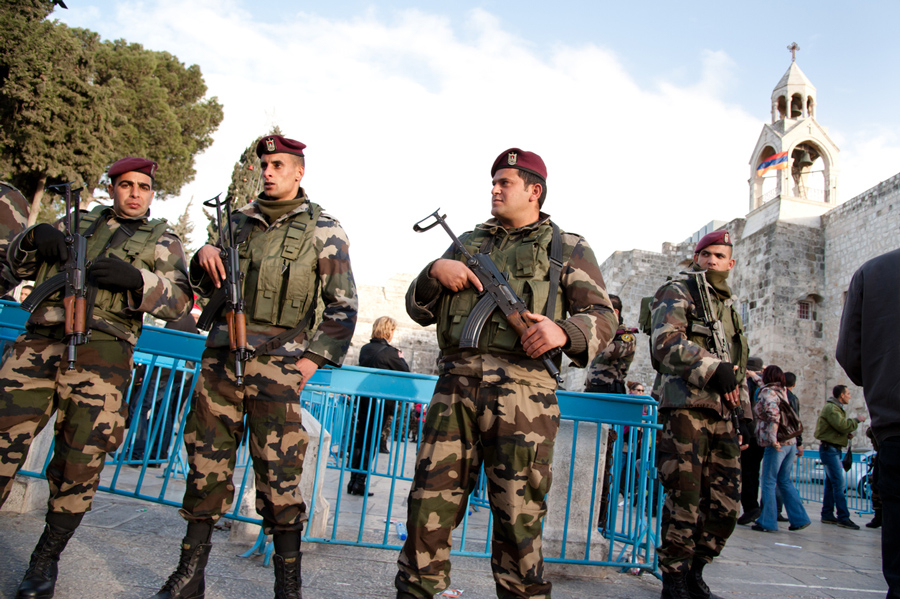
Since the Palestinian Authority (PA) assumed control of Bethlehem in 1995, the Christian share of the population has dropped from 65% to only 12% today. By contrast, the Christian population in Israel has been on the rise in recent years. "Most of us 180k Christian Israelis prefer to live under Israel freely rather than under a Palestinian Islamic Authority regime controlling Bethlehem. Israel gives us freedom while living under Arabs has been genocidal for Christians all across the Middle East," says Shadi Khalloul, a Christian Maronite who describes himself as a "patriotic Israeli." Pictured: PA policemen stand in Manger Square, Bethlehem, in front of the Church of the Nativity. (Image source: iStock)
On the same day that US television personality Tucker Carlson interviewed a pastor from Bethlehem who falsely accused Israel of mistreating Christians, Israel's University of Haifa announced the appointment of Professor Mona Maron as Rector. A Maronite Christian from the village of Isfiya, near Haifa, Maron has been a trailblazer for the integration and advancement of women in the sciences, particularly within the Arab community. She was the first Arab woman from her village to earn a doctoral degree and Israel's first Arab professor of neuroscience. "I am grateful for the trust I received from the members of the University senate and look forward to taking up the position," Maron said. "First and foremost, the University of Haifa is a home for me. A home that welcomed me into its ranks more than 30 years ago, as an undergraduate student, then as a faculty member in the neurobiology department and now with the Rector's role."
Continue Reading Article
by Daniel Greenfield • April 16, 2024 at 4:00 am
This was the "attack" prearranged for show between Iran and the Biden administration through backchannels. It's an attack that allows Iran to show off that it can reach Israel (look at those lights over the Temple Mount), while not inflicting any real damage. [H]ad Iran actually been trying to launch a serious attack, it would have used its Hezbollah, Houthi, Iraqi and whatever is left of its Hamas proxies to saturate local air defenses. Iran will do things beyond this light show, which was largely meant to reassure the Biden administration that its "diplomatic tools" have successfully solved the problem. That's an illusion that Iran has used to allow it to build up its nuclear weapons program.... It also learned under Obama that its greatest defense is convincing D.C. elites that diplomacy will successfully deescalate any conflicts with the regime.

The Biden administration has already made it clear that it will oppose any Israeli response to the Iranian missile and drone attack. There will be public condemnations and warnings about escalating the conflict further. Pictured: Ballistic missiles, launched from Iran, descend from Israel's skies and are intercepted by missile-defense systems, photographed from Hebron on April 14, 2024. (Photo by AFPTV/AFP via Getty Images)
This was not the actual Iranian attack. This was the "attack" prearranged for show between Iran and the Biden administration through backchannels. It's an attack that allows Iran to show off that it can reach Israel (look at those lights over the Temple Mount), while not inflicting any real damage. The Biden administration has already made it clear that it will oppose any Israeli response. There will be public condemnations and warnings about escalating the conflict further. So does that mean it's over? No. Iran did burn up some resources doing this, but apart from the morale boost of doing it, it set out to test U.S. and Israeli defenses. And the defenses did what they were supposed to. However, had Iran actually been trying to launch a serious attack, it would have used its Hezbollah, Houthi, Iraqi and whatever is left of its Hamas proxies to saturate local air defenses.
Continue Reading Article
by Bassam Tawil • April 15, 2024 at 5:00 am
The prospect of Hamas declaring or celebrating "victory" worries not only Israel, but many Arabs -- including Palestinians -- who want to see the terrorist group completely destroyed and removed from power, but are often afraid to speak out for fear of retaliation. "The continuity of Hamas's rule in Gaza is an ultra mega major disaster for the Palestinian people's aspirations, cause, hope for the reconstruction of the battered coastal enclave, and prospects for a new path forward to bring about progress, reconciliation, coexistence & peace." — Ahmed Fouad Alkhatib, "Proud American from Gaza City; pro-Palestine, pro-peace, anti-Hamas", X, April 8, 2024. Hamas, clearly buoyed by having the US on their side, has unsurprisingly hardened its position. It is now and is saying it wants Israel to make even more concessions. Where is any US pressure on Hamas, Iran or Qatar? "Yes, Hamas thanked the United States. When a terrorist group is thanking you, you're probably doing something wrong." — Joe Truzman, senior research analyst, X, April 9, 2024. The Hamas terrorists have only been emboldened by the Biden administration's growing hostility towards Israel and its demand that Israel end the war, a move that would effectively be a surrender to Hamas. "What victory are you talking about? Are you in your right mind? [Hamas has brought] complete devastation; thousands killed and displaced.... This is what the terrorist Hamas group, Iran's puppet, brought upon the people of Gaza. The leaders of Hamas defeated the people of Gaza and exterminated them without mercy." — Omar Shaybalras, X, April 9, 2024. "Gaza has been destroyed, starved, slaughtered.... The people of Gaza are cursing Hamas, [Palestinian] Islamic Jihad, and Iran.... The members of Hamas's armed wing use children as human shields." — Osama al-Ali ,member of the Palestinian National Council, the PLO's parliament-in-exile, television interview, X, December 7, 2023. "As long as [Hamas leaders Ismail] Haniyeh, [Yahya] Sinwar and [Khaled] Mashaal are alive, it is a victory for them, As for the destruction and the blood of the women and children of Gaza, it is a profitable enterprise as far as Hamas is concerned." — Abdallah Abou Aymen, April 9, 2024. Unlike the Biden administration and anti-Israel protestors in the West, these observers understand that Hamas, Iran and Qatar are fully and solely responsible for the mass destruction and high casualties in the Gaza Strip.... We are already seeing calls for "Death to America" in America. A ceasefire would save Hamas, allow it to continue preparing for future massacres against Israelis, and enable Iran and Qatar to "export the Revolution" even more aggressively. Above all, a US-bestowed, fake "victory" for Hamas would assure China, Russia and other predators that belligerency works and incentivize them to put the finishing touches on what many perceive as an "ultra mega major disaster" of a presidential legacy.

Hamas, clearly buoyed by having the US on their side, has unsurprisingly hardened its position. It is now and is saying it wants Israel to make even more concessions.Where is any US pressure on Hamas, Iran or Qatar? Pictured: Yahya Sinwar (L), leader of Hamas in the Gaza Strip, shares some laughs with senior Hamas leaders Khalil al-Haya (C) Ismail Haniyeh (R) in Rafah on February 24, 2017. (Photo by Said Khatib/AFP via Getty Images)
The Iran-backed Palestinian terrorist group Hamas is reportedly preparing to hold "victory" rallies if and when the war in the Gaza Strip ends. Many Arabs, however, have scoffed at Hamas's expected celebrations and accused the terrorist group and its patrons in Tehran of destroying the Gaza Strip. "A friend in the City of Rafah told me he saw large signs and banners being printed/prepared by Hamas to hold 'victory rallies' that the Islamist group plans on having when a ceasefire/hostage deal is announced, highlighting the withdrawal of IDF troops from Gaza as an achievement," said Ahmed Fouad Alkhatib, who describes himself as a "proud American from Gaza City; pro-Palestine, pro-peace, and anti-Hamas," who lost 31 family members in the Israel-Hamas war.
Continue Reading Article
|