Latest Analysis and Commentary
by Alan M. Dershowitz • April 18, 2024 at 5:00 am
Among the so-called innocent "civilians" who Hamas claims have been killed by Israel, there are thousands of guilty and complicit civilians without whose assistance Hamas could not have succeeded in their barbarisms. When Hamas provides its self-serving numbers of those allegedly killed by Israel, they refuse to distinguish between combatants and civilians. They certainly do not identify complicit "civilians," nor do they indicate how many were killed by the "friendly fire" of Hamas and other terrorist groups, whose rockets routinely misfire and land within Gaza. In a deliberate effort to mislead, Hamas instead purports to list the number of women and children who have been killed. But they include terrorists under the age of 19 as "children" and female terrorists as "women." All in all, the number of absolutely innocent Gazans — babies, children and adults who are not complicit in Hamas crimes — is a fraction of those claimed by Israel's enemies, including so-called human rights groups. It is time for a thorough and objective investigation of the actual status of all those allegedly killed by Israeli military actions. The results will show that Israel has achieved a remarkably low and unheard of ratio of combatants and complicit civilians to innocent civilians.

Some civilians in Gaza bear "a heavy responsibility for all these crimes committed by the government they have chosen themselves." Consider the Gazan civilians who followed the terrorists into Israel on October 7. These civilians captured a nurse named Nili Margalit and, after murdering other Israelis, abducted her to Gaza, where they displayed her to the "jubilant crowds" of civilians who cheered her kidnappers. Pictured: A Hamas terrorist and Palestinian civilian accomplices enter Kibbutz Be'eri to murder, rape, torture and abduct Jews, on October 7, 2023. (Image source: Kibbutz Be'eri security camera)
"The crimes committed by the Germans are horrible and one hears on every corner of the misery and losses they have intentionally brought over the peoples. The strangest thing is that even the better people among the Germans are not conscious of their heavy responsibility for all these crimes committed by the government they have chosen themselves, and that the outside world is rather inclined to forget about it." Those words were written by Albert Einstein on September 16, 1945, shortly after the end of World War II, in a letter I was fortunate enough to acquire. That letter could have been written to the so-called innocent adult civilians in Gaza. They too bear "a heavy responsibility for all these crimes committed by the government they have chosen themselves." They elected Hamas and, according to recent polls, continue to support it and would vote for those terrorists again.
Continue Reading Article
by Lawrence Kadish • April 17, 2024 at 1:39 pm
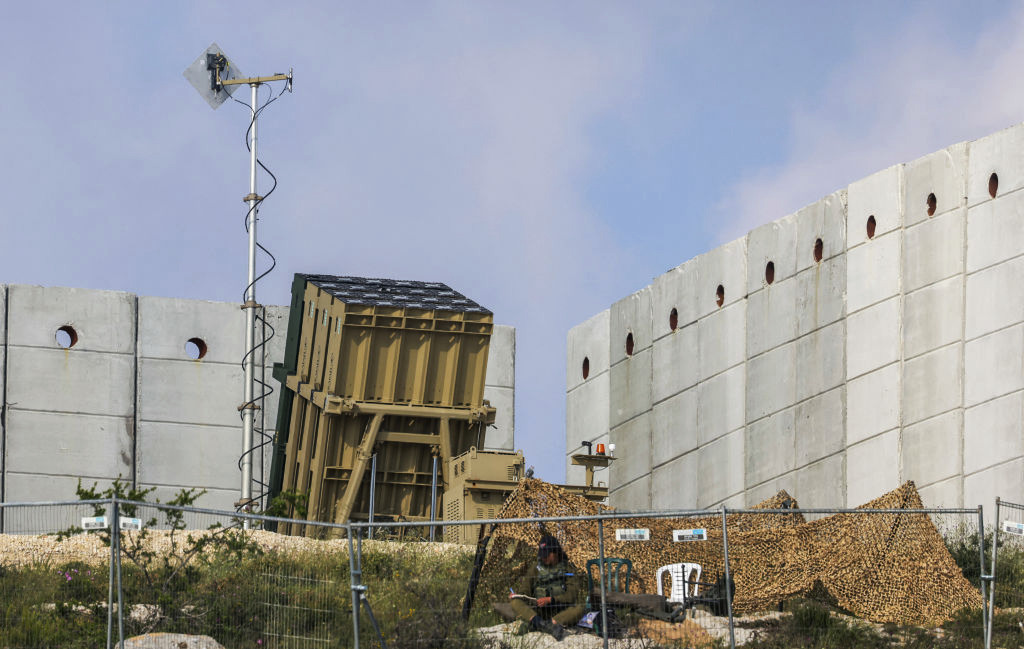
In the end, because of Israel's robust defense technology, Iran's recent drone and ballistic missile attack on Israel's urban centers was little more than a potentially deadly fireworks show. Pictured: A battery of the Iron Dome anti-missile defense system near Jerusalem on April 15, 2024. (Photo by Menahem Kahana/AFP via Getty Images)
In the end, because of Israel's robust defense technology, Iran's recent drone and ballistic missile attack on Israel's urban centers was little more than a potentially deadly fireworks show, reportedly choreographed by the United States, in coordination with Iran, "so that no one will be hurt and war with Israel will be avoided" -- apparently not with Israel. Make no mistake, though. Iran is capable and willing to engage in a far more strategic display of power in the Middle East.
Continue Reading Article
by Nils A. Haug • April 17, 2024 at 5:15 am
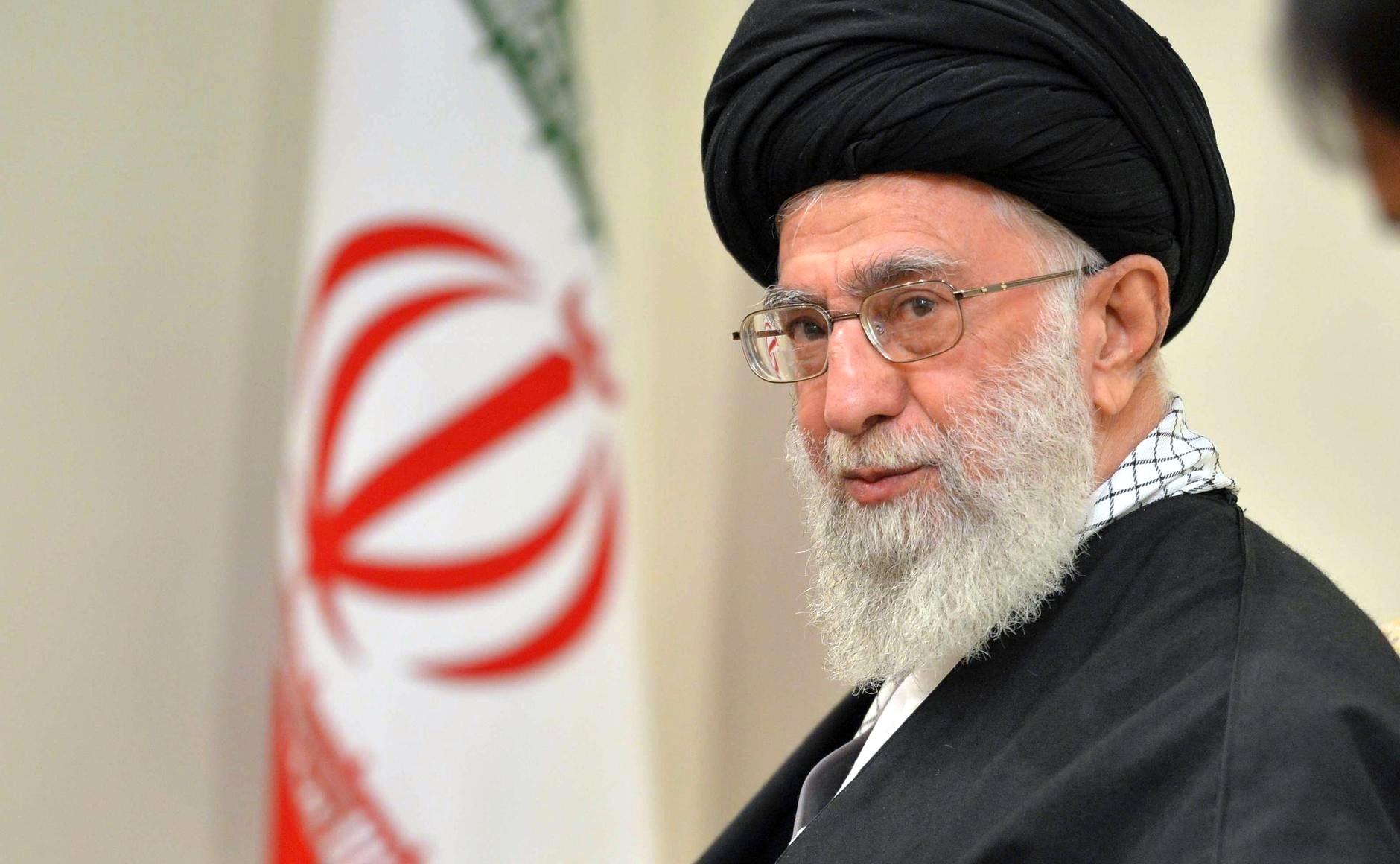
Not only are Jews under threat, but Christians and all "unbelievers" in the radical jihadist agenda as well. Although an "ostrich" mentality towards these genocidal objectives prevails among Western decision-makers, the reality is quite different: The driving ideology behind Hamas's murderous intent is exemplified by the "Doomsday Clock" located in Palestine Square, Tehran, Iran. Inaugurated by Supreme Leader Ayatollah Ali Khamenei in 2017, the clock counts down the time towards Israel's anticipated destruction in 2040, sixteen years from now. Iran's barrage of missiles and drones launched at Israel on April 13, 2024, was presumably another step toward fulfilling that destructive intent. Even though Iran remains essentially responsible for the actions of its agents, it has yet to suffer any consequences despite its direct attack on Israel on April 13-14. All the while, taking full advantage of US appeasement and unencumbered by meaningful sanctions, Iran races ahead with development of nuclear weapons for the sole purpose of eliminating Israel and, thereafter Jordan and ultimately the "Great Satan," the United States from the world map. On April 1, 2024, Abolfazl Bazargan, an Iranian international relations expert, made it clear, with a straight face, that "...for the purpose of bringing about peace - you have to create nuclear deterrence, even if only one (bomb)." Peace, however, seems to mean "after jihad has obliterated all opposition and established an Islamic Caliphate." This objective is couched in rational terms to appease West powers, the sympathetic world leaders, who might be persuaded that it is fair and right that Iran possess a nuclear weapon just as Israel, the US, UK, North Korea, and other nations possess such weapons. The underlying jihadist ideology of world hegemony is concealed under a veneer of rationalism, social justice, victimhood, and fairness. "It's a belief that goes a long way in explaining the dehumanization of the Jews: It's much easier to brutalize and slaughter, the way Hamas did on October 7, if you think that Jews are apes and pigs. In our rational Western way of thinking, all of this is unfathomable." — Idit Bar, expert on Islamism, Times of Israel, February 2, 2024. Refusing to directly confront Iran as the source of Middle Eastern terror -- and instead rely on diplomatic "conflict resolution" that enables Iran to buy time -- amounts to a form of appeasement. At this time, preparation for war is the best deterrence, especially in the current circumstances of a misguided faith in "talking." It was an attitude of pusillanimous appeasement by UK Prime Minister Neville Chamberlain of Nazi Germany in 1938, with the Munich Agreement, that directly resulted in Hitler's unrestrained march on neighbouring countries, thus inaugurating WW2. In like mode, US President Joe Biden's acolytes now appease Iran's Ayatollahs, an approach that commenced under President Barack Obama. Once again, the consequences for the West and the world at large will be horrendous.
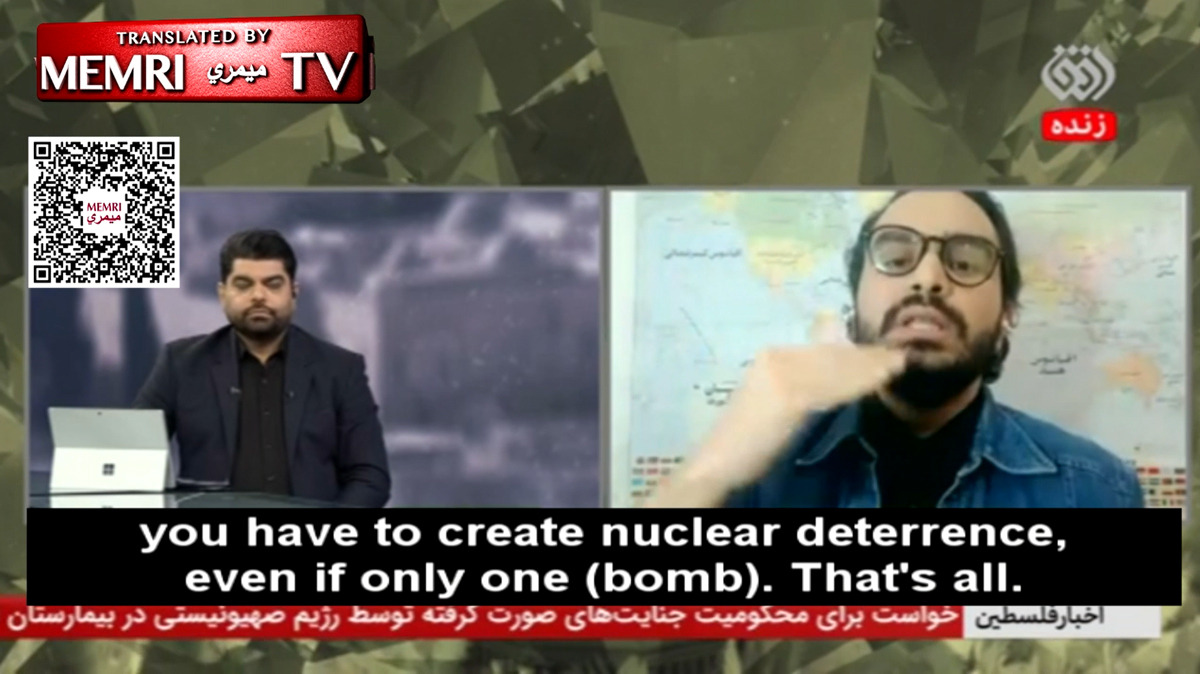
Abolfazl Bazargan, an Iranian international relations expert, recently said on Iran's Ofagh TV that "...for the purpose of bringing about peace - you have to create nuclear deterrence, even if only one (bomb)." Peace, however, seems to mean "after jihad has obliterated all opposition and established an Islamic Caliphate." (Image source: MEMRI)
On February 9, 2024, Imam Sheikh Abdul Salam Zoud at the Masjid As-Sunnah Lakemba in Sydney, Australia, made the following live-streamed pronouncement: "There is no solution other than Jihad which continues until Judgement Day. The Prophet Muhammad, the Righteous Caliphs – none of them conquered the world by peaceful means. They conquered it through Jihad. The goal of Jihad for the sake of Allah is not to kill people and take over their lands. Rather, the goal of Jihad is to remove obstacles before the spreading and rule of Islam."
Continue Reading Article
by Howard Levitt • April 17, 2024 at 4:00 am
Given their small numbers and the omnipresence of antisemitism, the Jewish community is reliant on protection from society: the courts, the legal system, the police and public sentiment itself. That is the social compact under which the community is able to thrive — and give back. But the social compact is now broken.... First, after Oct. 7, even before Israel invaded Gaza to root out Hamas, there were hate rallies.... It quickly became obvious that their targets were not Israelis, but Jews everywhere: in workplaces, unions, universities and on the street.... What is their goal? To intimidate the Jewish community, in the hope that it will capitulate and that its members will forfeit their identities as Jewish Canadians and perhaps even feel forced to leave. It is not just Jews who are under attack. Our entire civilization is threatened. The chants a short time ago to "shut down Christmas".... are deliberately targeting the functioning of society. [I]f there was a ceasefire now, Hamas would regroup and strengthen, as it has after every previous ceasefire, and would still run Gaza. The Israeli hostages would be stuck in Gaza indefinitely and Hamas would, as it keeps promising, repeat the Oct. 7 attacks a second, third and fourth time until Israel is eradicated.... If bad behaviour is permitted, it gets worse. It is not as if Hamas will somehow reform its ways: its 1988 charter has two main objectives, killing all Jews and the eradication of Israel.
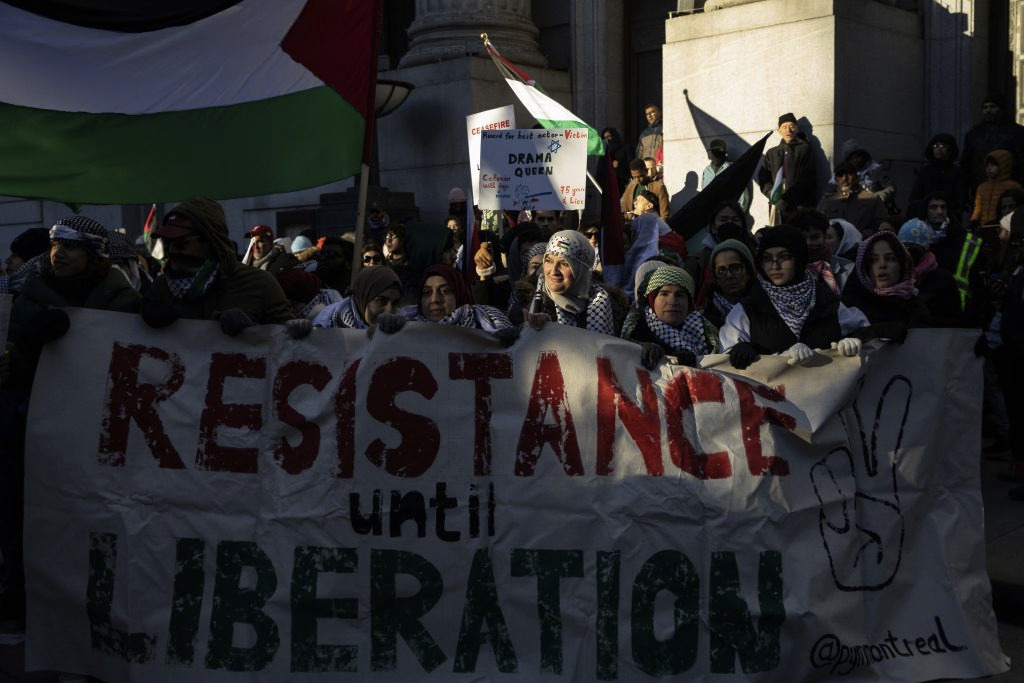
After Oct. 7, even before Israel invaded Gaza to root out Hamas, there were hate rallies in Canada. It quickly became obvious that their targets were not Israelis, but Jews everywhere: in workplaces, unions, universities and on the street. What is their goal? To intimidate the Jewish community, in the hope that it will capitulate and that its members will forfeit their identities as Jewish Canadians and perhaps even feel forced to leave. Pictured: Anti-Israel protesters in Montreal, Canada, on November 18, 2023. (Photo by Alexis Aubin/AFP via Getty Images)
There are very few Jews in the world. Not even one per cent of the world's population is Jewish. Not even 0.1 per cent. In fact, only about 15 million of the world's population of 8 billion people — less than 0.2 per cent — are Jewish. Canada has the fourth-largest population of world Jewry at 335,000, less than one per cent of our 39 million population, dramatically smaller than the Muslim population, now approaching two million. Canada's Jewish community has always taken pride in this country, contributing mightily in science, medicine, business and all forms of media and culture. It is part of Jewish upbringing to add value to the society in which one lives, which is perhaps why, despite the minuscule numbers, nearly 40 per cent of world chess champions have been Jewish and 22 per cent of Nobel Prize winners.
Continue Reading Article
by Bassam Tawil • April 16, 2024 at 5:00 am
Among the top 50 countries in which Christians were persecuted in 2023 were Yemen, Libya, Iran, Afghanistan, Iraq, Morocco, Qatar, Egypt, Turkey, and other Middle Eastern and Muslim-majority countries. Israel, needless to say, was not on the list. Despite these disturbing statistics, US television personality Tucker Carlson, in his interview with the Bethlehem pastor, chose to single out Israel, the only country where Christians feel safe and where their number is increasing every year. Carlson did not bother to ask the pastor about the persecuted Christians of Egypt. Carlson chose to interview Isaac, who has long history of promoting falsehoods about Israel and the Arab-Israeli conflict in his roles as pastor, academic dean of Bethlehem Bible College (a self-identified "Palestinian Christian Evangelical university college" that promotes a "Palestinian Christian theology"), and director of the "Christ at the Checkpoint" conferences -- the infamous venue where anti-Israel libels are proclaimed in the name of Christian love, justice and peace. "[T]hose of us who track these things know that Munther Isaac has long been the high priest of antisemitic Christianity; sadly, he spreads his hate from the city of Jesus' birth." — Rev. Johnnie Moore, president of the Congress of Christian Leaders, jewishinsider.com, April 11, 2024. "We have a mafia here that is seizing Christian-owned lands. I protested against this Muslim mafia, and I even called a large gathering. I invited 80 people to my home. That same night, fliers were distributed in Bethlehem threatening to kill me. Of course, I am worried about the future of Christians here. Looking at the facts on the ground, you can see that there is no future for the Christians here. We are melting; we are disappearing. I fear the day will come when our churches will become museums. That is my nightmare." — Samir Qumsieh, prominent Christian leader near Bethlehem, to Gatestone, April 2024.
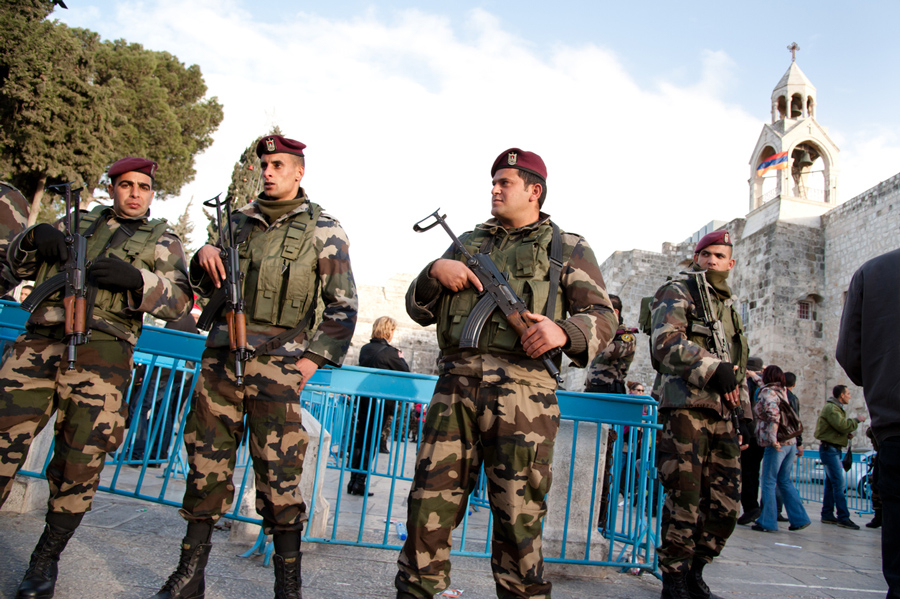
Since the Palestinian Authority (PA) assumed control of Bethlehem in 1995, the Christian share of the population has dropped from 65% to only 12% today. By contrast, the Christian population in Israel has been on the rise in recent years. "Most of us 180k Christian Israelis prefer to live under Israel freely rather than under a Palestinian Islamic Authority regime controlling Bethlehem. Israel gives us freedom while living under Arabs has been genocidal for Christians all across the Middle East," says Shadi Khalloul, a Christian Maronite who describes himself as a "patriotic Israeli." Pictured: PA policemen stand in Manger Square, Bethlehem, in front of the Church of the Nativity. (Image source: iStock)
On the same day that US television personality Tucker Carlson interviewed a pastor from Bethlehem who falsely accused Israel of mistreating Christians, Israel's University of Haifa announced the appointment of Professor Mona Maron as Rector. A Maronite Christian from the village of Isfiya, near Haifa, Maron has been a trailblazer for the integration and advancement of women in the sciences, particularly within the Arab community. She was the first Arab woman from her village to earn a doctoral degree and Israel's first Arab professor of neuroscience. "I am grateful for the trust I received from the members of the University senate and look forward to taking up the position," Maron said. "First and foremost, the University of Haifa is a home for me. A home that welcomed me into its ranks more than 30 years ago, as an undergraduate student, then as a faculty member in the neurobiology department and now with the Rector's role."
Continue Reading Article
by Daniel Greenfield • April 16, 2024 at 4:00 am
This was the "attack" prearranged for show between Iran and the Biden administration through backchannels. It's an attack that allows Iran to show off that it can reach Israel (look at those lights over the Temple Mount), while not inflicting any real damage. [H]ad Iran actually been trying to launch a serious attack, it would have used its Hezbollah, Houthi, Iraqi and whatever is left of its Hamas proxies to saturate local air defenses. Iran will do things beyond this light show, which was largely meant to reassure the Biden administration that its "diplomatic tools" have successfully solved the problem. That's an illusion that Iran has used to allow it to build up its nuclear weapons program.... It also learned under Obama that its greatest defense is convincing D.C. elites that diplomacy will successfully deescalate any conflicts with the regime.

The Biden administration has already made it clear that it will oppose any Israeli response to the Iranian missile and drone attack. There will be public condemnations and warnings about escalating the conflict further. Pictured: Ballistic missiles, launched from Iran, descend from Israel's skies and are intercepted by missile-defense systems, photographed from Hebron on April 14, 2024. (Photo by AFPTV/AFP via Getty Images)
This was not the actual Iranian attack. This was the "attack" prearranged for show between Iran and the Biden administration through backchannels. It's an attack that allows Iran to show off that it can reach Israel (look at those lights over the Temple Mount), while not inflicting any real damage. The Biden administration has already made it clear that it will oppose any Israeli response. There will be public condemnations and warnings about escalating the conflict further. So does that mean it's over? No. Iran did burn up some resources doing this, but apart from the morale boost of doing it, it set out to test U.S. and Israeli defenses. And the defenses did what they were supposed to. However, had Iran actually been trying to launch a serious attack, it would have used its Hezbollah, Houthi, Iraqi and whatever is left of its Hamas proxies to saturate local air defenses.
Continue Reading Article
by Bassam Tawil • April 15, 2024 at 5:00 am
The prospect of Hamas declaring or celebrating "victory" worries not only Israel, but many Arabs -- including Palestinians -- who want to see the terrorist group completely destroyed and removed from power, but are often afraid to speak out for fear of retaliation. "The continuity of Hamas's rule in Gaza is an ultra mega major disaster for the Palestinian people's aspirations, cause, hope for the reconstruction of the battered coastal enclave, and prospects for a new path forward to bring about progress, reconciliation, coexistence & peace." — Ahmed Fouad Alkhatib, "Proud American from Gaza City; pro-Palestine, pro-peace, anti-Hamas", X, April 8, 2024. Hamas, clearly buoyed by having the US on their side, has unsurprisingly hardened its position. It is now and is saying it wants Israel to make even more concessions. Where is any US pressure on Hamas, Iran or Qatar? "Yes, Hamas thanked the United States. When a terrorist group is thanking you, you're probably doing something wrong." — Joe Truzman, senior research analyst, X, April 9, 2024. The Hamas terrorists have only been emboldened by the Biden administration's growing hostility towards Israel and its demand that Israel end the war, a move that would effectively be a surrender to Hamas. "What victory are you talking about? Are you in your right mind? [Hamas has brought] complete devastation; thousands killed and displaced.... This is what the terrorist Hamas group, Iran's puppet, brought upon the people of Gaza. The leaders of Hamas defeated the people of Gaza and exterminated them without mercy." — Omar Shaybalras, X, April 9, 2024. "Gaza has been destroyed, starved, slaughtered.... The people of Gaza are cursing Hamas, [Palestinian] Islamic Jihad, and Iran.... The members of Hamas's armed wing use children as human shields." — Osama al-Ali ,member of the Palestinian National Council, the PLO's parliament-in-exile, television interview, X, December 7, 2023. "As long as [Hamas leaders Ismail] Haniyeh, [Yahya] Sinwar and [Khaled] Mashaal are alive, it is a victory for them, As for the destruction and the blood of the women and children of Gaza, it is a profitable enterprise as far as Hamas is concerned." — Abdallah Abou Aymen, April 9, 2024. Unlike the Biden administration and anti-Israel protestors in the West, these observers understand that Hamas, Iran and Qatar are fully and solely responsible for the mass destruction and high casualties in the Gaza Strip.... We are already seeing calls for "Death to America" in America. A ceasefire would save Hamas, allow it to continue preparing for future massacres against Israelis, and enable Iran and Qatar to "export the Revolution" even more aggressively. Above all, a US-bestowed, fake "victory" for Hamas would assure China, Russia and other predators that belligerency works and incentivize them to put the finishing touches on what many perceive as an "ultra mega major disaster" of a presidential legacy.
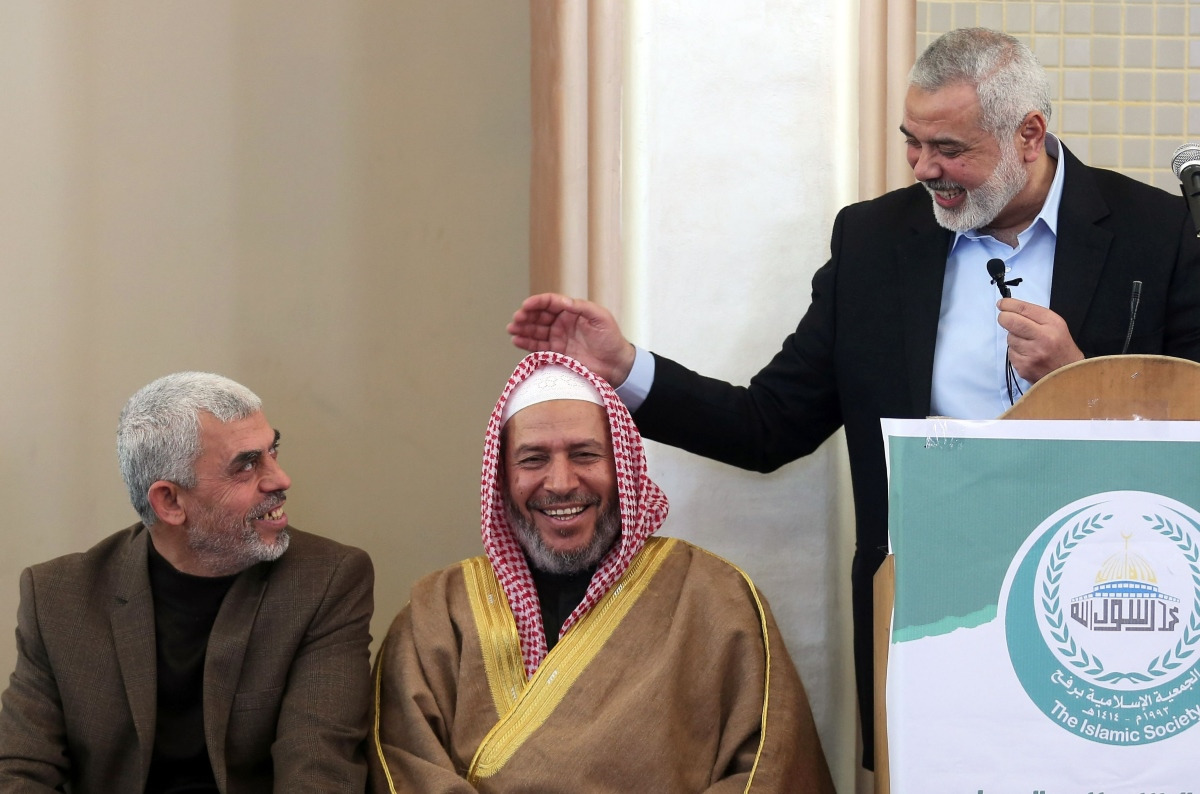
Hamas, clearly buoyed by having the US on their side, has unsurprisingly hardened its position. It is now and is saying it wants Israel to make even more concessions.Where is any US pressure on Hamas, Iran or Qatar? Pictured: Yahya Sinwar (L), leader of Hamas in the Gaza Strip, shares some laughs with senior Hamas leaders Khalil al-Haya (C) Ismail Haniyeh (R) in Rafah on February 24, 2017. (Photo by Said Khatib/AFP via Getty Images)
The Iran-backed Palestinian terrorist group Hamas is reportedly preparing to hold "victory" rallies if and when the war in the Gaza Strip ends. Many Arabs, however, have scoffed at Hamas's expected celebrations and accused the terrorist group and its patrons in Tehran of destroying the Gaza Strip. "A friend in the City of Rafah told me he saw large signs and banners being printed/prepared by Hamas to hold 'victory rallies' that the Islamist group plans on having when a ceasefire/hostage deal is announced, highlighting the withdrawal of IDF troops from Gaza as an achievement," said Ahmed Fouad Alkhatib, who describes himself as a "proud American from Gaza City; pro-Palestine, pro-peace, and anti-Hamas," who lost 31 family members in the Israel-Hamas war.
Continue Reading Article
by Con Coughlin • April 14, 2024 at 5:00 am
Iran's decision to rely on groups such as Hezbollah and Hamas to prosecute its war against Israel has resulted in the Israelis regularly having to retaliate with air strikes against Iranian and Hezbollah targets in Syria and Lebanon in an attempt to disrupt their terrorist infrastructure. Since October 7, the consulate served as Tehran's main regional command centre, helping to supervise the activities of Iran's so-called "axis of resistance". [A]s recent events have indicated, Israel is not just fighting a war against the Iranian-backed Hamas terrorists who committed the terrible atrocities on October 7. It is in an existential battle for survival against the Iranian regime and its many proxies which, if left unchecked, will continue seeking to achieve their ultimate goal of destroying the Jewish state.
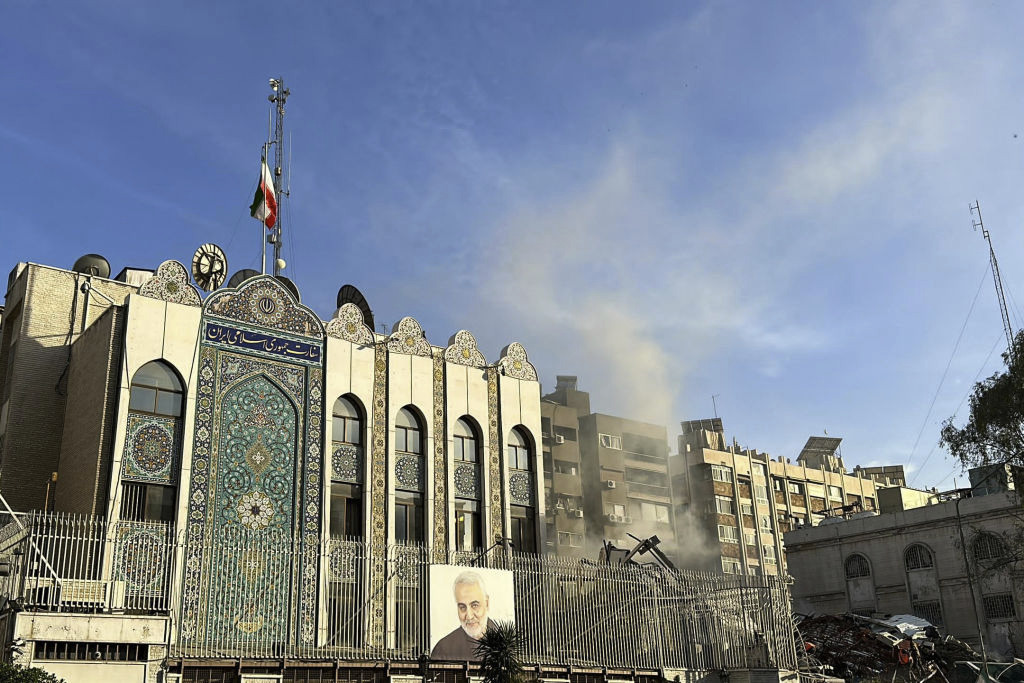
The bombing of the Iranian consulate in Damascus, Syria was not, as the Iranians claim, simply an attack on a blameless diplomatic mission. It was a carefully targeted strike on the headquarters of the expansive terrorist network that Tehran has established throughout the Middle East. Pictured: The Iranian Embassy compound in Damascus, Syria on April 1, 2024, following an airstrike that destroyed the consulate building. (Photo by Maher Al Mounes/AFP via Getty Images)
The bombing of the Iranian consulate in Damascus, Syria was not, as the Iranians claim, simply an attack on a blameless diplomatic mission. It was a carefully targeted strike on the headquarters of the expansive terrorist network that Tehran has established throughout the Middle East. The real purpose of the Iranian consulate building, an adjunct of the Iranian Embassy in Damascus, was revealed when the Iranians themselves admitted that two senior commanders of the elite Quds Force of Iran's Islamic Revolutionary Guard Corps (IRGC) were killed in the air strike, which has widely been attributed to the Israeli air force. The Quds Force, which has direct responsibility for overseeing Iran's global terrorist operations, reports directly to Iranian Supreme Leader Ayatollah Ali Khamenei, and was established to fulfil the ayatollahs' ambition of exporting Iran's Islamic revolution throughout the Muslim world.
Continue Reading Article
by Amir Taheri • April 14, 2024 at 4:00 am
A system is in crisis when it is hit by what in medical terms would be described as three "conditions". The first is a growing loss of public trust in the system as a whole. The second "condition" is the sluggish state of the European economies. Even Germany, the EU's wunderkind for generations, may be hit by negative growth. The third and, perhaps, far more important is an unprecedented desacralization of political power and a sharp fall in the prestige of those holding high offices of the state. Instead of moving towards a European super-state or a federal outfit, the EU's current trajectory seems to be back to the nation-state model. The coming European Parliament elections will show whether that trend is set to continue

Instead of moving towards a European super-state or a federal outfit, the EU's current trajectory seems to be back to the nation-state model. The coming European Parliament elections will show whether that trend is set to continue (Photo by Sean Gallup/Getty Images)
With the campaign for the election of the next European Parliament heating up, it is becoming clear that the European Union of 27 democracies that together form the largest economic bloc in the world, is not in good shape. To be sure, the European Union isn't quite on life-support as its arch-foe Russian President Vladimir Putin likes to claim. But nor is it in the robust, all-conquering health that French President Emmanuel Macron pretends. To put it shortly, the EU is in crisis, deep and potentially life-threatening crisis. A system is in crisis when it is hit by what in medical terms would be described as three "conditions". The first is a growing loss of public trust in the system as a whole.
Continue Reading Article
by Majid Rafizadeh • April 13, 2024 at 5:00 am
Israel is currently facing a multi-front war for its survival, with Qatar, Iran and Iran's proxies, which are encircling Israel, leading the charge. The gravity of this aggression cannot be overstated: not just for the existence of Israel, but also for that of the US, Europe and the West. Israel's struggle for survival is not solely a regional conflict; it is a battle between civilization and those who think international law, human rights and the rules of war are a Western joke. Since the founding of the Islamic Republic of Iran in 1979, its rulers have been calling for "Death to America" – now also demanded in Dearborn, Michigan. Which side is the US on? President Joe Biden's legacy, especially after surrendering Afghanistan to the Taliban in 2021, will be "Biden, friend of the Terrorists." All the US would have to do to stop much of Iran's bellicosity is take out the bases of the Islamic Revolutionary Guard Corps (IRGC) inside Iran -- so there is a direct cost to Iran, not just to its human shields. Iran, on the way to having nuclear bombs, has provided support to terrorist organizations such as Hamas and Hezbollah, Islamic Jihad and the Houthis, all of which have vowed to annihilate Israel. Hezbollah, based in Lebanon, boasts an arsenal of an estimated 150,000 missiles, many precision-guided, aimed at Israel's population. Meanwhile, Hamas has demonstrated its willingness to commit a genocide, launching more than 12,000 indiscriminate rocket attacks just since October at civilian targets in Israel, a country the size of New Jersey. Iranian Supreme Leader Ali Khamenei has outlined his vision for Israel's demise in his book, Palestine, a 416-page "guide to destroying Israel," and railing against "The Great Satan," the United States. This is not a hypothetical scenario; it is a meticulously planned campaign of annihilation. While the Biden administration is threatening to withhold life-saving arms from Israel, the Biden administration just rewarded both of its chief attackers, Iran and Qatar. The Biden administration just actually invited Hamas's main funder, Qatar, to operate a planned pier in Gaza to bring in humanitarian aid. All of it will certainly end up with Hamas, not Gazan civilians -- and, one can imagine what else Qatar will allow in, from heavy weapons to more terrorists. A Hamas "victory," incentivizing aggression, cannot be rewarded; it must be stopped.

Israel is currently facing a multi-front war for its survival, with Qatar, Iran and Iran's proxies, which are encircling Israel, leading the charge. If the Biden administration abandons Israel now, it would not only betray a steadfast ally, it would seriously jeopardize the entire region and the Free World. (Image source: iStock)
In the tumultuous landscape of the Middle East, Israel stands as a beacon of freedoms, human rights and democracy amid a sea of terrorist organizations and authoritarian regimes seeking its destruction. Israel is currently facing a multi-front war for its survival, with Qatar, Iran and Iran's proxies, which are encircling Israel, leading the charge. The gravity of this aggression cannot be overstated: not just for the existence of Israel, but also for that of the US, Europe and the West. To prevent Israel's adversaries from escalating – which, of course, is what they do when they receive US support, the Biden Administration needs to show Israel and other US allies unwavering support – just as the US did this week with Japan. If the Biden administration abandons Israel now, it would not only betray a steadfast ally, it would seriously jeopardize the entire region and the Free World.
Continue Reading Article
by J.B. Shurk • April 12, 2024 at 5:00 am
If you live in a "democracy" where everyone routinely votes to censor and imprison one another, you still live in a police state. The word "democracy" appears to have become polite shorthand for insisting that an insular minority in control of the American government always knows what is best for the vast, unrepresented majority. Even worse, it sometimes seems nothing more than a convenient disguise for camouflaging abuses of power.

The word "democracy" appears to have become polite shorthand for insisting that an insular minority in control of the government always knows what is best for the vast, unrepresented majority. Even worse, it sometimes seems nothing more than a convenient disguise for camouflaging abuses of power. (Image source: iStock/Getty Images)
The American system of government is a federation of sovereign states that retain inherent powers not specifically delegated to the national government. It is a republic that separates discrete powers among coequal and competing branches of government — namely the Legislative, Executive, and Judicial. It is a representative democracy that empowers the people to vote into office those who presumably will best serve their interests. Most importantly, it is a constitutional system that severely limits government's authority and proscribes government agents from infringing upon freedoms retained by the people. Just to be indisputably clear that the government is forbidden from rewriting its own delegated powers in such a way that they violate an American's God-given liberties, the first ten amendments to the U.S. Constitution — the Bill of Rights — act as a redundancy measure and explicit warning to state actors not to infringe upon or water down the rights delineated there.
Continue Reading Article
by Aymenn Jawad Al-Tamimi • April 11, 2024 at 5:00 am
There is no need, therefore, to abandon the terms jihadism and jihadist out of political correctness or fear of offending Muslims. When appropriately defined, those terms are helpful in grasping the terrorist and insurgent threats and challenges posed by al-Qa'ida, the Islamic State and similar groups -- far more so than khawarij, a term that does not have immediately clear meaning for wider audiences, is historically inaccurate, and sounds like a sneaky effort to cloud a very real threat.
There is no need to abandon the terms jihadism and jihadist out of political correctness or fear of offending Muslims. When appropriately defined, those terms are helpful in grasping the terrorist and insurgent threats and challenges posed by al-Qa'ida, the Islamic State and similar groups. (Image source: iStock/Getty Images)
Recently, the Daily Wire revealed that an internal newsletter from the Office of the Director of National Intelligence featured an article arguing for "changing terminology related to counterterrorism," because "certain phrases to identify international terrorism... are hurtful to Muslim-Americans." One of the supposedly "problematic phrases" is the term "jihadist." An alternative suggestion given in the newsletter to denote jihadists is the word khawarij.[1] If one wanted to find stereotypical "woke" discourse and political correctness, one would be hard pressed to find a better example than this. Unfortunately, the suggested change in terminology only creates more obstacles to an accurate understanding of contemporary terrorism and insurgent activity associated with the Islamic State (ISIS) and al-Qa'ida.
Continue Reading Article
by Lawrence Kadish • April 10, 2024 at 3:00 pm

The Great Depression swept across the nation some 90 years ago, creating a level of despair that nearly crushed America. Washington was either indifferent or inept in responding to a calamity that threatened the very foundation of the republic. Today we have a new generation of "forgotten men" – and women. They too have lost faith in a Washington that seems to have dissolved into a dysfunctional collection of politicians far removed from the difficulties facing our citizens. Pictured: A bread line outside the Rescue Society on Doyers Street in New York City, during the Great Depression, in 1929. (Photo by Archive Photos/Getty Images)
The Great Depression swept across the nation some 90 years ago, creating a level of despair that nearly crushed America. Standing mute and dumbfounded on a breadline, tens of thousands became "forgotten men"; stripped of their jobs, their dignity, and their future. Washington was either indifferent or inept in responding to a calamity that threatened the very foundation of the republic. Some of these forgotten men sought refuge in God, solace in the Bible, and prayed for salvation or, at the very least, a pathway that would lead them to a better life. Others looked to a vibrant, dynamic president, who would inspire those victims of a national calamity that we are still a nation capable of greatness with the ability to rescue those forgotten men from devastating unemployment.
Continue Reading Article
by Bassam Tawil • April 10, 2024 at 5:00 am
Recently, US Secretary of State Antony Blinken said after meeting with [Saudi Crown Prince and Prime Minister Mohammed] bin Salman that there is "good progress" on Saudi Arabia-Israel normalization talks. "I believe we can reach an agreement which would present an historic opportunity... We had a very good discussion about the work that we've been doing for many months now on normalization, and that work is moving forward. We're continuing to make good progress." [T]here is good reason to believe that the Saudis will eventually agree to normalize their relations with Israel. In order for that to happen, however, Hamas, which is strongly opposed to any peace with Israel and does not recognize its right to exist, must be defeated and eradicated. It is no secret that Saudi Arabia and other Arab countries despise Hamas and consider it a threat to their own national security.... There is no doubt that the Saudis, together with the UAE, Bahrain and the even the Palestinian Authority, are quietly praying for Israel to finish the job and get rid of Hamas. These Arabs, understandably, cannot express their views in public lest they be accused of "colluding" with Israel. Arab states are motivated to sign peace treaties with Israel when they see Israel as a winner. By pressuring Israel not to invade Rafah, the US administration is sabotaging its own efforts to persuade Saudi Arabia to normalize its ties with Israel... By demanding that Israel refrain from entering Rafah, the Biden administration is actually asking Israel to forget about recovering the 130 hostages being raped and tortured by Hamas every day -- which still include six Americans – and to lose the war. This is something that neither Israel nor Hamas's Arab enemies -- nor even Biden -- can afford to accept.

Arab states are motivated to sign peace treaties with Israel when they see Israel as a winner. By pressuring Israel not to invade Rafah, the US administration is sabotaging its own efforts to persuade Saudi Arabia to normalize its ties with Israel. Pictured: US Secretary of State Antony Blinken meets with Saudi Crown Prince Mohammed bin Salman in Jeddah, Saudi Arabia on March 20, 2024. (Photo by Evelyn Hockstein/Pool/AFP via Getty Images)
When the Iran-backed Hamas terror group invaded Israel on October 7, 2023, it not only sought to kill and kidnap Israelis. The group and its patrons in Tehran undoubtedly had other goals in mind, such as thwarting US-sponsored efforts to achieve normalization between Israel and Saudi Arabia. Fortunately, Hamas has so far been unsuccessful in achieving this goal. In addition, Hamas has failed to drive a wedge between Israel and the Arab countries that have peace treaties with it: Egypt, Jordan, the United Arab Emirates, Bahrain and Morocco. None of these countries has cut off its diplomatic relations with Israel, despite their harsh criticism of Israel over the war in the Gaza Strip and pressure from the Arab street. Less than a month before the Hamas assault, Saudi Arabia's de facto ruler, Crown Prince Mohammed bin Salman, told Fox News that the prospect of normalized relations with Israel was "getting closer every day."
Continue Reading Article
by JNS • April 10, 2024 at 4:00 am
Iranian officials told the Times that Tehran had not singled out one particular terrorist organization it would support with firearms and ammunition, choosing instead to inundate the area with weapons. The majority of the weapons smuggled into Judea and Samaria are small arms and assault rifles, analysts said. However, the U.S. and Israeli officials charged that the Islamic Republic is also smuggling advanced weaponry, including anti-tank missiles and rocket-propelled grenades.

Pictured: A shipment of weapons smuggled into Israel from Jordan by a Bedouin Arab in December 2023, which was seized by the Israel Police. (Image source: Israel Police Spokesperson)
As the Israel Defense Forces fight Hamas terrorists in the Gaza Strip, the Iranian regime continues to foment violence in Judea and Samaria by flooding the territory with weapons, The New York Times reported on Tuesday, citing officials in Washington, Jerusalem and Tehran. Judea and Samaria saw a dramatic rise in terrorist attacks in 2023 compared to the previous year, with shootings reaching the highest level since the Second Intifada of 2000-05, according to Israeli military data. The violence has continued to escalate since Hamas started a war with its murderous rampage across the northwestern Negev last year. Since Oct. 7, at least eight Israelis have been murdered in Judea and Samaria. Iranian officials told the Times that Tehran had not singled out one particular terrorist organization it would support with firearms and ammunition, choosing instead to inundate the area with weapons.
Continue Reading Article
|