








"China Is Now the World's Great Oil Power," The Economist declared on August 9.
So, what is the significance of this pronouncement? The world's oil power is also the world's energy power. The world's energy power, in turn, is a leading contender for the world's dominant power. "Energy is the foundational brick of the global economy," Jonathan Bass, the CEO of Argent LNG, told Gatestone.
China, the world's largest importer of crude oil, exerts great leverage over markets, but The Economist is nonetheless wrong.
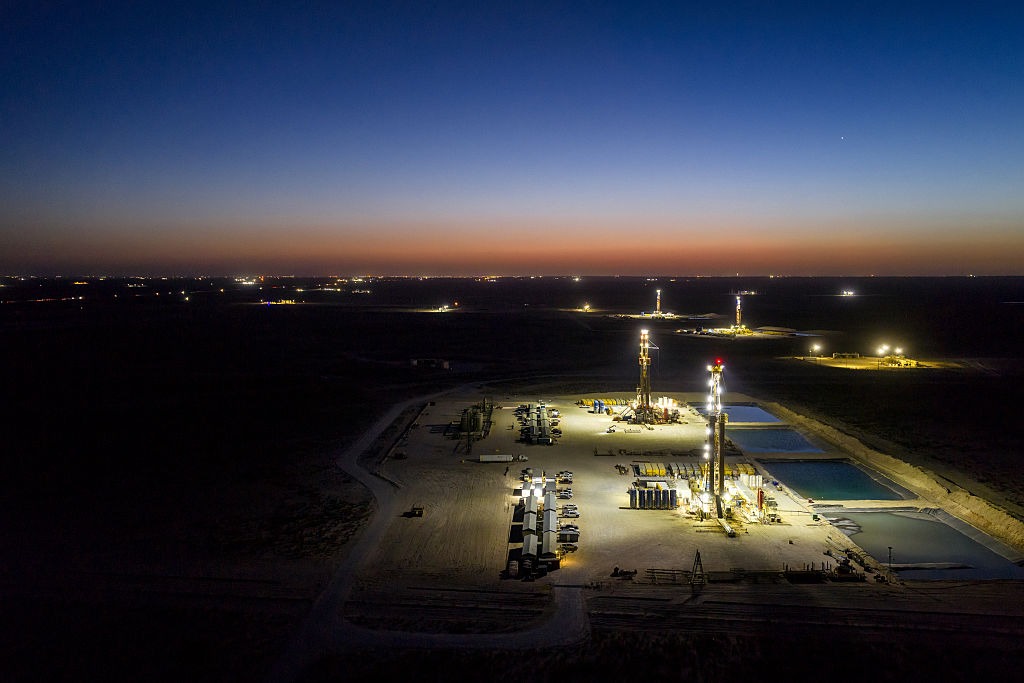
The "Great Oil Power" is the United States of America. The U.S. has been the world's largest producer of crude oil for eight straight years, from 2018 through 2025.
Moreover, the U.S. will almost certainly retain that crown indefinitely. Last year, the U.S. produced 13.6 million barrels of oil and lease condensate per day.
The country in second place was not even close. Russia produced 9.9 million barrels per day, and thanks to Ukraine's punishing attacks on refineries, Russia's production will almost certainly decline this year. Last month, the International Energy Agency dropped its 2026 forecast of Russian output to 8.9 million barrels per day and its 2027 forecast to 8.8 million.
The U.S., by contrast, is forecast to produce 13.7 million barrels per day this year and 14.2 million next year.
And where was China in the rankings last year? Sixth place, with 4.3 million barrels per day.
The other half of oil dominance is refining capacity. The Economist calls China the world's second-largest oil refiner, which by implication means that publication believes the U.S. is the largest.
Many rankings, however, give China a narrow lead in refining capacity over the U.S.
In view of all this, why did the Economist proclaim China the world's dominant oil power? Because of its ability to influence prices. The publication points out that oil prices did not climb as much as analysts had feared during this year's Iran war because Beijing was able to both depress demand inside China and draw upon its petroleum reserve, believed to be the world's largest.
"The Iran war has shown that, in practice, China can singlehandedly stabilize the global oil market over a period of many months," the Economist wrote. "Leaders of the increasingly fractious oil cartel can only dream of doing the same." Buyers, unlike producers, cannot form an OPEC-like group, but, according to the magazine, China's "central planners can act unilaterally on the orders of one man, President Xi Jinping."
As a result, an oil-trading boss, in comments to the Economist, called China "the new OPEC."
There were, it seems, other factors reducing Chinese demand, such as a faltering economy. China's economy is not growing anywhere near the 4.3% pace reported for this year's second calendar quarter. Furthermore, China was able to control prices by purchasing sanctioned oil at large discounts from Iran and Russia.
In any event, China can set oil prices only in the American-led international system. "In his first term, President Trump embraced a pro-energy policy to take advantage of recent advances in American oil and gas production," KT McFarland, deputy national security advisor then, told me. "American energy companies developed new engineering, mapping, and drilling techniques. We could now discover and extract abundant amounts of oil and natural gas cheaper, cleaner, faster, safer, and more reliably than other suppliers."
Trump knew he not only could make America energy independent, he also realized that by selling oil and gas, he could influence others.
America reversed a slump and began increasing oil output in 2008, but it was Trump who saw the significance and raced to high production levels. It is no coincidence that in the middle of his first term, America became the world's No. 1 energy producer.
Not surprisingly, Trump returned to his first-term energy policy just hours after taking the oath of office the second time. On the first day back in the Oval Office, the 47th president issued an executive order declaring a "national energy emergency."
Demand for energy will only increase. "The U.S. now controls the world's light switch," Bass said this month, "and it will continue to control the switch for the indefinite future because Trump believes in drilling, fracking, and refining to the max." That, Bass said, "will give America enormous leverage over the world."
China will continue to be influential in oil markets, but it will always be working within the context of an American world. After all, the reason China had to cut demand was the American attack on Iran and the blockades of the Strait of Hormuz imposed on April 13 and July 14.
If the United States had imposed the blockade at the beginning of hostilities on February 28 and had not decided to lift it in June, China might not have had the ability to keep a lid on energy prices during that period.
Let us, nevertheless, assume that Chinese officials in fact have the pricing power the Economist believes they possess. That means they can raise energy prices at any time, perhaps at a moment intended to target, say, the U.S.
It is way past time, therefore, to undermine China's pricing power. Trump can do that in many ways, but they all begin with making sure that the Chinese no longer continue to take sanctioned oil from, among others, Iran. When the U.S. is determined to use its vast power over energy, there is no way that Beijing can manage oil prices.
Gordon G. Chang is the author of Plan Red: China's Project to Destroy America, a Gatestone Institute distinguished senior fellow, and a member of its Advisory Board.
 Pudik
Pudik