








Military superiority rarely decides wars against regimes that measure victory by survival. The Islamic Republic of Iran, since its Islamic Revolution in 1979, has been refining this distinction.
By the first week of April, Iran was losing. Its naval fleet was on the seabed, its aircraft grounded, and American and Israeli aircraft were operating in Iranian skies unopposed. Washington then began granting extensions. Five months later, the Iranian regime is still setting conditions rather than receiving them.
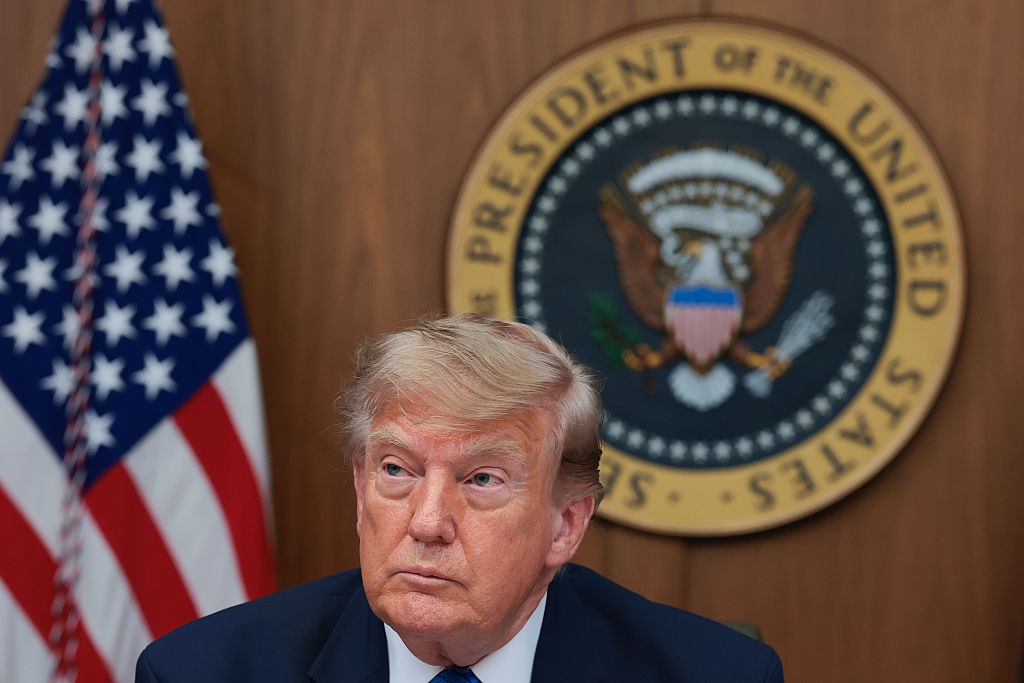
Operation Epic Fury opened on February 28 with strikes that killed Supreme Leader Ali Khamenei, and with a video address in which US President Donald J. Trump told the Iranian people that their hour of their freedom was at hand and that their government would be theirs to take. Six weeks earlier, during the January uprising in which regime security forces killed tens of thousands of its own citizens -- estimates range from 32,000 to 100,000 -- Trump had urged the Iran's population to keep protesting and promised that "help is on its way." The objectives assigned to the US military were narrower: destroy Iran's ballistic missile and drone capabilities, destroy its navy, destroy its defense industrial base. By the White House's own accounting, more than 13,000 targets were struck in 38 days.
Tehran's answer was maritime. Iran closed the Strait of Hormuz, mined it, boarded merchant vessels and made the shipping chokepoint its one remaining instrument of pressure. Washington replied with ultimatums. On March 22, Trump gave Iran 48 hours to reopen the strait or lose its power stations. The deadline slipped five days, then ten more, to April 6, when he described a four-hour plan to demolish every bridge and every power plant in the country. On April 7, hours before that deadline expired, Trump warned that a whole civilization would die that night, then suspended the attack for two weeks after calls from Pakistan's prime minister and army chief, calling a ten-point Iranian proposal a workable basis for negotiation.
Three postponements in 16 days amount to a strategy. Military campaigns do not resume at the point where they were interrupted, and surprise cannot be put into storage. What Iran's regime learned was that American resolve carried a price negotiated in public. Confirmation came within hours. On the day Trump was promising annihilation, Iran's Islamic Revolutionary Guard Corps (IRGC) halted two Qatari gas tankers that a Pakistani-brokered arrangement had cleared for transit in the Strait of Hormuz.
Israeli Prime Minister Benjamin Netanyahu had telephoned days earlier to counsel against any ceasefire at that stage. Direct talks in Islamabad collapsed after 21 hours on April 12, and Washington began blockading Iranian ports the next day, which is not the conduct of a government confident its truce is holding.
The mediation architecture compounded the problem. Pakistan carried the American proposals and brokered the April pause. Egypt and Turkey pressed a phased framework. Qatar and Oman took the maritime file. Their effect was to guarantee Tehran an interlocutor other than the United States, and to ensure every American ultimatum arrived with a third party counseling restraint. Iran built its regional network so that pressure applied to Tehran could be exported elsewhere, and diplomacy that leaves the network standing preserves the system the war was meant to dismantle.
The Islamabad Memorandum, signed June 17, measures the distance traveled in 14 articles. Article 2 commits both parties to refraining from interfering in each other's internal affairs, retiring Trump's February 28 encouragement to revolution. Article 6 commits Washington and regional partners to a reconstruction plan for Iran worth at least $300 billion. Article 7 commits the US to terminate all sanctions, including UN Security Council and IAEA resolutions. Article 9 freezes Iran's nuclear program at its current status quo and bars Washington from new sanctions or additional deployments. Article 8 obtains in exchange a reaffirmation that Iran will not acquire nuclear weapons, and an agreement to discuss uranium enrichment later.
Ballistic missiles appear nowhere in that text. Neither Hezbollah nor Hamas nor the Houthis are mentioned at any point. The objectives that justified the war to the American public survived in the military ledger and evaporated from the diplomatic one. IAEA inspectors have been unable to account for Iran's enriched uranium since June 2025, and the agency's director believes much of the 440 kilograms enriched to 60% remains buried at Isfahan.
The asymmetry is structural. Tehran has never needed to defeat the United States on a battlefield. The regime needs only to survive long enough for American objectives to become negotiable. When the regime fears imminent consequences, its appetite for diplomacy grows; when the danger recedes, diplomacy becomes the instrument for obtaining what its military cannot. By stopping when it did, Washington also demonstrated that Hormuz could be converted into American restraint.
The June framework lasted three weeks. After Iranian drones struck merchant ships in Hormuz, Trump on July 8, declared the MOU finished, called Iranian officials "scum," and ordered new strikes. Tehran suspended its own commitments 10 days later. By mid-July, Washington was reimposing the blockade and floating the idea of US tolls on the strait, while Iran informed ships transiting the strait must follow routes that it defined.
August clarified America's options. Iran's Supreme National Security Council now conditions the reopening of Hormuz on an end to American military operations against Iran and its allies, the lifting of the US blockade, the withdrawal of American forces from the region, the release of frozen assets, sanctions relief, and compensation for war damage.
Trump said on August 9 that Washington is low-keying it and only "semi-negotiating," apparently content to let Iranian inflation accomplish what bombing did not. He answered the reparations claim the next day with one of his own, instructing his negotiators to demand payment for Americans killed by Iranian roadside bombs and for protesters the regime has killed over 47 years, and citing Iran's nuclear weapons program as the reason the war began, two months after signing a document that froze that program in place. Tehran had meanwhile replaced the secretary of its security council with Mohsen Rezaei, who led the IRGC through the Iran-Iraq War and advises the new supreme leader, Mojtaba Khamenei.
Meanwhile, US Secretary of the Treasury Scott Bessent announced a total economic siege on Iran, including secondary sanctions — sanctioning not only Iran but also countries that do business with it. Iran's population is already suffering from an inflation rate of 87%, and reports have disclosed that lines for gasoline last all night. Bessent added that the US knows where Iran's leaders' secret bank accounts are in the British Virgin Islands, as well as their $100 million homes.
A domestic reckoning might be on the way. Trump's brand had rested on the proposition, backed up by action, that American threats would be believed.
Trump's biggest objectives at the moment concern not only Iran, Russia and China, but also how to help his party retain control of the House of Representatives and Senate. Most important is to remind voters not of his accomplishments, but to return to what got him elected in the first place: focus on them. He will need to tell Americans, whose wages have not kept up with inflation, what, in the most practical terms, he will do to help.
Voters possess a healthy, survival-dose of self-interest. They do not need to hear about Trump's many accomplishments, as praiseworthy as they are. They need to hear from Trump what he will do for them. The cost of food, housing, electricity and gasoline — combined with subversive foreign propaganda to induce a fear of artificial intelligence and data centers — are all too real. It is hard to be impressed even by a spectacular and extremely necessary campaign against Iran if you are one of the 271,000 people whose jobs were cut by the administration, or one of the 180,000 who were laid off by Big Tech. Too many voters are understandably terrified. They are looking to anyone who will address their immediate concerns. Every morning, Trump needs to repeat "Kitchen Table" a hundred times.
Yes, Trump needs to win in Iran, continue his crucial reshoring, expand his economic boom even further to the middle class and the disadvantaged, and keep Russia, China and North Korea in line. To have a historic final two years of his term, however, Trump will need to reassure voters about their future, not his past.
Pierre Rehov, who holds a law degree from Paris-Assas, is a French reporter, novelist and documentary filmmaker. He is the author of six novels, including "Beyond Red Lines", "The Third Testament" and "Red Eden", translated from French. His latest essay on the aftermath of the October 7 massacre " 7 octobre - La riposte " became a bestseller in France. As a filmmaker, he has produced and directed 17 documentaries, many photographed at high risk in Middle Eastern war zones, and focusing on terrorism, media bias, and the persecution of Christians. His latest documentary, "Pogrom(s)" highlights the context of ancient Jew hatred within Muslim civilization as the main force behind the October 7 massacre.
 Left Coast