








"Kristallnacht," took place in Nazi Germany on the night of November 9–10, 1938, and marked one of the pivotal stages on the road to the Nazi Holocaust.
Anyone who has watched a film documenting the dark events of Kristallnacht, when the streets of German cities became a stage for violence and hate. Shop windows, homes, and synagogues were smashed. Shards of broken glass covered the streets.
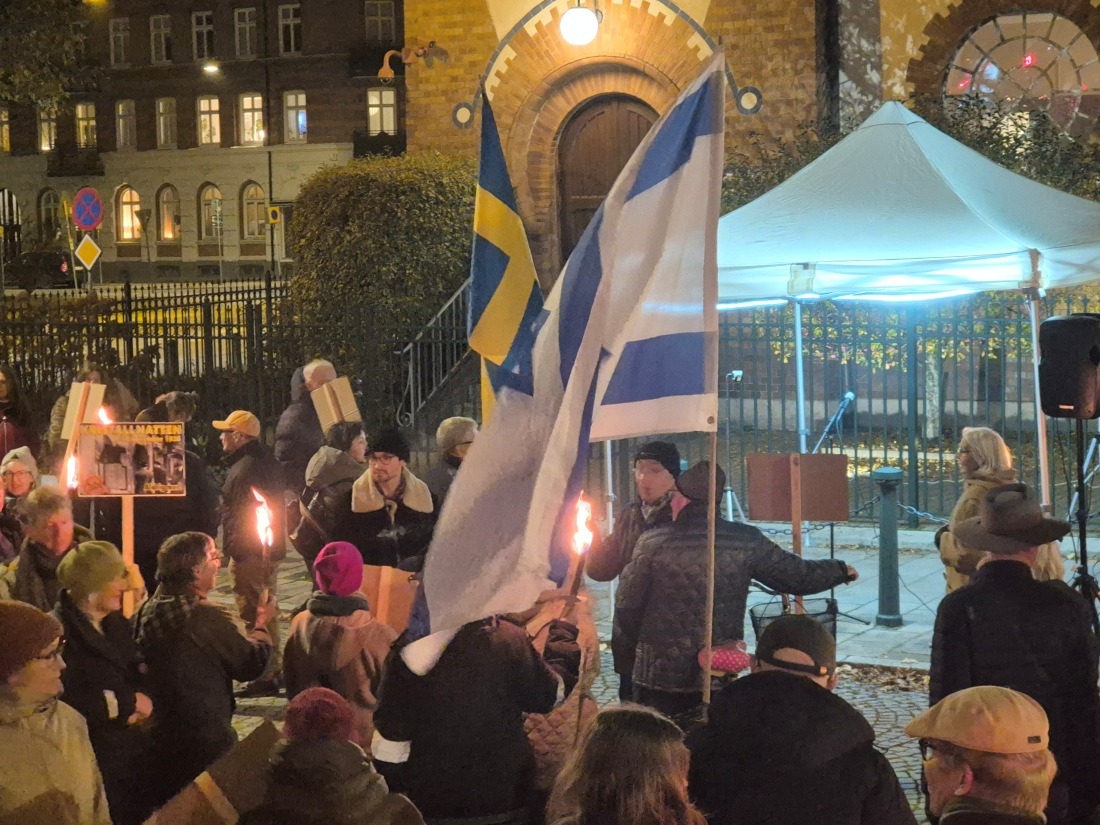
The deeper meaning of the commemoration in Malmö was how hatred can begin with rhetoric, turn into incitement, escalate into acts of violence, and ultimately end in a human catastrophe whose traces can never be erased from history.
Those addressing the gathering were veteran Swedish politician Lars Leijonborg, a current Member of the Swedish Parliament (Riksdag) representing the Liberal Party (Liberalerna) for the Malmö constituency; writer and commentator Andreas Birro; and journalist and author Sofia Nerbrand.
The attacks targeting shops during Kristallnacht, Leijonborg noted, were not random acts of vandalism, but rather precise and deliberate attacks directed specifically against Jewish shopkeepers and Jewish-owned businesses.
The German police had not done what they could to protect the shopkeepers. On the contrary, they had stood by, applauded, and supported the rioters.
Who had been held responsible? The Jews. Holding them collectively responsible was utterly unreasonable, unacceptable, but a practice that had been repeated time and again throughout history — to this day.
Andreas Birro spoke of his father's brother-in-law, Cesare, an Italian partisan who was imprisoned in the Mauthausen concentration camp, where roughly 40,000 Jews were murdered.
Cesare had managed to escape and make his way home across the Alps. He walked for months; when he returned, he weighed just 35 kilos, or 77 pounds.
Cesare rarely spoke about what he had endured but sometimes would wake up in the middle of the night, sit, and cry.
Cesare had not even been Jewish — but he had fought for the cause of the Jews.
How fast, Birro said, memories can disappear. First, we forget the person, then the story, then the name, until finally all that remains is a number on a list.
Meanwhile, people just look on, adapt themselves to the circumstances, and remain silent.
Responsibility did not rest solely with those who smashed and shattered shop windows. It also rested with those who stood by as spectators, those who watched, and those who had the power to intervene but chose not to.
Although the world is beautiful, Sofia Nerbrand reminded everyone, Kristallnacht was not beautiful. It was horrific, terrifying, and ominous.
At least 91 Jews were murdered, more than 1,000 synagogues were set on fire or destroyed, and around 30,000 Jewish men were taken to concentration camps.
Hitler and Propaganda Minister Joseph Goebbels orchestrated Kristallnacht, with the help of the SA, the SS, and the Nazi Party. It marked the beginning of the systematic destruction of everything that Jews in Europe had built. The families, the children, the synagogues, the traditions, the music, the businesses, the education. The architecture, the scientific achievements — everything.
There is still a phantom pain left by the annihilation of large parts of the Jewish people in Europe.
Six million people, the children and grandchildren who never got the chance to live, their culture, and whatever else they could have contributed are missing from our world.
It is crucial, she said, to be a "mensch" (a stand-up person) in these times, when antisemitism is so evident -- not least here in Malmö.
The fight against Jew-hatred should not be a left-right political issue, as it has become since Hamas's terrorist attack on October 7, 2023 — the largest assault against Jews since the Holocaust.
Kristallnacht must never happen again.
Mohamed Saad Khiralla is a political commentator on Middle East Affairs and Islamist Movements. He is currently a Research Fellow at the Ideological Defense Institute (IDI).
