








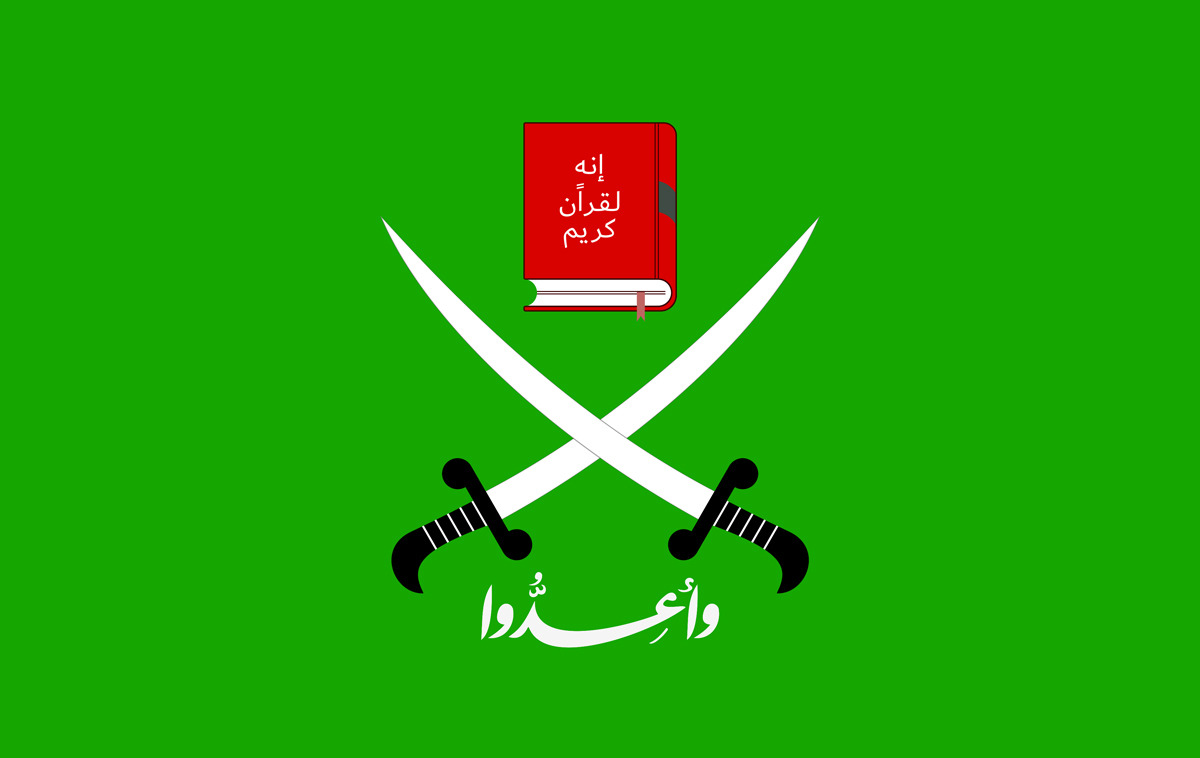
The Muslim Brotherhood, a transnational Sunni Islamist organization aiming to institute sharia-based governance, has come out against the US-Israeli military operation targeting the Shiite Iranian regime, despite the Sunni-Shia divide that originated in 632 CE over who should succeed Islam's Prophet Mohammed.
Sunnis, who make up 90% of Muslims, believed leaders should be elected by consensus, chose Abu Bakr as caliph. Shias believed leadership should follow Mohammed's bloodline, specifically via his cousin and son-in-law, Ali.
In a statement published on March 1, Professor Mahmoud Hussein, acting "general guide" of the Muslim Brotherhood, wrote:
"The Muslim Brotherhood affirms that the policy of arrogance and dominance pursued by the U.S. administration, along with the Zionist arrogance seeking to impose a new reality in the region in which the Zionist entity becomes the dominant power, is a rejected policy, and that the peoples will prevent the implementation of this scheme. The group condemns the recent Zionist and American attacks on Iran, which threaten the security of the region and open the door to conflicts among its countries....
"The group stresses the necessity for Arab and Islamic peoples, the peoples of the free world, and all international and regional institutions to assume their role in confronting the increasing Zionist recklessness, declaring rejection of the policy of arrogance pursued by the U.S. administration, and working to spare the region the calamities of war...."
This statement shows that the Muslim Brotherhood and the Iranian regime share anti-Western and anti-Israel sentiments.
The Muslim Brotherhood is no less dangerous than the Iranian regime. While banned as a terrorist organization in some Arab countries, it maintains a presence in the Middle East and operates through networks and affiliates in Western countries through various organizations, think tanks and charities that promote its Islamist ideology.
According to the Institute for National Security Studies in Tel Aviv:
"The Brotherhood and its activity are divided into three fronts: The London front, led by Salah Abdel-Haq; the Istanbul front, headed by Mahmoud Hussein; and the 'Current of Change' front, led by Mohamed Montasser.
"Its main communication channels are:
"Television channels: Mekameleen, Rabia, Al-Sharq, Misr al-An;
"Websites: Ikhwan Online, Ikhwan Web, Ikhwan Wiki, Ikhwan Search, Ikhwan Book, Rassd;
"Social media accounts on Facebook, Telegram, and other networks operated by individuals and communities identifying with the Muslim Brotherhood;
"Research institutes, including the Egyptian Institute for Political and Strategic Studies, based in Istanbul;
"The Brotherhood's periodical, Majallat al-Da'wa;
"Al-Jazeera TV and Qatari-funded newspapers, including Al-Quds al-Arabi and Al-Arabi al-Jadid, which promote the agendas of the Muslim Brotherhood and Hamas."
The Muslim Brotherhood cannot be eliminated through military action. Fighting this movement involves a multifaceted, long-term approach combining legal designations, financial restrictions, and ideological counter-messaging. Key strategies include designating affiliates as terrorist organizations, dismantling financial networks, and limiting their influence in education and religious institutions.
The Muslim Brotherhood and Iran's regime share a deadly hatred of the West, advocate the destruction of Israel, and seek to undermine Arab and Islamic states that are moderate or pro-Western. Both have supported Hamas (the Palestinian branch of the Muslim Brotherhood) and aim to unify the Muslim world (ummah) under a shared political-religious vision.
Despite the historic Sunni-Shia rivalry, it is hard to ignore the influence of the Muslim Brotherhood on the leaders and ideology of the Iranian regime.
The late Supreme Leader of Iran, Ali Khamenei, translated four books of Sayyid Ibrahim Qutb, an Egyptian political theorist who was a leading member of the Muslim Brotherhood, and whose writings formed the foundation of modern radical Sunni Islamism.
Qutb's ideology centers on restoring "pure" Islam by replacing jahiliyyah (pre-Islamic "ignorance" or "barbarism") and secularism with strict sharia law. Qutb saw Islam as a liberation movement requiring active struggle -- including violence -- to overthrow governments that obstruct Allah's law. Qutb proposed a dedicated vanguard of believers to revive Islam and re-establish a true Islamic state, and he advocated violent, offensive jihad.
According to the Australian Army Research Centre:
"Qutb has been one of the most important influences on Dr Ayman al-Zawahiri—the man considered to be the intellectual architect behind much of al-Qa'ida's rhetoric and campaign planning...
"Osama bin Laden also clearly identified with Qutb's Islamist ideology. As mentioned earlier, while a student at King Abdul Aziz University in Saudi Arabia, bin Laden was tutored by Qutb's brother, Muhammad... His numerous public announcements since the mid-1990s have continually reflected key Qutbian beliefs, indicating an earnest desire that he and his followers in the al-Qa'ida network are the spearhead of the modern international Islamic movement, committed to restoring Islam to the glory of its medieval days.
"Militarily, the al-Qa'ida leadership has adopted Qutb's understanding of jihad and embraced his overall objective—that is, the destruction of jahiliyya for the creation of 'freedom' defined in an Islamist sense. This view is reflected in al-Qa'ida's rhetorical emphasis on an overall international strategy. By appropriating Qutb's interpretation of the justification for jihad, al-Qa'ida has been able to rationalise war against the United States."
According to Arab writer and political analyst Radwan al-Sayed, the relationship between the Muslim Brotherhood and the Iranian regime is not just a circumstantial alliance, but one that extends to a "documented intellectual connection" that dates back decades.
Al-Sayed recalled a meeting he had with Khamenei:
"He told me that Imam [Ayatollah Ruhollah] Khomeini used to ask us in the 1960s to translate the books of the Muslim Brotherhood into Persian, and my share was to translate the books of Sayyid Qutb. We benefited greatly in the jurisprudence of the state from the Muslim Brotherhood."
The Iranian regime is not the only head of the snake responsible for killing tens of thousands of innocent people, including Christians, Muslims and Jews. The Muslim Brotherhood is the other head of the snake that needs to be cut off. The organization has inspired Iran's mullahs and served as the root from which several Islamist terror groups, such as Hamas, Islamic State (ISIS) and al-Qaeda have risen and flourished.
The US government recently designated certain chapters of the Muslim Brotherhood (specifically in Egypt, Jordan and Lebanon) as foreign terrorist organizations, following US President Donald J. Trump's November 2025 executive order to begin that process. Trump's order and the subsequent designation were good steps in the right direction, but they are hopelessly insufficient. The entire organization should be banned. There is no reason why the Trump administration should not follow the actions of Muslim countries such as Egypt, Saudi Arabia, the United Arab Emirates and Jordan, and officially designate the entire Muslim Brotherhood as a terrorist organization. It is meaningless to get rid of the Iranian regime while allowing the Muslim Brotherhood to continue serving as an inspiration to Islamist terrorists.
The Muslim Brotherhood's reaction to the US-Israeli attack on the Iranian regime includes an appeal to Muslims to rise against the US and Israel. This call should be treated by the US and the rest of the West as a declaration of war by the Muslim Brotherhood. The Muslim Brotherhood seriously needs to be the next target after the mullahs of Iran.
Khaled Abu Toameh is an award-winning journalist based in Jerusalem.
 Stuart J Schoenberger