








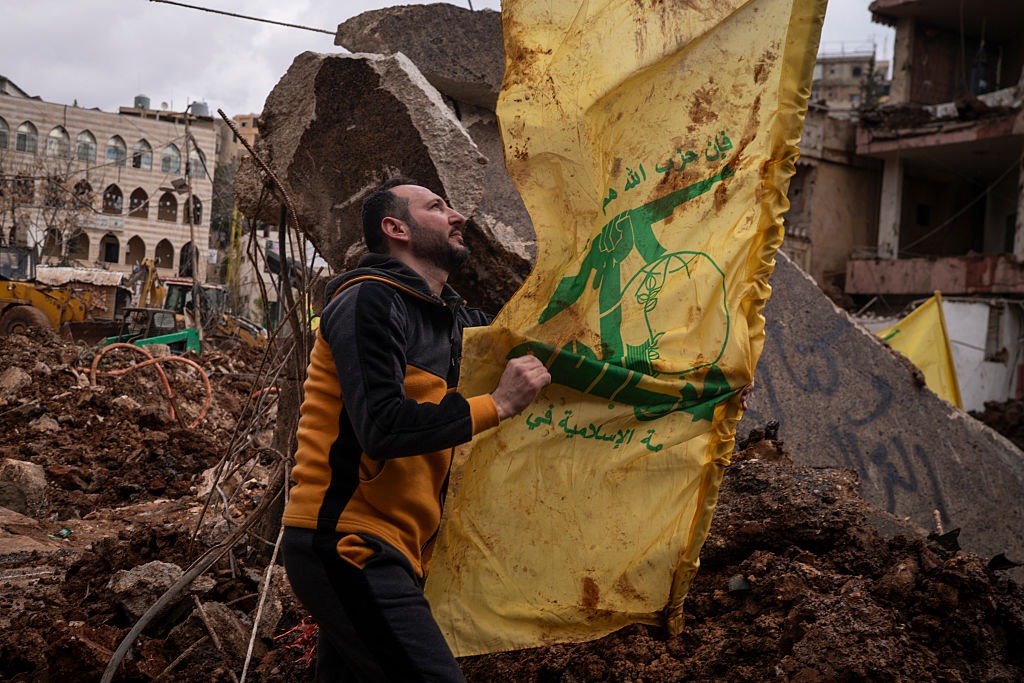
On March 2, Lebanon's Hezbollah terror group formally joined the current Israeli-US war with Iran by firing missiles and drones at various Israeli military bases, oil infrastructure, and northern communities.
Hezbollah's decision to resume its attacks on Israel came in violation of the November 2024 US-brokered ceasefire agreement between Israel and the terror organization. It also came in violation of calls for the "disarmament of all armed groups in Lebanon," as required by United Nations Security Council Resolution 1701.
In August 2025, the Lebanese government, under Prime Minister Nawaf Salem and President Joseph Aoun, initiated a five-stage plan to establish a state monopoly on weapons. In response, the US has provided more than $230 million to support Lebanese security forces in their effort to disarm Hezbollah and other armed groups, and to confiscate rockets and missiles.
Hezbollah, however, has since refused to disarm, rejecting Lebanese government directives and international pressure, specifically from the US and Israel, to relinquish its weapons. "The state is holding talks with Hezbollah to persuade it to hand over its weapons, but it refuses," Lebanese Foreign Minister Yousef Rajji stated in November 2025.
Hezbollah Chief Naim Qassem threatened open confrontation if Lebanon's government proceeds with plans to disarm his organization:
"The [Hezbollah] party will fight a (historic) battle if necessary in the face of this Israeli-US project, whatever the cost. There will be no life in Lebanon if the government tries to confront the party."
Since the resumption of the fighting between Israel and Hezbollah this month, the cost has been painfully high for hundreds of thousands of Lebanese civilians who were forced to evacuate their homes. "We're sleeping here in the streets – some in cars, some on the street, some on the beach," complained one man in Beirut. "No one even brought a blanket."
Hezbollah's decision to enter the war was not spontaneous or impulsive. Rather, it was a calculated decision to help its patrons in Tehran.
The leaders of Hezbollah undoubtedly knew that their entry into the war would elicit a strong response from Israel. They were also aware that the decision would bring destruction on Lebanon and cause suffering to hundreds of thousands of civilians.
For Hezbollah, however, serving the interests of the Iranian regime has always taken precedence over the well-being and safety of the Lebanese people.
The US and the rest of the international community were wrong to assume that Hezbollah would honor the ceasefire agreement with Israel. They were also wrong to assume that the terror organization would voluntarily give up its weapons or that the Lebanese government would take any real action to reassert its security control over Lebanon.
Westerners do not seem to understand that Iran's terror proxies, Hezbollah and Hamas, are deeply rooted in jihadist ideology within the "Axis of Resistance." While Hamas and Hezbollah originate from different branches of Islam (Hamas is Sunni, Hezbollah is Shia), both employ the concept of jihad (holy struggle) to justify armed conflict against Israel, a country they regard as a totally unacceptable, illegitimate presence in the Middle East.
The 1988 Hamas charter defines the conflict with Israel as a religious struggle: "Jihad is its path and death for the sake of Allah is the loftiest of its wishes." Both Hezbollah and Hamas view all of Palestine as sacred Islamic land. Their primary goal is to destroy Israel and replace it with an Islamic state.
Hezbollah aims to eliminate Israel, which it views as an illegitimate entity, and the organization supports the establishment of a regional Islamic order led by Iran's mullahs.
Hezbollah's ideology centers on the concept of jihad against Israel and Western influence in the Middle East, with its military wing explicitly called the "Jihad Council."
Both groups reflexively use the "jihad of the sword" and martyrdom as central pillars for political mobilization and violent, armed struggle.
Although the separate ceasefire agreements Israel reached with Hezbollah and Hamas require both terrorist groups to disarm, the US administration has failed to take a firm position on this issue. Over the past few months, US President Donald J. Trump has issued severe, repeated threats demanding the disarmament of Hamas in the Gaza Strip and, to a lesser extent, Hezbollah in Lebanon. He warned Hamas that if it doesn't lay down its weapons, "there'll be hell to pay for them." Addressing the need for Hezbollah to disarm, Trump acknowledged that the terror group "has been behaving badly" and that the US expects them to adhere to disarmament agreements.
Obviously, Hezbollah and Hamas are unfazed by Trump's threats. Both groups are incontestably determined to pursue their jihad to destroy Israel. That is why they will never agree to give up their weapons. They view their weapons not merely as military tools, but as existential symbols of honor, pride, and dignity. Recently, Hamas leader Khaled Mashaal stated that "resistance and its weapons are the honor and pride of our nation."
The late Hezbollah Secretary-General Hassan Nasrallah was once quoted as saying:
"They will take our souls before they take our weapons – not because we love the weapons, but because weapons are a symbol of honor and pride."
It is time for the Trump administration and other international parties to understand that ceasefire agreements or threats will never convince the jihadists of Hezbollah and Hamas voluntarily to lay down their weapons.
Al-Qaeda and Islamic State (ISIS) did not surrender their weapons or abandon their jihad against the West because of deals or threats. Both groups were crushed through the only language that they understand: force.
It is incorrect to assume that there is a difference between one jihadi group and another. They all share a fundamental hostility toward the West, in particular the US and Israel. Given that no Arab or Islamic country is prepared to disarm Hezbollah or Hamas, the only two countries that have the will and ability to do so are, like it or not, Israel and the United States.
Khaled Abu Toameh is an award-winning journalist based in Jerusalem.
 Bettina