





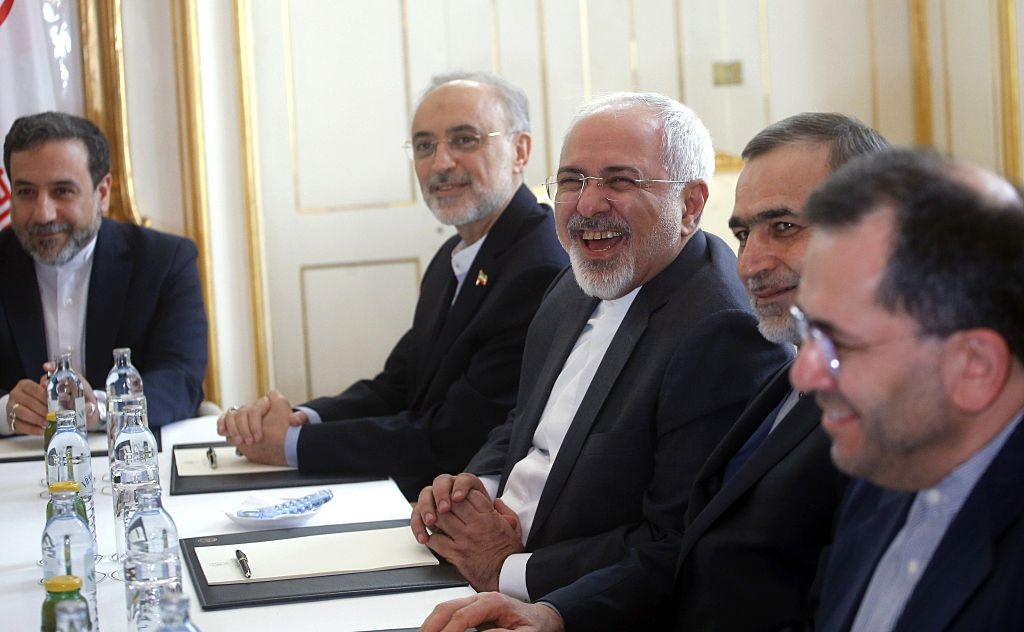
Before agreeing to the JCPOA (the Iran "nuclear deal") in 2015, President Barack H. Obama assured the American people that he understood, in the words of his press secretary, Josh Earnest, that "no deal is better than a bad deal."
Obama then proceeded to make a historically epic terrible deal.
Because Obama made it clear to friend and foe alike that he would never use military force to prevent Iran from obtaining nuclear weapons, the only possible outcome was a "bad deal."
As Obama told a skeptical and worried Israeli public on June 1, 2015:
"I can, I think, demonstrate, not based on any hope but on facts and evidence and analysis, that the best way to prevent Iran from having a nuclear weapon is a verifiable, tough agreement.... A military solution will not fix it. Even if the United States participates, it would temporarily slow down an Iranian nuclear program but it will not eliminate it."
The Obama strategy was apparently to make any deal and call it a "good deal."
President Donald J. Trump is assuring the American people that he will only make a "good deal." Trump, unlike Obama, has demonstrated his willingness to use military force. Because of the nature of the Iranian regime and the damage done to America's national security interests in the region, not to mention the distrust Obama's nuclear deal engendered among our Arab allies, it is not possible for Trump to make a "good deal" with Iran's current regime.
Trump's only alternative for a positive outcome is regime change, which can only be achieved by resuming kinetic military action. It appears that Trump has reached the same conclusion, and renewed military operations against the Iranian regime have commenced this week.
Obama, while purposely misleading the average American about the terms of his deal and the nature and goals of the Iranian regime, may well have believed that he made a "good deal." It seems that for Obama, the goal of the deal (any deal) justified the lies.
The Obama deception was not the good deal/bad deal dichotomy. The lie was the motivation behind the deal and how it was sold to the American people.
For Obama, even a deal like the one he negotiated that empowered the Iranian regime and fundamentally changed the security architecture of American policy in the Middle East from an Israel-centric system to an Iranian-centric or bi-polar Israeli-Iranian geopolitical paradigm, was a "good deal."
On March 24, 2007, the United Nations Security Council unanimously adopted Resolution 1747, imposing sanctions on Iran for violating its obligations under the Treaty on the Non-Proliferation of Nuclear Weapons.
On March 3, 2008, the UN Security Council adopted Resolution 1803, imposing additional sanctions on Iran for its refusal to suspend its uranium enrichment.
On June 9, 2010, the UN Security Council adopted Resolution 1929, noting that Iran had failed to abide by previous resolutions designed to stop its uranium enrichment program, and prohibiting it from outsourcing its nuclear program.
The UN Security Council also seems to have understood that a nuclear weapon without the means to deliver it was of limited use. Therefore, the international community sought to frustrate Iran's ability to launch a nuclear warhead, and included the following provision in Resolution 1929:
"... Iran shall not undertake any activity related to ballistic missiles capable of delivering nuclear weapons, including launches using ballistic missile technology, and that States shall take all necessary measures to prevent the transfer of technology or technical assistance to Iran related to such activities."
Obama allowed Iran to continue developing nuclear weapons. He refrained from enforcing the UN resolutions or supporting the popular uprisings of the Iranian people in 2009 and 2015 that sought to overthrow Ayatollah Ali Khamenei's Islamic Republic. Instead, Obama agreed to a deal that allowed the mullahs to violently crush the popular protests, and required the repeal of each of the UN resolutions. Obama's deal provided for all limitations on Iran's uranium enrichment and development of its "civilian" nuclear program to expire in 2030, and permitted Iran, the world's leading state sponsor of terrorism for 39 straight years, to enrich uranium and legitimately develop a ballistic missile system designed to deliver nuclear weapons at the expiration of the agreement in October 2025.
In exchange for these concessions to the Ayatollah, the Obama Administration agreed to lift economic sanctions on Iran at a time when its frozen overseas assets totaled approximately $115 billion, and delivered $400 million of cash on a pallet as ransom for American hostages being illegally held by the Islamic Republic.
In short, Obama gave away everything and got nothing in return. Now that is a really bad deal.
Obama and his lead negotiator, Secretary of State John Kerry, must have understood that the money Iran received was to be used to fund its military, its international terror network, and to advance its hegemonic goals in the region.
Obama rammed the deal down the throats of a skeptical American public and implemented it in the face of overwhelming bipartisan congressional opposition. Moreover, Israel and the Gulf Arab states -- the countries most directly impacted by the deal and that strenuously opposed it -- were not consulted.
The Obama propaganda machine also understood that it could not tell the truth about the terms of the deal if they wanted any support from the American people. So they simply lied about them.
We were famously told by Kerry that the Iran deal "closed off all paths to a bomb." Obama told an identical fib when he announced to the world that America had reached a "[c]omprehensive long-term deal with Iran that will prevent it from obtaining a nuclear weapon... Every pathway to a nuclear weapon has been cut off."
There was talk of "[c]onstant international supervision," "24/7 access to key nuclear facilities," and "access where necessary, when necessary."
Obama and his lackeys left out the part of the deal that effectively prevented inspectors from searching Iranian military sites and the requirement of almost one month's notice by international inspectors concerning locations they found suspicious. That allowed ample time for Iran to cover its tracks.
Obama could not but appreciate that the deal was problematic. It could never pass the Senate as a treaty. There was no possibility of getting 67 votes (two-thirds of the Senate) to approve it.
With the help of Kerry and the complicity of Senate Democrats, in particular Chuck Schumer, Obama turned the Constitution on its head and implemented a protocol requiring 67 votes to disapprove the nuclear deal. The fix was in.
The current hostilities with Iran are a direct result of Obama's failed policy. Obama did not just save the Iranian regime; he empowered it. Every pathway to an Iranian nuclear weapon was not cut off. To the contrary, Obama guaranteed Iranian success. He helped Iran fund its military and its terror proxies -- the same ones that have killed and maimed thousands of American service members. Obama's nuclear deal helped fund the October 7 attack against Israel. The attack drones and ballistic missiles that Iran launched at American service members, at Israel, and at our Gulf Arab allies, were paid for in large part by Obama's nuclear deal.
Yet, the nuclear deal did have one positive unforeseen consequence. It persuaded many of the Arab states looking for a reliable ally that an alliance with Israel was their best geopolitical hedge against an ascendant Iran and a schizophrenic America.
To his credit, Trump understood the dynamic and seized the opportunity. The Abraham Accords was born.
Iran's regime will only make a deal with the US if Iran's rulers believe the survival of the regime is guaranteed. No matter what is agreed to by Trump, Iran's rulers are sure to violate the agreement. Maybe not today or tomorrow, but as soon as Trump leaves office.
The regime will test the next president.
If it is a Democrat, whatever Trump agrees to will be meaningless. Can anyone imagine a President Harris or Buttigieg using military force against Iran? These people are rooting for Iran to win the war just so they can say "Trump lost."
Depending on who the next president is, it is more likely that American policy will be to move away from, weaken, and isolate Israel. Israel will be cut loose, and with it, the safety net the members of the Abraham Accords are looking to build.
The principal beneficiary of such an "agreement" will be Iran. The Gulf Arab states understand that all too well.
If Trump makes a deal, even a great one, it will last no longer than his presidency. The Gulf states will hedge their bets. Trump will be gone but the Iranian regime, perhaps with the support of a new American administration, will still be in their midst.
The Arabs no doubt are planning for that possibility now and will make accommodations with Iran at a time when we need them to stand with us against this predatory death cult. Rather than join the Abraham Accords, Saudi Arabia and other Gulf states will run from it. Joining the Abraham Accords under those circumstances would be tantamount to suicide.
Trump's only long-term "good deal" is no deal. Regime change is his only option.
Our enemies are watching.
Eric Levine, a New York attorney, represents both plaintiffs and defendants. His clients range from individuals to Fortune 100 companies. He served formerly at the U.S. Department of Treasury, Office of Thrift Supervision, where he prosecuted Savings and Loan fraud. Mr. Levine then worked at the international law firm, Proskauer Rose, before starting his own firm in New York City, Eiseman Levine. He has appeared multiple times on FOX Business News, FOX News, and CNN. Mr. Levine is also a co-host of the Sunday morning WABC radio show, Let the Record Show, where he discusses local, state, federal, and national security issues. He has appeared on BBC radio and been quoted in the New York Times, the Washington Post, Le Monde and other international publications concerning his views on the American political landscape.
 tiki
tiki