








Israeli Prime Minister Benjamin Netanyahu faces a consequential decision on Gaza. The political environment is difficult, the Israeli election is approaching, and every concession will be contested. But Israel's security cannot be subordinated to an electoral calendar. The question is more fundamental: can Hamas be verifiably disarmed while Israel withdraws without recreating the conditions that produced October 7? Jared Kushner is attempting to provide Netanyahu with a mechanism to achieve precisely that—and Netanyahu has strong strategic reasons to support it.
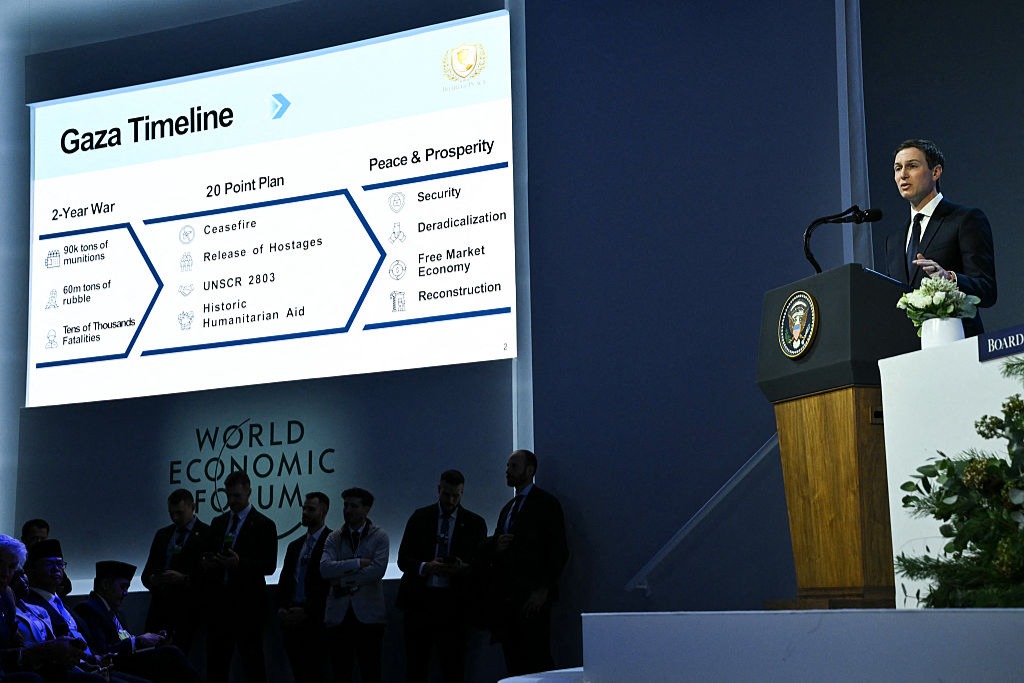
Kushner is not asking Israel to trust Hamas. Nor is he proposing that Israel exchange security for a diplomatic achievement. His approach is built around a more rigorous equation: measurable disarmament, independent verification and phased Israeli withdrawal, with each Israeli step conditioned on implementation of the corresponding security commitment.
Netanyahu's substantive concern must remain at the center of any agreement. Israel cannot withdraw only to discover that Hamas has preserved tunnels, weapons, command structures or the capacity to rebuild them. October 7 made such a risk unacceptable. His requirement is therefore clear: Hamas must take irreversible steps toward genuine disarmament before Israel assumes an irreversible security risk.
The importance of Kushner's approach is that it seeks to make that requirement executable.
Hamas disarms in defined and verifiable stages; compliance is independently certified; Israel responds with the corresponding stage of withdrawal. Neither party receives the full benefit before fulfilling its obligations, and neither is required to surrender all its leverage at the outset.
This is why Kushner's sequence—Hamas, regional mediators, Netanyahu—is important. His objective should not be to bring Netanyahu assurances from Hamas. Israel has heard assurances before. It is to bring him a structure in which assurances are no longer necessary.
The difficult questions are practical. Who verifies disarmament? Which weapons are covered? What happens to tunnels, production facilities and command infrastructure? What constitutes a breach, and what are its consequences? These provisions are not technical details surrounding an agreement. They are the agreement.
Kushner brings another advantage. The Abraham Accords gave him political capital in Israel and across the Arab world that few American negotiators possess. They also demonstrated a method: identify converging interests, construct reciprocal obligations and connect peace to tangible economic benefits.
Earlier this year, I argued that Kushner should avoid becoming too deeply involved in the Iranian file. That was not an argument for reducing pressure on Tehran. Quite the opposite.
Iran remains the central strategic challenge. Its military capabilities have been weakened and its economy severely damaged, but the regime has proved resilient. It retains financial resources, instruments of coercion and the capacity to rebuild. Time cannot be offered to Tehran as a strategic gift.
Iran has also skillfully shifted the focus of the confrontation. The debate over the vulnerability of the regime has increasingly given way to the Strait of Hormuz, energy security and the economic consequences of escalation. This places pressure not only on Washington and Israel but on the Gulf states, Europe and Asian economies whose interests are directly affected by the security of this vital passage.
The United States cannot carry that burden alone. Europe and Asia have substantial interests at stake and must assume their share of responsibility. Nor can Washington disregard Gulf partners that have taken significant risks and made consequential choices in support of the United States.
The answer, therefore, is not to resolve Gaza first and return to Iran later. The two challenges must be addressed simultaneously, but not necessarily by the same people or with the same instruments.
Pressure on Iran must continue. Kushner's particular diplomatic capital should be concentrated where it can produce a different kind of strategic result. That is Gaza.
Success there would not automatically disarm Hezbollah or separate the Houthis from Iran. These organizations have their own political structures, military interests and long-established relationships with Tehran. Pretending otherwise would underestimate both. But Gaza could demonstrate a different method.
Disarmament cannot be presented simply as surrender. It must open the door to reconstruction, investment and economic recovery. Israeli withdrawal cannot depend on promises; it must follow verified security guarantees. International and Arab financing must accompany credible governance and stability.
The equation is not peace instead of security. It is security as the condition for peace, and peace as the foundation for prosperity.
That principle could eventually be adapted to Lebanon. Restoring the Lebanese state's authority over weapons will require pressure and enforceable commitments, but it will also require offering Lebanon a credible economic future: reconstruction, Gulf investment, infrastructure and reintegration into the regional economy.
Yemen will require a different architecture, reflecting its internal political realities and the security requirements of Saudi Arabia and the Gulf. But there too, military pressure alone has limits. Reconstruction and economic reintegration can become part of the incentives for a durable settlement.
This is where the legacy of the Abraham Accords remains relevant. Their significance was not simply normalization between governments. They demonstrated that diplomacy becomes more durable when peace creates tangible economic interests in preserving it.
Iran offers its region a permanent confrontation. The United States and its allies must continue to contain that threat and deny Tehran the time and space to rebuild its capabilities. But they must also offer a more compelling proposition: security, investment, economic integration and a future beyond permanent confrontation.
For Netanyahu, the immediate question is not whether Hamas can be trusted. It cannot. The question is whether Kushner can construct an agreement in which trust is replaced by verification, reciprocity and enforcement—one that delivers Hamas's disarmament without compromising Israel's security and makes Israeli withdrawal the consequence of verified implementation rather than political promises.
That is a framework Netanyahu can support without retreating from Israel's fundamental security requirements.
If that mechanism can verifiably disarm Hamas, protect Israel's security and open Gaza to credible governance and reconstruction, it would represent more than the settlement of one war.
It would put back on the table the proposition the Middle East urgently needs: that security can make peace possible, and that peace can make prosperity more powerful than confrontation.
That is the strategic opportunity Jared Kushner is pursuing. It deserves to be taken seriously.
Ahmed Charai is the Chairman and CEO of World Herald Tribune, Inc., and the publisher of the Jerusalem Strategic Tribune, TV Abraham, and Radio Abraham. He serves on the boards of several prominent institutions, including the Atlantic Council, the Center for the National Interest, the Foreign Policy Research Institute, and the International Crisis Group. He is also an International Councilor and a member of the Advisory Board at the Center for Strategic and International Studies.
This article was originally published in the Jerusalem Strategic Tribune. It is reprinted here by the kind permission of the author.
 cammo99