








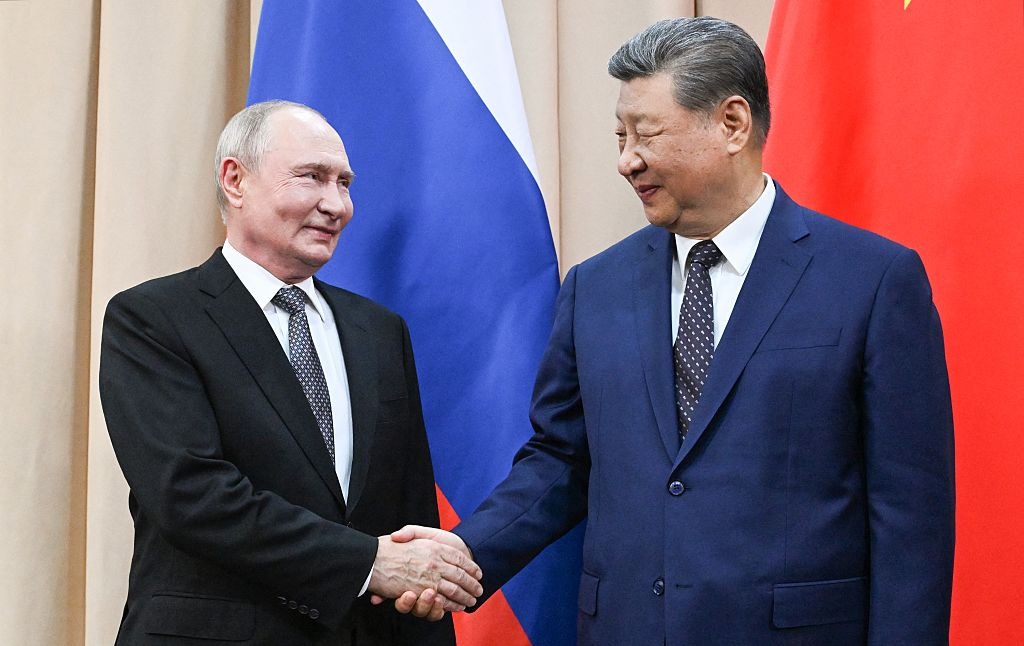
Russian President Vladimir Putin has proposed another meeting with US President Donald Trump, this time with Chinese President Xi Jinping at the table.
At the upcoming "summit" there will be photographers, interpreters, handshakes and much talk of peace. One man will apparently have to make do with just the television coverage: Ukrainian President Volodymyr Zelenskyy, whose country Russian forces are still trying to dismember. Putin has a considerable talent for turning a war of his own making into a dispute that others are invited to settle at his convenience.
Zelenskyy merely happens to represent the country invaded, Ukraine, after Russia violated the 1994 Budapest Memorandum, in which Russia — and the United States — agreed to respect Ukraine's sovereignty if it forfeited its stockpile of nuclear weapons. Ukraine complied. Russia obviously did not. Why should any upcoming agreement be different?
Putin reportedly raised the idea of a summit in an October 9 telephone call with Trump. The suggested venue is Shenzhen, where the Asia-Pacific Economic Cooperation summit is scheduled for November 18-19. Putin reportedly sees the gathering as a kind of new Yalta, with European leaders excluded, along with Ukraine. Kremlin spokesman Dmitry Peskov confirmed that the subject came up, while stressing that no concrete arrangements had been made. Beijing claims to have no information about a meeting, although Chinese representatives have indicated they would not oppose one if Trump agreed.
Trump said on October 19 that he would attend if Xi wanted him there, and that the main subject would be nuclear weapons. He also remarked that "Russia, frankly, has been fine on Ukraine." It has? Hours earlier, Russian forces had launched 16 ballistic missiles at Kyiv and the surrounding area. Whatever diplomatic opening Trump sees, Putin's generals have shown little inclination to celebrate it by giving their missile crews any time off.
At the Shenzhen meeting, Russia will be treated as an indispensable architect of European security. China will have a voice in settling a European war. Ukraine will discover which parts of its future had been discussed or carved up in its absence. Even Peskov conceded that a final agreement cannot be reached without the participation of someone in Kyiv -- carefully avoiding the name of a president Putin calls illegitimate. Trump, for his part, has said Zelenskyy "doesn't know what he's talking about" and that it is "time for somebody else to negotiate on behalf of Ukraine." Once the great powers have reached an understanding, the pressure on Kyiv to accept it could be immense. It is not hard to see why the Kremlin likes the arrangement. A third of Ukraine would be better than no Ukraine. China may well conclude from the summit that a third of Taiwan would be better than no Taiwan.
On October 21, the Kremlin announced that Putin had agreed in principle to resume separate trilateral negotiations with Ukraine and the United States after November 10. Those negotiations, unlike the proposed Shenzhen meeting, would include Ukraine. So far, however, there is neither a ceasefire nor the slightest evidence of Russia conceding anything apart from releasing an elderly, ill American schoolteacher, Stephen Hubbard, wrongfully detained in Russia for more than four years. Russia is still holding hostage at least nine more Americans.
For Putin, diplomacy is already paying off — bigly. On October 16, just before new measures were due to take effect, Trump issued an open-ended waiver covering virtually all the major sanctions and tariffs in the Lindsey O. Graham Sanctioning Russia and Iran Act, signed into law on September 18. Previous sanctions remain, but the new penalties have been set aside. A US Treasury Department license issued on October 9 also permits imports of Russian diesel until April 2027.
Moscow has escaped another round of economic pressure without making a single verifiable concession on the battlefield. Trump has understandable reasons to worry about fuel prices ahead of the midterm elections. The Kremlin knows how to exploit an American president's domestic concerns.
Meanwhile, Russia is doing its best to make Ukraine's winter miserable. The October 19 attacks damaged more than 10 energy facilities, leaving over half a million people without electricity, heating or running water. Zelenskyy complained that Ukraine had again received no advance warnings from partners that had previously provided them. Washington denied changing its policy and attributed the failure to a technical problem. After talks in Oslo with U.S. envoy Steve Witkoff on October 20, Zelenskyy confirmed that the early warnings had resumed. Ukraine has also attacked Russian refineries to cut the revenues financing the invasion; Washington has urged it to scale back those strikes. The newly authorized diesel trade makes that request especially awkward.
Then there are the Patriot missiles. Countries prepared to transfer American-made interceptors to Ukraine are still awaiting Defense Secretary Pete Hegseth's approval. Zelenskyy says his country has almost exhausted its supply of American interceptors. On October 20, Secretary of State Marco Rubio acknowledged that deliveries might be delayed because the weapons could be "needed somewhere else," while denying any deliberate effort to deprive them to Ukraine.
The war with Iran has indeed strained the American stock market. Zelenskyy has proposed a 30-day halt to attacks on Russian refineries in exchange for help defending Ukrainian skies, but says that Washington has offered no encouragement. For people living under the bombardment of Russian missiles, the distinction between a political delay and a logistical one offers little consolation.
Putin knows how much time can be consumed by negotiations about negotiations. The Minsk agreements of 2014 and 2015 were followed by years of arguments over implementation, violations and blame. Responsibility for their failure remains disputed. Putin's full-scale invasion of Ukraine in February 2022, in violation of Russia's commitment in the 1994 Budapest Memorandum not to invade Ukraine, however, gave ample evidence of the value he places on his neighbor's sovereignty when it obstructs his ambitions. Any agreement bearing his signature deserves particular scrutiny, preferably before sanctions are lifted or celebrations arranged.
Xi would bring complications of his own. NATO's 2024 Washington Summit Declaration described China as a decisive enabler of Russia's war, pointing to Beijing's vast purchases of Russian oil as well as continuing support for China's defense-industrial base. China rejects that assessment and presents itself as a champion of peace. Yet its commercial and strategic partnership with Moscow gives Xi little incentive to impose terms that would seriously damage Putin. A summit would also confer on China something Beijing has long coveted: recognition as a power entitled to help settle the affairs of Europe. Perhaps Trump is trying to give rewards now in the hope of receiving concessions later. The author of The Art of the Deal should know better.
Trump's desire to end the killing deserves respect. He has spoken with genuine disgust about the needless deaths on both sides and prefers bargaining to a wider war. His interest in nuclear-arms reductions is serious as well. Putin, however, can be expected to bring Ukraine's borders and military future into any discussion of strategic weapons. Those questions cannot reasonably be settled over the head of the country whose survival depends on the answers. Before committing to a summit, Washington ought to know exactly what Moscow is prepared to discuss, and what Putin is willing to do rather than merely promise.
President Trump has reason to trust his instincts as a negotiator. The Abraham Accords succeeded where years of conventional diplomacy had failed. The Accords established constructive relations between Israel and Arab governments without waiting for a settlement of the Palestinian question. The Accords produced diplomatic ties and commitments that could be identified, implemented and tested. So far, Putin is offering dates, venues and a place for himself among the world's most powerful men. His armies are offering a rather different program in Ukraine. Even if he agrees to settle the conflict, how long can anyone expect that committee to last? Until the day after Trump leaves office?
Diplomacy could conceivably be helpful, but only provided it asks something of the man who started the war. A ceasefire would require a timetable, independent monitoring and severe consequences for renewed attacks. Questions of occupied territory and prisoner releases would have to involve Ukraine's elected government. Sanctions relief should only follow measurable Russian action and remain reversible. Defensive missiles should be supplied to Ukraine according to military needs, without allowing Putin to turn the protection of Ukraine's cities into another bargaining chip. And — always the sticking point - all those conditions have to be enforced.
Putin is betting that Trump's determination to secure peace will keep him at the table long after Moscow has stopped offering anything of value. Trump should know about negotiating with men who promise more than they deliver; he should demand evidence before rewarding this one with a diplomatic triumph. The simplest evidence would come from Russian commanders ordered to stop firing at Ukrainian cities. Until then, Putin's invitations deserve all the suspicion his conduct has earned. A seat beside the American and Chinese presidents in Shenzhen would essentially give a mass-murdering KGB goon the prestige of international statesmanship, courtesy of the United States, a country he has spent years trying to threaten.
Pierre Rehov, who holds a law degree from Paris-Assas, is a French reporter, novelist and documentary filmmaker. He is the author of six novels, including "Beyond Red Lines", "The Third Testament" and "Red Eden", translated from French. His latest essay on the aftermath of the October 7 massacre " 7 octobre - La riposte " became a bestseller in France. As a filmmaker, he has produced and directed 17 documentaries, many photographed at high risk in Middle Eastern war zones, and focusing on terrorism, media bias, and the persecution of Christians. His latest documentary, "Pogrom(s)" highlights the context of ancient Jew hatred within Muslim civilization as the main force behind the October 7 massacre.