








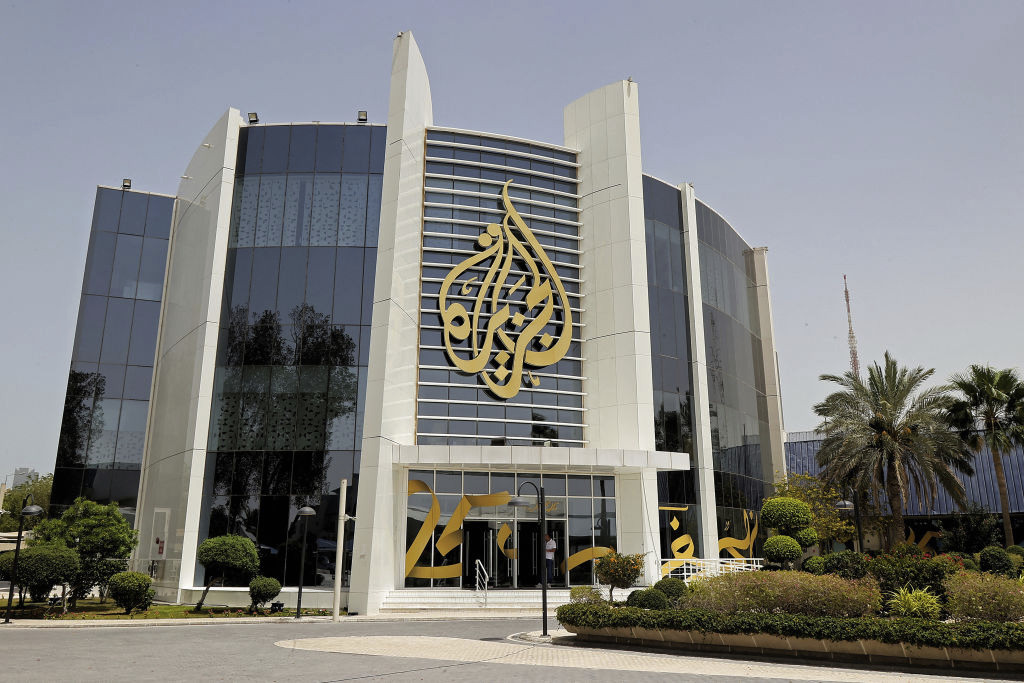
Qatar's state-owned Al-Jazeera television network has once again demonstrated why its Arabic-language news coverage deserves particularly close scrutiny. Al-Jazeera has broadcast previously unseen footage, recordings, and documents showing senior Hamas military commanders preparing for the October 7, 2023 massacre in Israel.
Instead of using this material to expose the criminal nature of Hamas's activities, Al-Jazeera has presented it as an exclusive glimpse into the lives of the organization's senior commanders. The Hamas officials featured in Al-Jazeera's footage are portrayed as military leaders, strategists, and figures worthy of admiration.
The question is not merely why Al-Jazeera chose to broadcast its "exclusive" material. It is also how the network obtained it, who provided it, and how long it had possessed it before deciding to make it public.
On October 30, Al-Jazeera's investigative program, "What is Hidden is Greater," aired previously unseen recordings of Mohammed Deif, the former commander of Hamas's military wing, and other senior Hamas officials. The program included footage of meetings inside Gaza's underground tunnel network, discussions about terror attacks, and documents that purportedly shed light on the preparations for the October 7 massacre.
Among the most disturbing revelations was an operational order attributed to Deif and dated October 5, 2023. According to the network's presentation, the document specified that the invasion of Israel would begin at 6:30 a.m. on October 7. Another document reportedly recorded a decision by Hamas's military leadership in February 2023 to begin preparations for the attack.
The footage and documents provide another reminder that October 7 was not a spontaneous outburst of anger or an improvised act of "resistance." It was a carefully prepared military operation, planned months in advance by Hamas's senior leadership.
Another recording shows Izz al-Din al-Haddad, a senior Hamas commander, reading Deif's operational order. Haddad subsequently rose through the organization's military hierarchy and was killed by Israel in Gaza City in May 2026.
Another recording shows Deif meeting with senior commanders, including Marwan Issa, Mohammed Sinwar, Ahmed Ghandour, and other members of Hamas's military leadership. A separate photograph shows Deif surrounded by senior commanders inside a tunnel complex.
All the commanders identified in that photograph have since been killed by Israel.
The Al-Jazeera broadcast also included a recording of a telephone conversation between Deif and Hamas leader Yahya Sinwar after the May 2021 ceasefire with Israel. Sinwar, the mastermind of the October 7 massacre, is seen becoming emotional while congratulating Deif over what Hamas considered a "victory" against Israel.
The presentation raises another important question: What exactly was Al-Jazeera trying to communicate to its Arabic-speaking audience? The message is clear: These are your heroes – men who planned and carried out the massacre of Jews on October 7 and whose declared objective is the destruction of Israel.
This is not journalism exposing terrorism; it is a platform for glorifying it.
Al-Jazeera could have used the material to examine how Hamas transformed Gaza into a military base, diverted resources into tunnels and weapons production, and prepared an assault in which they murdered approximately 1,200 people in Israel and the abducted 251 others.
Instead, Al-Jazeera chose to turn the architects of the massacre into celebrated military figures. The images of commanders gathering underground, discussing operations and examining military plans create the impression of a conventional army's general staff. These were, however, the leaders of an Iran-backed Islamist terrorist organization whose October 7 assault included the deliberate mass-murder of civilians, rape, torture, and hostage-taking.
Al-Jazeera is not an ordinary international broadcaster operating independently of its political environment. The network is based in Doha and is funded by the Qatari government. Although Al-Jazeera describes itself as an independent media organization, the relationship between the network and its principal state patron deserves scrutiny, particularly when its coverage concerns organizations with which Qatar maintains political relationships.
Qatar has hosted senior Hamas leaders for years, including Khaled Mashaal, Khalil al-Hayya, Ghazi Hamad, and Ismail Haniyeh. Doha has also served as a diplomatic base for purportedly "neutral" negotiations involving the terrorist organization.
The US Congressional Research Service, which notes that Hamas is an offshoot of the Muslim Brotherhood, has also documented Qatar's engagement with the organization and the presence of senior Hamas leaders in Doha.
Hamas itself identified the Muslim Brotherhood as its parent movement in its 1988 charter, describing itself as the Palestinian branch of the Brotherhood.
This relationship is especially relevant because Al-Jazeera has frequently provided Hamas leaders with a prominent platform to communicate their positions to Arab audiences. Its coverage of Hamas leaders and commanders, their statements and their military activities should be examined in this broader context.
There is also a significant difference in the way Al-Jazeera reaches its audiences. Al-Jazeera English presents itself as a major international news organization, competing for credibility among Western viewers.
Al-Jazeera Arabic, meanwhile, operates in a political and cultural environment in which the Muslim Brotherhood and Hamas enjoy considerable support among segments of the public. Its coverage should be judged not just by the information it broadcasts but also by the voices it chooses to amplify, the language it uses and the distinction it makes – or fails to make – between terrorism and legitimate political activity.
The most important unanswered questions concern the source of the newly released material. How did Al-Jazeera obtain recordings of Hamas's most sensitive military meetings, internal secret discussions, and operational documents? Who handed them to the network? When did this transfer take place? Did Hamas provide the material as part of a propaganda campaign? Did Al-Jazeera or Qatar have advance knowledge of the October 7 massacre?
Several Arab governments have had serious confrontations with Al-Jazeera. Egypt banned the network in 2013, while Saudi Arabia, the United Arab Emirates, and Bahrain blocked its website during the 2017 Gulf crisis. Jordan closed its Amman bureau that year. These actions were part of wider political disputes involving Qatar, which has been accused by the Arab countries of supporting the Muslim Brotherhood and terrorism, promoting regional instability, and interfering in various countries' domestic affairs.
Western governments should pay attention to the concerns that have repeatedly been raised about the political role of Qatar and its Al-Jazeera network.
The United States, in particular, should examine the extent of Qatari funding and influence in American institutions, universities, media, and public life. American universities, policymakers, and media organizations should ask whether foreign government funding creates conflicts of interest and delectable opportunities for political influence.
Qatar cannot simultaneously present itself as a trusted Western partner and avoid serious questions about its relationships with Hamas and the Muslim Brotherhood.
Al-Jazeera's latest broadcast has brought these contradictions back into the spotlight. The United States and other Western governments should demand answers.
Sheikh Tamim bin Hamad Al Thani, the current Emir of Qatar, and his family, who provide a media platform for Hamas's leaders to glorify the October 7 massacre, should not be allowed to hide behind the claim that they are merely reporting the news.
Khaled Abu Toameh is an award-winning journalist based in Jerusalem.