








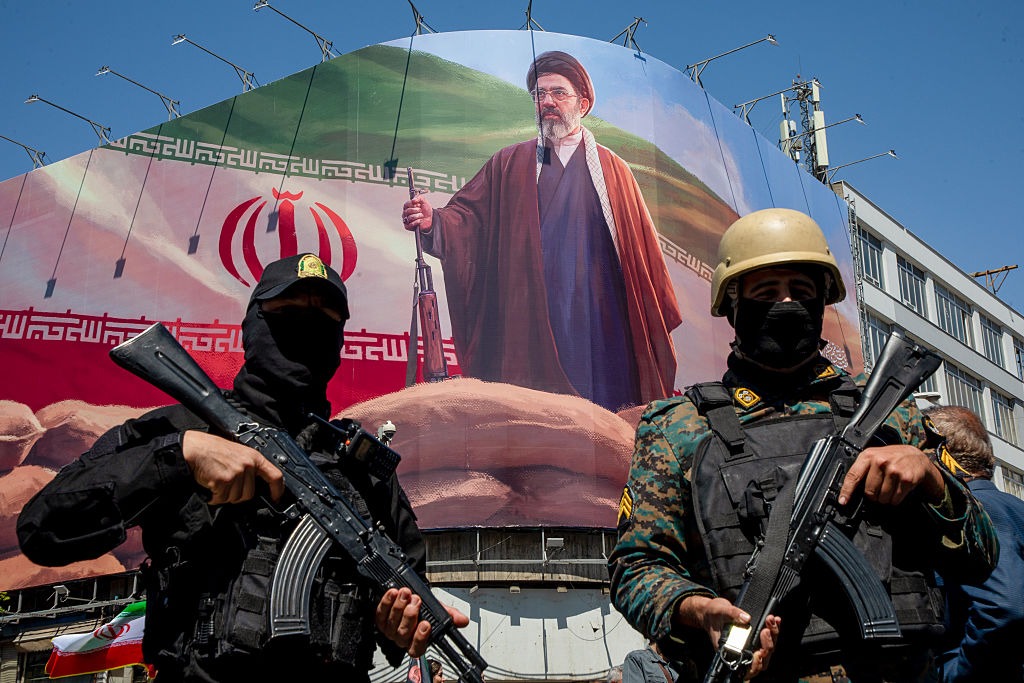
This is a regime under which I lived -- under its institutions, schools and mosques. What they teach is hatred of Israel and the United States. That is not a policy preference. That is their reason for existing -- their religious mission on Earth. By extension, any country allied with -- or even just maintaining normal relations with - the United States is regarded as an enemy.
This is the reality that has already been visited upon Iran's Muslim neighbors -- Saudi Arabia, the United Arab Emirates, Bahrain, Jordan, Kuwait -- even though not one of them was a party to this war.
Nevertheless, they all have been deliberately attacked by Iranian missiles and drones. These attacks -- launched despite no provocation, have devastated infrastructure, mown down people, and forced Iran's neighbors to live under non-stop threat.
The big prize, though, remains the United States. Israel is just its forward base. All that US President Donald J. Trump's considerate negotiations have done is simply enable Iran's Islamic Revolutionary Guard Corps, now ruling the country, to begin rebuilding their war machine: nuclear weapons, more precise ballistic missiles and drones, and now, apparently, chemical weapons to be used on Washington DC.
Iran's attacks on its neighbors and those of their proxy, the Houthis, are a clear violation of the UN Charter's prohibition on the use of force against other member states. Yet the United Nations and most international bodies remain silent – except to blast Israel, which has been sacrificing the lives of its citizens to save these deeply corrupt (here, here, here, here, here and here) and racist ingrates (here and here).
Just contrast this silence with the speed and volume of criticism directed at Israel for defending itself it after decades of deadly attacks on it, this time October 7, 2023. Since then, Iran has fired more than 400 ballistic missiles alone since the start of the war at a country the size of New Jersey (roughly 22,000 sq km). Meanwhile Israel continues to deliver humanitarian aid to Gaza every day (here, here and here).
Iran's regime will not change. Its identity is built on eliminating Israel, confronting the United States, and "exporting the revolution." The Houthis, a priority, continue to attack Saudi Arabia as well as international shipping.
This is not a regime that diplomacy can moderate. It is a brutal theocracy whose highest priority is its ideological mission. Meanwhile, inside Iran, executions, lashings (here and here) and torture escalate .
A regime that shows no regard for the lives of its own people will show even less for anyone else's. Add nuclear weapons – even just the threat of them -- to this equation and the risk becomes catastrophic.
Arab countries should not have to spend the next decades fighting the Houthis, confronting Iranian-backed militias, dismantling terrorist cells operating within their borders, and defending themselves against groups financed, armed, and directed by Iran. If they will not, or cannot, eliminate the source of these threats, at least they should help others to eliminate it.
As long as Iran's regime remains in power, it will continue to establish, finance, arm, and mobilize proxy organizations across the region and beyond. (here and here).
The alternative is perpetual vulnerability for the West and its putative allies , repeated attacks by missiles and drone, economic disruption, and the permanent possibility that a nuclear-armed Iran regards one or more of its neighbors as expendable. A regime that already fires conventional weapons at neighboring infrastructure without hesitation will also not hesitate to use just the threat of nuclear weapons to seize whatever it can –in the region and beyond.
Iran's threat is no longer confined to the Middle East. On November 7, 2026, Iran's Revolutionary Guard announced that it had lifted its self-imposed 2,000-kilometer limit on ballistic missile ranges. Parts of southeastern Europe are easily within the range of Iran's existing capabilities, and further developments place additional European countries at risk.
Would Europe really like to wait until Iran threatens more of its cities, targets more of its military bases, and destroys more of its way of life?
The Iranian regime does not belong in the twenty-first century. It is a medieval revolutionary theocracy that treats its own people as expendable, treats its neighbors as targets, and treats the destruction of Israel and the United States as sacred duties.
Leaving the regime in place guarantees continued attacks, continued proxy wars, continued threats to the Strait of Hormuz, and a certain nuclear crisis. The longer the wait to remove it, the higher the eventual price.
Dr. Majid Rafizadeh is a political scientist, Harvard-educated analyst, and board member of Harvard International Review. He has authored several books on the US foreign policy. He can be reached at dr.rafizadeh@post.harvard.edu