






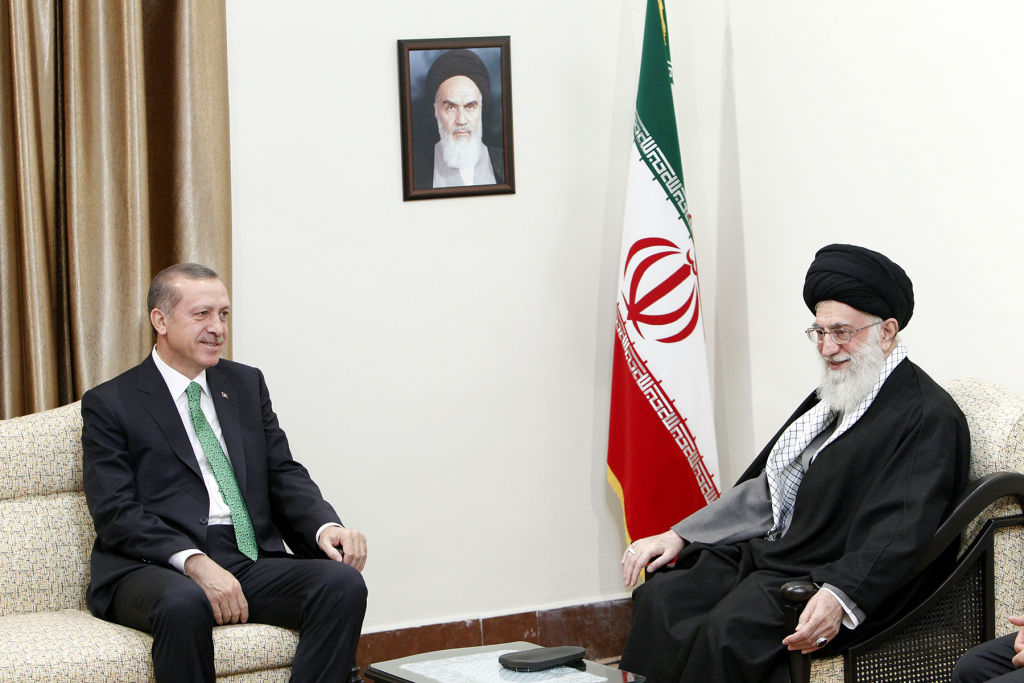
US President Donald J. Trump's decision to launch his devastating military campaign against Iran's ayatollahs means that countries, such as Turkey and Qatar, which have previously been ambivalent about their attitude towards Tehran, will now need to undertake a serious reappraisal of where their true interests lie.
Prior to Trump launching "Operation Epic Fury", the military campaign designed to eliminate Iran's ability to produce nuclear weapons, ballistic missiles or support its proxies once and for all, several important regional players sought to remain neutral as the tensions deepened between Washington and Tehran over Iran's nuclear programme.
Even though they claimed to be allies of the US, they also sought to maintain links with the ayatollahs, even when it became abundantly clear that the Trump administration was determined to confront Iran over its clear delaying tactics in the recent round of nuclear negotiations.
Now, following the demise of Iran's Supreme Leader, Ayatollah Ali Khamenei, as well as scores of other prominent members of the regime, countries that have previously tried to maintain cordial relations with the ayatollahs face a stark choice: do they want to maintain their ties with known Islamist extremists, or forge closer ties with the US and its allies?
How they respond to this dilemma could have vital implications for their future development. By aligning themselves with the West, they will have the opportunity to benefit from having access to the exciting technological revolution taking place in Silicon Valley, involving new technologies such as artificial intelligence. On the other hand, if they choose to maintain their ties with extreme Islamist groups, such as the Muslim Brotherhood and the founders of Iran's Islamic Revolutionary Guards Corps, they will be left to fend for themselves.
What if, however -- Washington and Jerusalem should both carefully note -- they choose both? With the Iranian threat gone, what would prevent them from complying with Trump's demands of the moment and enjoying the benefits of modernity -- and then, when he is no longer in office, continue supporting terrorism, religious extremism and jihad (holy war)?
Just because one is happy to have a roaring economy -- as we already see with Qatar -- that does not necessarily mean one will be happy with what is already being reported as "concern" about Israel's increased standing in the region.
The first suggestion that many Arab leaders may be reconsidering their neutral status in the conflict between the US and Iran came over a week ago, when Gulf leaders voiced their condemnation of Iran's "reckless and indiscriminate attacks" on their territory and infrastructure.
Leaders of the Gulf Cooperation Council (GCC), a regional organisation comprising Saudi Arabia, Bahrain, Kuwait, Oman, Qatar and the United Arab Emirates, indicated they were giving serious consideration to exercising their right "to respond to Iranian attacks" in order to protect regional security and stability.
In an attempt to escalate the conflict, Iran has deliberately targeted several of its Gulf neighbours, launching missiles and drones targeting sites in Kuwait, Bahrain, Dubai, Abu Dhabi, Oman, Qatar, and Saudi Arabia. The attacks are seen by many as a deliberate ploy by the Iranian regime to pressure pro-Western Gulf states into calling on Trump and the Israelis to end their military campaign against the ayatollahs.
To judge by the response from Gulf leaders, however, the Iranian ploy has had the opposite effect, with Arab leaders now giving serious consideration to abandoning their neutrality and actively giving their backing to the US military campaign.
The only GCC member state opposed to confronting Iran was -- predictably -- Qatar, a state that has tried to maintain ties with the ayatollahs while becoming one of the main backers of Hamas terrorists in Gaza.
Qatar's former prime minister and foreign minister, Sheikh Hamad bin Jassim bin Jaber Al Thani, cautioned that GCC states "must not be dragged into a direct confrontation with Iran", even though Tehran "violated the sovereignty of the Council's states and was the aggressor".
Another sign that attitudes in the Arab world were hardening towards Iran's mullahs came with a joint statement issued by the leaders of Bahrain, Iraq, Jordan, Kuwait, Oman, Qatar, Saudi Arabia and the United Arab Emirates, saying that "Iran's actions represent a dangerous escalation that violates the independence of numerous countries and threatens regional stability. Targeting civilians and countries not engaged in hostilities is reckless and destabilizing".
Another important consequence of Iranian aggression is that it has helped to heal the deepening rift between the UAE and Saudi Arabia, whose relations had been badly affected by rifts caused by their involvement in the conflicts in Yemen and Sudan, where the two monarchies have often found themselves supporting different sides. In a sign of a rapprochement, Saudi Crown Prince Mohammed bin Salman and the UAE's President Mohammed bin Zayed spoke for the first time in months.
The shifting geopolitical landscape in the Middle East certainly makes the position of Turkey, a country that has sought to maintain strong ties with both Washington and Tehran, look even more exposed, especially after Turkish President Recep Tayyip Erdogan publicly condemned the joint US-Israeli attack on Iran while saying he is "saddened" by the elimination of Khamenei and offering his "condolences" to the people of Iran.
Erdogan's reaction is indicative of the close ties he has developed with Iran's ayatollahs, and his opposition to the notion of the emergence of a democratic, Western-aligned government in Tehran.
Prior to the launch of Operation Epic Fury, Turkey had joined several Arab states in trying to negotiate a "diplomatic solution" between Washington and Tehran.
Turkey's objective in the negotiations was to strike a deal whereby Tehran would be allowed to preserve elements of its nuclear infrastructure, thereby keeping open the option of the mullahs being able to develop nuclear weapons at a future date.
Turkey, which remains a member of the Nato alliance, has done its best to undermine the Trump administration's military campaign against Iran, denying US forces vital access to its air, land and maritime space to conduct operations against the ayatollahs.
Pakistan, which sits on Trump's "Board of Peace," despite its failure to recognize Israel, has also been clearly pro-Iran, although carefully framing its objections in terms of international law rather than theology.
The Trump administration certainly needs to take note of the long-term hostile conduct of so-called allies such as Turkey, Qatar and Pakistan as the US and Israel attempt to destroy Iran's nuclear program once and for all, and especially in rebuilding Gaza.
At the very least, if Turkey is not prepared to support the US military in times of crisis and no longer acts as an ally -- and is indeed acting contrary to US interests -- then the White House would do well to conclude that the US and its allies should cease all military cooperation with it.
Con Coughlin is the Telegraph's Defence and Foreign Affairs Editor and a Distinguished Senior Fellow at Gatestone Institute.
 William Downey