








Over the course of 48 hours, the strategic architecture of the Middle East shifted with a speed few could have anticipated. A coordinated Israeli-American operation, prepared in secrecy and executed with surgical exactitude, began by striking key command nodes of the Islamic Republic of Iran, including senior leadership figures, nuclear enrichment infrastructure and long-range missile facilities — and culminated in eliminating Iran's Supreme Guide Ayatollah Ali Khamenei.
The operation was framed as a decisive effort to end a system whose doctrine rests on the permanent destabilization of its neighbors and nearly half a century of arresting, torturing and murdering tens of thousands of its own citizens. Tehran's response has followed in waves. Ballistic missiles and drones have been launched not only at Israel, but at regional states hosting American assets — including the United Arab Emirates and Bahrain — confirming that the confrontation was never confined to a bilateral dispute.
Iranian officials and military commanders had warned that American bases across the region would be treated as military targets, language that broadened the theater from a localized clash to a confrontation with the Western security presence as such.
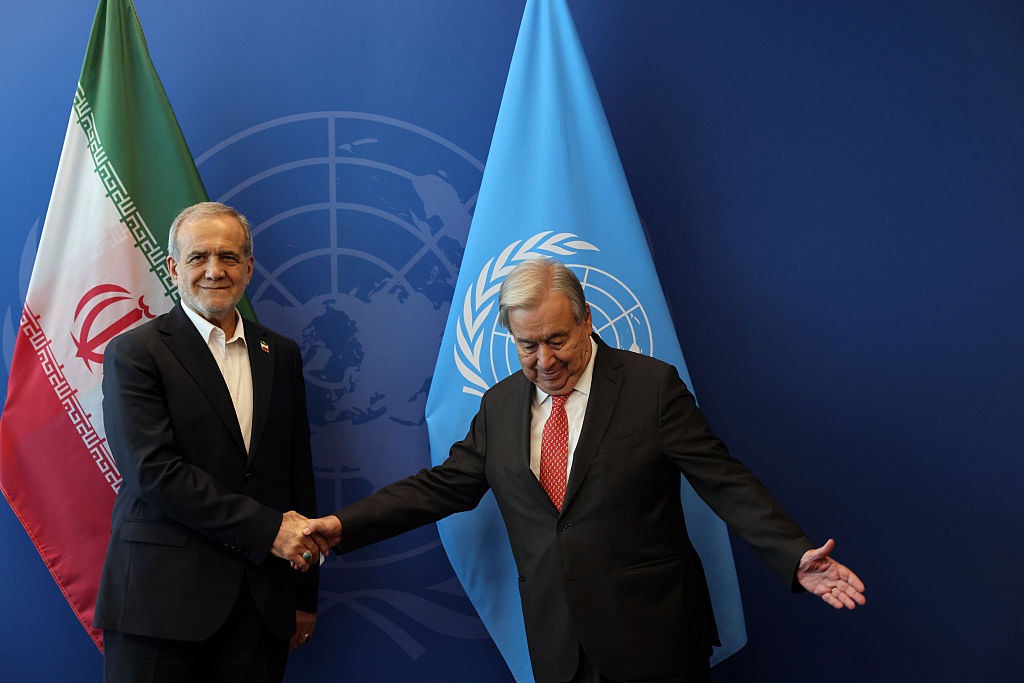
Against this backdrop, the reactions from European capitals and from the United Nations were swift — and revealing. Within hours, United Nations Secretary-General António Guterres, issued a statement whose opening line set the tone: "I condemn today's military escalation in the Middle East." He continued with the formulation that has become the UN's signature posture in moments of crisis:
"The use of force by the United States and Israel against Iran, and the subsequent retaliation by Iran across the region, undermine international peace and security." The statement concluded with the point that allows the organization to appear principled while remaining inert: "All Member States must respect their obligations under international law, including the Charter of the United Nations."
The language was calibrated, procedural, formulaic. What it avoided was any sustained engagement with the ideological zealotry of the regime, or with the decades of destabilizing conduct that had preceded the strikes. The UN Security Council convened an emergency session. Russia and China denounced the operation as a violation of Iranian sovereignty. Several European governments echoed concerns about precedent and pressed for an immediate cessation of hostilities and a return to talk, talk, talk.
France, Germany and the United Kingdom, while condemning Tehran's attacks on neighboring states, quickly moved to place distance between themselves and the military operation. Their joint statement used a phrase that expresses Europe's enduring instinct: "We call for a resumption of negotiations and urge the Iranian leadership to seek a negotiated solution."
French President Emmanuel Macron, speaking publicly and on social media, intoned:
"The current escalation is dangerous for everyone. It must stop... The Iranian regime must understand that it now has no other option but to engage in good-faith negotiations to end its nuclear and ballistic missile programs, as well as its actions to destabilize the region."
The British and German positions followed the same patronizing platitudes: insistence that they were not participants in the strike, condemnation of Iran's retaliatory salvos across the Gulf, and an immediate pivot back to negotiation as the legitimizing grammar of European diplomacy. On X, the cadence was consistent across ministers and ministries: defense of "international law," fear of regional spillover, and repeated emphasis on safeguarding civilians and maritime corridors.
These reactions -- never spontaneous improvisations -- reflect a dismissive European posture that has been consistent for years: a preference for managed "containment" over the inconvenience of actually having to address a problem head-on, and for diplomatic processes over taking decisive outcomes. The European Union's institutional voice crystallized in the official statement by its foreign policy representative, Kaja Kallas, which should be read as an explicit, doctrinal template:
"We call for maximum restraint, protection of civilians and full respect of international law, including the principles of the United Nations Charter, and international humanitarian law."
The statement then shifted to regional blame allocation -- in unusually direct language for Brussels: "Iran's attacks and violation of sovereignty of a number of countries in the region are inexcusable. Iran must refrain from indiscriminate military strikes." The same document then reaffirmed the EU's deepest instinct — to privilege "diplomacy" as the preferred policy:
"The European Union will continue to contribute to all diplomatic efforts to reduce tensions and to bring about a lasting solution to prevent Iran from acquiring a nuclear weapon."
Even as Iranian missiles and drones targeted states hosting NATO forces, European institutions stressed concerns about the disruption of energy markets and the safety of maritime routes — and warned that "the disruption of critical waterways, like the Strait of Hormuz, must be avoided." The only goal, apparently, was "stability" -- no matter how morally flatulent -- but evidently preferable to actually having to do anything apart from lecturing everyone.
The UN's institutional reflex seems to follow an established pattern. For decades, UN General Assembly resolutions have disproportionately targeted Israel, often in numbers that dwarf condemnations of far more venomous regimes. The UN Human Rights Council has devoted more agenda items to maligning Israeli policies than to the far worse abuses in authoritarian states. Usually, in crises from Syria's civil war to Iran's crackdowns on dissidents, UN language is diluted through negotiated compromise and voting-bloc discipline. The present crisis unfolded within that same architecture: the immediate emphasis from UN podiums was to advocate containing escalation and restoring "international peace and security," even when the subject at hand was the need to dismantle a regime that defined itself through perpetual confrontation with the West.
The Islamic Republic of Iran's record is neither ambiguous nor marginal. Since the 1979 Islamic Revolution, its leadership has articulated a venomous ideological hostility toward Western liberalism and democracy by portraying them as decadent and spiritually corrosive — not merely as competitors, but as enemies of the revolutionary project. Under Ayatollah Ali Khamenei, this worldview hardened into a state doctrine: "exporting the revolution," sacralizing "resistance," and normalizing proxy warfare.
Hezbollah in Lebanon, the Bashar Assad regime in Syria, militias in Iraq, and the Houthis in Yemen have not been peripheral instruments but pillars of a regional strategy designed to encircle Israel, bleed American influence, and fracture sovereign states through permanent low-intensity conflict.
At home, repressing women, persecuting minorities, and crushing dissent are not episodic excesses; they are mechanisms of regime survival. Abroad, terrorism has been used as a tool of coercion -- too often with the affected nations permitting success. Iran's nuclear weapons program advanced under the cover of perpetual negotiations, while its ballistic missile development and production proceeded in parallel. The regime's hostility was embedded in doctrine.
Yet European statements rarely invoke Iran's record with any moral clarity. Instead, they emphasize fears of precedent — the risk that regime change through force might normalize unilateral intervention. The concern is not trivial, but it becomes analytically incomplete when divorced from context. For decades, Iran has eroded the very norms now cited in its defense: proxies have crossed borders as policy; ballistic missiles have threatened multiple countries; nuclear ambitions challenge the non-proliferation order; hostage diplomacy and extraterritorial intimidation became routine. The insistence on procedural etiquette in the moment of crisis reveals Europe's long investment in managing, rather than resolving, the threat from Iran.
Economic interdependence is not incidental. Several European states have maintained commercial ties with Iran even under sanctions regimes. Unworkable strategies for energy diversification intensified Europe's anxiety about Gulf stability.
Domestic political considerations — including the management of migration flows and relations with Arab states — have further complicated open endorsement of decisive military action. The result is a posture of distance from Washington's and Jerusalem's operation, emphasizing autonomy while avoiding direct confrontation — and returning, almost automatically, to the language of negotiation as the moral alibi of strategic caution.
At the UN, the broader geopolitical alignment was equally telling. Russia condemned the strikes in the most categorical terms, aligning rhetorically with Iran. China issued familiar calls for sovereignty and restraint, seeking to preserve a posture of order while benefiting from being off the West's radar for a bit. Within this constellation, European representatives positioned themselves as guardians of multilateralism. The cumulative effect is a chorus of caution directed more forcefully at the actors who are dismantling Iran's regime -- Israel and the US -- rather than at the regime's long record of destabilization — a pattern that has become so normalized that it is often mistaken for moral sophistication.
These moral gymnastics are not unprecedented. During the Cold War, debates at the UN reflected blocs more than principles. Authoritarian regimes benefited from solidarities rooted in ideology, transactional alliances, or sheer voting arithmetic. The contemporary landscape differs in form but not entirely in substance. Coalitions within the UN General Assembly, including states with limited or no democratic credentials, shape the tone and content of resolutions. Within that environment, Israel has long been a focal target of attack, a convenient proxy through which regimes and blocs rehearse moral posturing while deflecting attention from the abuses they inflict at home.
The deeper analytical question concerns the concept of "stability." European diplomacy has often equated stability with the absence of open war, even if that equilibrium rests on coercion, intimidation, and the slow metastasis of threat. The Israeli-American operation in Iran has shattered that equilibrium. For those invested in negotiated containment, the US-Israeli response appears destabilizing. For others, it represents the removal of a huge source of instability — the elimination of a regime whose worldview treats conflict not as a failure of policy but as the essence of policy. The divergence reflects differing premises about how order should be maintained and what price is acceptable for maintaining it.
European governments are probably now recalibrating policies shaped by decades of appeasing Iran. The UN faces renewed scrutiny over the consistency of its posture toward authoritarian regimes versus democratic states. The decapitation of Iran's theocratic leadership is not merely a regional episode; it is a stress test for multilateral institutions that have often confused procedural language with strategic seriousness.
Whether Europe and the UN will reinterpret this moment as a correction of what needs to be done to a destabilizing presence, or whether they persist in framing malignancy primarily as a procedural violation, remains uncertain. What is already visible is that the reflex of "caution" — so immediate, so uniform, so instinctive — has exposed the enduring tension between legal niceties and the urgent need to act.
Pierre Rehov, who holds a law degree from Paris-Assas, is a French reporter, novelist and documentary filmmaker. He is the author of six novels, including "Beyond Red Lines", "The Third Testament" and "Red Eden", translated from French. His latest essay on the aftermath of the October 7 massacre " 7 octobre - La riposte " became a bestseller in France. As a filmmaker, he has produced and directed 17 documentaries, many photographed at high risk in Middle Eastern war zones, and focusing on terrorism, media bias, and the persecution of Christians. His latest documentary, "Pogrom(s)" highlights the context of ancient Jew hatred within Muslim civilization as the main force behind the October 7 massacre.
 Naomi Be