








One of the most persistent and dangerous misreadings of the confrontation with Iran is the stubborn confusion between a brutal ideological regime and the people it has oppressed for nearly five decades.
This is no accident. Tehran has long understood that its best defense is not its missiles or its proxies, but its control of the narrative. In Western capitals, where moral clarity too often yields to political expediency, this confusion produces a strange paralysis: the fear of "hurting the Iranian people" serves as an excuse to tolerate a regime that has hurt them far more cruelly and systematically than any outside power ever has.
Since the 1979 Islamic Revolution, the Islamic Republic of Iran has ruled through repression, ideological indoctrination, and outbursts of extreme violence, such as the mass executions of 1988. After a fatwa issued by the Islamic Republic's Supreme Leader Ayatollah Ruhollah Khomeini, "death commissions" conducted summary trials — often lasting just minutes — before executing political prisoners. Estimates of the death toll vary. International human rights organizations and former regime insiders speak of several thousand (commonly between 2,800 and 5,000), while opposition groups put the figure as high as 30,000. Many of the victims were young activists, students, or supporters of opposition movements, including the Mujahedin-e Khalq. Their bodies were dumped in mass graves, and their families were left without answers.
To this day, the regime denies the full scale of these mass murders, even as some of those directly involved later rose to the highest offices of state. Rather than being "just" an aberration, this slaughter of its own citizens was a blueprint for how the system deals with internal dissent.
The pattern has not only continued, it has intensified. In November 2019, protests triggered by a sudden fuel price hike were met with lethal force under a near-total information blackout. According to a Reuters investigation citing Iranian Interior Ministry sources, security forces killed about 1,500 people in a matter of days. Thousands more were arrested, tortured, or simply disappeared. In 2025, at least 1,639 Iranian citizens were executed. This year, just in the first three months, 657 were executed, and at least 1,600 more are scheduled to be executed.
In September 2022, the death in custody of 22-year-old Mahsa Amini — arrested and evidently tortured by the "morality police" for allegedly violating the rule requiring that a headscarf cover women's hair — sparked another nationwide uprising. Once again, the regime responded with live ammunition. Human rights groups documented more than 500 killed, including dozens of children, and over 20,000 arrests. Again, these are not isolated episodes; they form part of a sustained internal war waged by the regime against large segments of its own population.
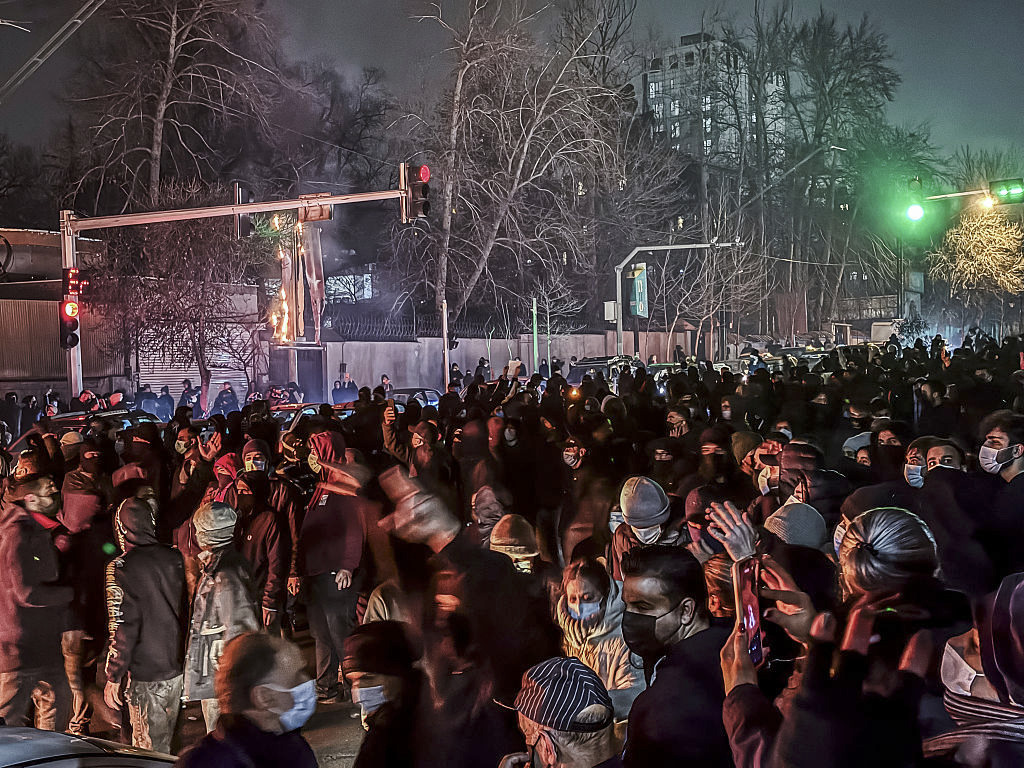
In January 2026, the Iranian regime launched one of the deadliest crackdowns in its modern history, with protests met by a "shoot-to-kill" order "by any means necessary," issued by the late Supreme Leader Ali Khamenei on January 9. Estimates vary, but internal health data and independent investigations suggest that between 30,000 and 36,500 protesters were killed in just two days, and tens of thousands more wounded or arrested in January alone.
Security forces — including the Islamic Revolutionary Guard Corps and Basij — fired live ammunition at unarmed civilians, often targeting the head and torso, while a nationwide internet blackout was imposed to conceal the scale of the killings.
Mass burials, disappearance of bodies, and intimidation of medical staff were reported, confirming a systematic effort not only to crush dissent, but to erase the evidence of mass murder.
Much Western commentary nevertheless still frames any pressure on Iran as a danger primarily to "the Iranian people," as if those people were not already living under daily threat from their own rulers. In what clearly appears to be journalistic malpractice, Iranians who risk their lives chanting "Death to the dictator" in the streets of Tehran, Shiraz or Isfahan are portrayed abroad as passive victims of foreign aggression rather than as active agents of resistance against a system that fears them more than it fears any external enemy.
This brings us to US President Donald J. Trump's much-discussed statement that "Help is on its way." Dismissed by critics as empty rhetoric, the remark was never a promise of instant military spectacle. Geopolitics does not unfold like a television drama. What matters is the underlying strategy: combining economic pressure, targeted military actions against regime assets, and psychologically undermining the regime's aura of invincibility.
The idea that Iran's beleaguered people will suddenly, somehow, with no weapons whatsoever, magically rise up and take back their country from a regime armed to the teeth and with a rich record of mass-murder is beyond delusional. The result would be equivalent to the Warsaw Ghetto, whose last few hundred inhabitants tried to take on the German army, or the US resistance at the Alamo: heroic but predictably headed to defeat.
Some of the Gulf countries, such as Saudi Arabia, might prefer Iran to remain as any kind of dictatorship rather than a democracy, in order not to give their own citizens fancy ideas about freer forms of government. Such a sham solution, however, would be seen as a monumental betrayal of "Help is on its way" -- and undoubtedly be used to harm Republicans in the upcoming US midterm elections.
The worst result would be for the Trump Administration to throw Iran's desperate citizens from a ruthless clerical frying pan into a ruthless militaristic fire. The brutality would be the same, just secular instead of religious -- a predatory system whose power rests on projecting strength at home while playing the victim abroad.
Tehran's response follows a familiar playbook — deliberately embedding military assets among civilians (a war crime), then immediately weaponizing any civilian casualties for international outrage. This is a form of propaganda warfare, also used by terrorist groups such as Hamas and Hezbollah, for which the media and international community fall every time. If the West treats the Iranian regime and the Iranian people as one and the same, the tactic succeeds. If these false equivalences are exposed, the narrative collapses.
The Iranian people have shown repeatedly that they do not identify with the rulers who claim to speak for them. This is a population held hostage, not a nation united behind its regime.
No force can deliver sustainable regime change on its own. Real transformation must ultimately come from within – but with generous outside assistance. External pressure can weaken the system economically and create openings, but the Iranians – in practical terms – cannot be expected bravely to commit collective suicide confronting their armed oppressors if the West is too cowardly to help. That moment nearly arrived before, in 2009, 2019, and 2022, only to be crushed by both the regime's brutal efficiency and even more by West's callous dismissal of the protesters and instead, cozying up to Iran. The difference today is that the regime no longer enjoys uncontested domination.
Western critics who call a military approach – even one that has offered the regime many off-ramps – reckless should answer a simple question: what is the alternative? More rounds of negotiations with a regime that has violated every agreement it ever signed? Passive acceptance while thousands more Iranians are jailed, tortured, or executed? Moral grandstanding without consequences? That is not a policy — it is abdication.
The Iranian regime is not just another geopolitical player. It is a predatory system that devours its own people while exporting instability across the region. "Iran is a 47-year-old war crime," stated Senator John Fetterman (D-PA). The Trump Administration needs to "Make Iran Great Again," to liberate it. Opposing the regime is not an attack on Iran; it is finally winning a half-century war that its rulers have imposed on its own people, its neighbors, and the West. Trump is not "hurting" Iran. He is on the verge of freeing it. The greatest misfortune for the Iranian people and the Free World would be if he now decides to stop.
The real Iran — the one that protests, resists, and yearns for normal life — has been the victim of a war its leaders have waged on it for decades. The real tragedy would be to prolong any part of it. For too long, the West has looked away while the regime, without restraint, has massacred its own people, attacked and destabilized its neighbors, and killed nearly a thousand Americans, and attempted to assassinate Trump and other US officials.
Until this strategic distinction is understood, debates about Iran will remain trapped in the same sterile cycle of confusion and fear — the very environment in which the West has enabled the regime not only to thrive, but to prevail.
Pierre Rehov, who holds a law degree from Paris-Assas, is a French reporter, novelist and documentary filmmaker. He is the author of six novels, including "Beyond Red Lines", "The Third Testament" and "Red Eden", translated from French. His latest essay on the aftermath of the October 7 massacre " 7 octobre - La riposte " became a bestseller in France. As a filmmaker, he has produced and directed 17 documentaries, many photographed at high risk in Middle Eastern war zones, and focusing on terrorism, media bias, and the persecution of Christians. His latest documentary, "Pogrom(s)" highlights the context of ancient Jew hatred within Muslim civilization as the main force behind the October 7 massacre.
 Neal
Neal