








A recurring illusion in American foreign policy is that removing the most visible layer of oppression in a brutal regime, as in Haiti, Afghanistan, Libya and Iraq, is enough to claim victory. It is politically convenient and media-friendly, but in the instance of the Islamic Republic of Iran, looks to be strategically disastrous.
Today, as pressure mounts on Iran and US President Donald J. Trump signals a willingness to seize a perceived opening — most recently through a 15-day ceasefire — the same illusion is once again taking shape. The issue is no longer whether the regime in Tehran is under strain — it clearly is — but whether Washington is preparing, consciously or not, to replace a brutal clerical dictatorship with a brutal military one.
Iran has two armies. One is the "Artesh," the regular national army that pre-dates the 1979 founding of the Islamic Republic. It presents itself as a standard professional military, and not as an ideological organization. The Artesh operates under strict government oversight, with embedded supervision that limits its autonomy. It is disciplined and not independent.
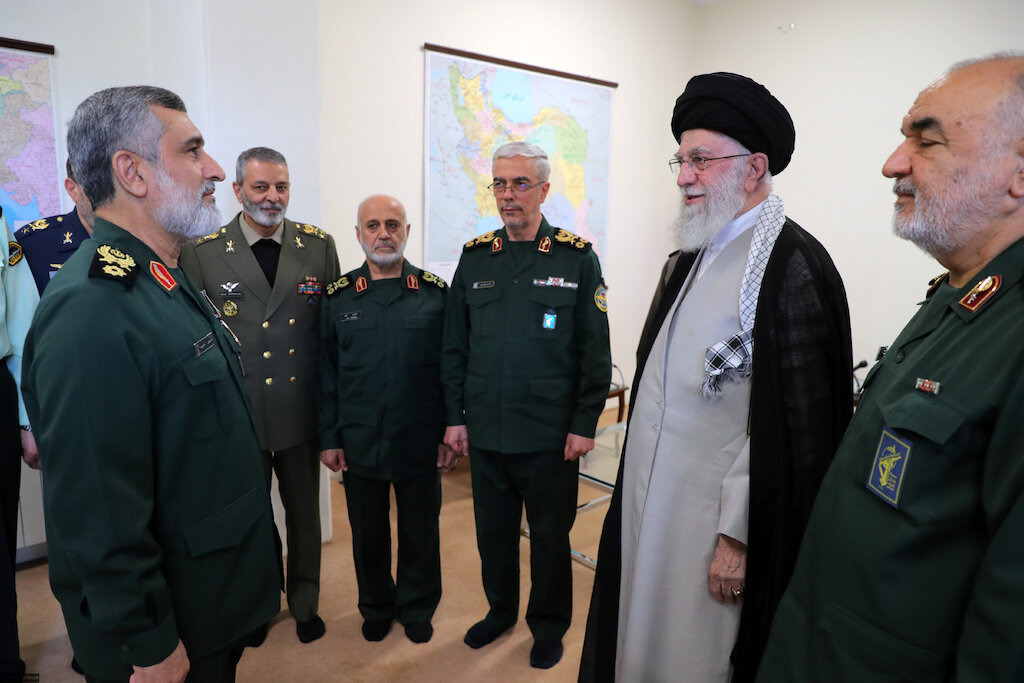
Iran's second army is the country's true center of power: the Islamic Revolutionary Guard Corps (IRGC), a parallel military created after the 1979 Islamic Revolution as a counterweight to the Artesh, which had previously been commanded by the Shah. The IRGC's purpose is to defend the revolution itself. It also controls a vast business empire that accounts for a large part of Iran's economy. It is structured with its own ground, naval and aerospace forces, and promotions depend as much on loyalty as competence.
The Basij, an auxiliary force of the IRGC, is a vast volunteer paramilitary network embedded throughout society, capable of suppressing civil dissent or protest at scale. The Basij exists to crush protests, hunt dissidents, and ensure the regime's survival through fear and repression.
The divide is clear: the IRGC and Basij form the fanatical core, while the Artesh represents a more professional but tightly controlled layer. Neither has shown the slightest interest in any kind of liberalizing transformation.
The idea that a military structure could serve as a "moderate" transitional governing authority in Iran seems to rest on the fragile assumption that professionalism leads to moderation. Regional history says otherwise. From Egypt to Pakistan, militaries that stepped in to "restore order" entrenched their own authoritarian rule. Iran offers no reason to believe it would be different.
The former Shah's army, the Artesh, relegated to patrolling Iran's borders, may lack the theological zeal of the IRGC, but it has shown no commitment to dismantling the structures of repression.
Trump, for all his instinctive grasp of power dynamics, appears tempted by a shortcut — a rapid strategic win framed as geopolitical success. The reasoning is simple: weaken Iran's regime, fracture its internal balance, and allow a more pragmatic governing authority to emerge. The plan fits a transactional worldview, but the Iranian leadership, even at levels that might seem less ideological, is nevertheless shaped by the autocracy of the past 47 years.
The Iranian people, by contrast -- from the Green Movement in 2009 to the uprisings of 2017 and 2019, the protests after the death of Mahsa Amini in 2022, and even more powerfully in January 2026 -- have demonstrated not just a desire for reform, but a rejection of the Islamist regime itself. Women defying compulsory veiling, students confronting armed security forces, workers striking across sectors -- this is not a population asking for adjustments but a society demanding a complete break.
Any kind of real, long-term peace requires the total end of Iran's regime, not its adaptation. The Islamic Republic unfortunately cannot be reformed, any more than could the Afghan Taliban. The regime's legitimacy is rooted in a doctrine built on confrontation — both with the West and with its own population. Preserving any part of this ruling structure, whether through the IRGC or segments of the military, risks perpetuating the same destabilizing brutality.
Preventing Iran from acquiring nuclear weapons, while essential, addresses only one dimension of the threat. A non-nuclear authoritarian Iran remains capable of repression at home and destabilization abroad. Removing the threat of nuclear bombs does not create peace; it merely limits the scale of the potential catastrophe.
What makes the current moment so dangerous is that, if no credible alternative to the mullahs takes power -- one that is rooted in popular legitimacy -- the vacuum will not remain empty. It will be filled by the most organized, armed actors available — the IRGC and security apparatus -- the same forces that slaughtered more than 30,000 of their own citizens on the streets in just two days.
The pattern is not new. Remove the ideological leadership in Iran, and the military leadership takes over – leading most likely to an even more unsparing grip on the unarmed Iranian people – and even more difficult to combat. The faces change, but the repression, torture and hangings stay the same.
We have seen this devastation before – in Haiti, Afghanistan, Libya and Iraq – not to mention Iran itself starting in 1979. The Iranian regime's militaries are just as determined and deeply anchored. They are not interested in being reshaped. For Trump to declare victory based on a ceasefire, partial concessions, or the emergence of supposedly "pragmatic" actors would be catastrophically naïve.
The real danger for Washington is not failure, but the illusion of success. A deal signed, a regime weakened, a new brutal authority emerging — presented as a "solution." It is no different from British Prime Minister Neville Chamberlain's hapless 1938 declaration of "peace for our time." Then, the realization that, fundamentally, nothing has changed. Trump is right to confront Iran's regime, but the urgency to bring an end to the conflict appears to be heading toward an Iranian regime just as repressive as, or worse than, the current one.
Whatever happened to Trump's "Help is on its way"?
To say that economic collapse will make it easier for the Iranians to change their government if they wish might sound good, but it is fantasyland. They have no weapons.
The Iranian people are not asking for a redistribution of brutality. They are asking for a new system entirely.
Will Washington recognize this distinction, or will Trump's legacy, instead of peace, be -- in Syria as well -- that he simply exchanged one tyranny for another?
Pierre Rehov, who holds a law degree from Paris-Assas, is a French reporter, novelist and documentary filmmaker. He is the author of six novels, including "Beyond Red Lines", "The Third Testament" and "Red Eden", translated from French. His latest essay on the aftermath of the October 7 massacre " 7 octobre - La riposte " became a bestseller in France. As a filmmaker, he has produced and directed 17 documentaries, many photographed at high risk in Middle Eastern war zones, and focusing on terrorism, media bias, and the persecution of Christians. His latest documentary, "Pogrom(s)" highlights the context of ancient Jew hatred within Muslim civilization as the main force behind the October 7 massacre.
 Rob Porter