








In Germany, is support for its Jewish minority and the State of Israel as government policy and "reasons of state" -- known as Staatsräson, or, more vaguely, the "core national interest" -- still prioritized, or has Germany begun to renege on its hitherto moral commitments?
According to Australian economist Gordon de Brouwer:
"The national interest has three components -- security, prosperity, and social wellbeing—and they should all be part of framing the problem and solutions. Security underpins prosperity, prosperity creates power and pays for security, and a well-functioning society reduces economic and security risks.... a country should identify the risks to the national interest broadly defined and look for practical ways to mitigate those risks."
In Germany, the term Staatsräson has come to be used for the state's obligations towards its Jewish community and the state of Israel, following the Third Reich's "final solution" during WWII – the murder of more than six million Jews – in its quest to eliminate all the Jews of Europe.
By the end of the war, social normalcy between Christians and the country's remaining Jews no longer existed to any significant degree in Germany. A cultural and moral vacuum ensued.
The postwar West German government nobly acknowledged an overriding obligation to ensure the revival of its state to ensure that it would never undergo such a mass moral failure. It initiated ways of restoring the fractured social compact between Germany's citizens and the state. Political action was oriented toward benefiting all communities – not for a war machine as in the past, but for social harmony and cohesion.
For a time in Germany, Staatsräson was considered an obligation to the country's small Jewish community, which has grown from 15,000 members in 1950 to roughly 100,000, out of a current population of 84 million, or 0.12%. The state had positioned its "core national interest" toward the protection and welfare of the few Jews under its watch, including as well their ancestral homeland, Israel. By the early 2000s, this Staatsräson came to be spoken of as a primary component of foreign policy -- one which considered support for Israel as unalterably connected to Germany's reason for existence.
The Staatsräson policy, however -- perhaps inexplicably, perhaps not -- was never codified into enforceable law. The policy does not appear in Germany's constitution, nor in any legislation. Consequently, Germany's support for Israel, conceivably based on shame rather than on moral conviction, can still be debated.
On March 18, 2008, Germany's then Chancellor Angela Merkel doubled down on the importance of the Staatsräson for the security of Israel, saying:
"This historic responsibility of Germany is part of my country's Staatsräson. That means, for me as German Chancellor, the security of Israel is never negotiable. And if that is the case, then these must not remain empty words in the hour of truth."
Merkel forthrightly acknowledged Germany's "perpetual responsibility for the moral catastrophe of German history" and pledged the country's support for both Israel and Jews.
In 2025, amidst the Hamas-Israel war, Germany's President Frank-Walter Steinmeier hosted Israel's President Isaac Herzog on the 60th anniversary of diplomatic relations between the countries. In line with Merkel's approach, Steinmeier graciously acknowledged that establishing relations in 1965 was "a gift that we Germans could not have expected after the horrors of the Second World War."
When Germany considers its national interests, Israel's security should surely be among its highest priorities. Apart from historic factors, Israel is the sole democracy in the region and the lone upholder of the values of Western civilization with which Germany, one assumes, identifies. Israel is a primary source of intelligence information for the continent's security agencies, which is important given the mass migration of Muslims into Europe, including Germany.
Similarly, when taking into account its past conduct, Germany's social well-being would be well-served by adhering to its Staatsräson policy towards Israel. Notwithstanding Germany's solid aid to Israel during its early years when the nation faced grave threats, such as during period preceding the Six-Day (1967), the situation in recent times appears to have altered.
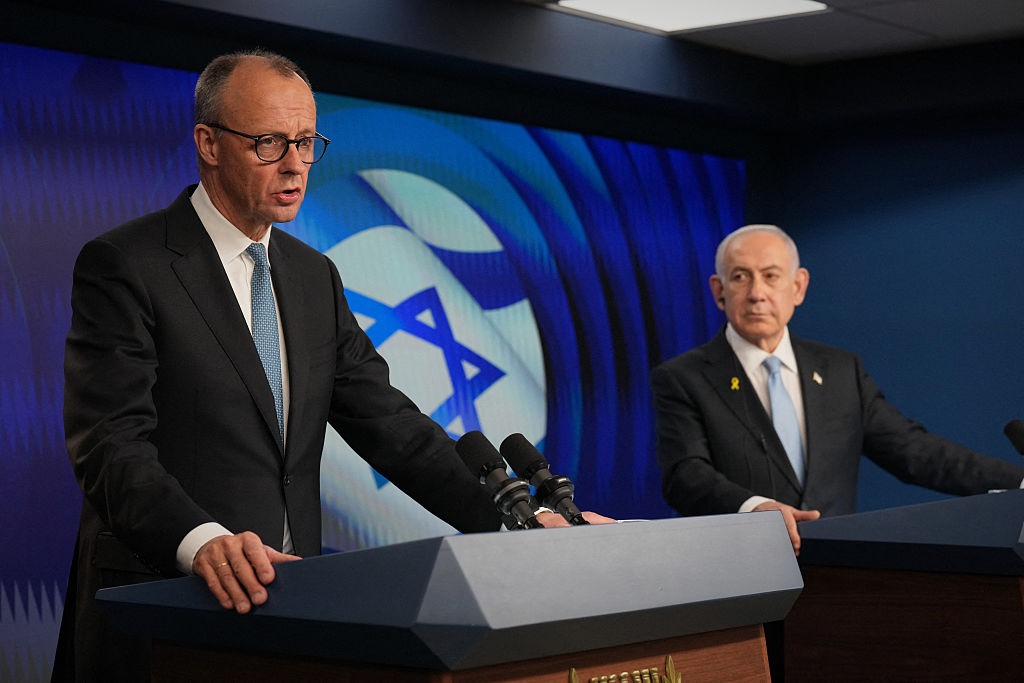
In May 2025, following a meeting between Herzog and German Chancellor Friedrich Merz, Al-Monitor reported:
"While Berlin, now led by conservative Chancellor Friedrich Merz, says support for Israel remains a core principle, relations have come under strain in recent years, over the Gaza war and other issues."
Since Hamas's invasion of Israel on October 7, 2023, the relationship between Germany and Israel has become strained by injudicious claims against the latter of "disproportionate" responses, allegedly resulting in unnecessary civilian deaths.
Ignoring facts on the ground, the complexity of the situation, and Israel's moral obligation to its residents, Merz castigated Israel by saying it "must also remain a country that lives up to its humanitarian obligations, especially as this terrible war is raging in the Gaza Strip."
"What the Israeli army is doing in the Gaza Strip, I no longer understand the goal... To harm the civilian population in such a way... can no longer be justified as a fight against terrorism," Merz said in a May 2025 televised interview. Perhaps if German children had been beheaded or burned alive in their beds on October 7, 2023, he would have a clearer understanding of Israel's "goal" in the Gaza Strip.
At the height of the war in Gaza, Merz, adding insult to injury, imposed a ban on supplying of weapons to Israel, despite contractual obligations and his prior voiced "non-negotiable" support. As Israel's second most important foreign supplier of munitions, Germany's decision had serious implications for Israel.
Germany also did not intervene in Israel's legal defense against meritless charges filed by South Africa at the International Court of Justice. Germany also refused to provide a guarantee that Israeli Prime Minister Benjamin Netanyahu would not be arrested under an International Criminal Court warrant, should he happen to visit.
Leftism in Germany is alive and well, which could augur poorly for its political and moral commitment to Staatsräson. According to the Maastricht Diplomat:
"For example, the far-left [German] party Die Linke's portrays Israel as a colonial oppressor and equates it with Nazi Germany... This directly contradicts the 'Staatsräson'... Moreover, several authors point out a gradual decline of this feeling of responsibility towards Israel..."
As "anti-Zionism" – the politically correct term for hating Jews -- has become popular, the future for Staatsräson begins to look even more fragile. The question then is, will Germany honor Angela Merkel's promise of unconditional support for Israel as it is fighting to preserve Western civilization against totalitarian barbarism, or will it merely pay lip-service? Specifically, will Germany stand alongside Israel, supporting it in the European Union and in forums such as the United Nations and others? Perhaps even more importantly, will Germany sell Israel the weapons and ammunition it requires at times of existential danger? Indications are that the historic promise of unconditional support is withering fast.
Israel's present war against Iran and its proxies may not be the last it fights, given the surrounding hordes of jihadists keen to annihilate all Jews and wipe out Israel. For the foreseeable future, Israel will be forced to rely on allies such as the US for some of its military supplies until it becomes self-sufficient.
In the interim, with a global red-green alliance and Germany's rapidly growing Muslim population, its supportive policy towards Israel appears to have become even more tenuous.
According to the Maastricht Diplomat:
"The memory of the Holocaust continues to serve as a moral compass for and key pillar of German Identity. However, this is changing as old generations are passing away, antisemitic attacks rise and there is an increased pragmatism in German foreign policy."
Is "pragmatism," then, the new term in Germany for condoning antisemitism?
Nils A. Haug is an author and columnist. A lawyer by profession, he is member of the International Bar Association, the National Association of Scholars, the Academy of Philosophy and Letters. Among degrees in Philosophy, English Literature, and Law, Dr. Haug holds a M.A.in Jewish Studies (cum laude) and a Ph.D. in Apologetical Theology. He is author of 'Politics, Law, and Disorder in the Garden of Eden – the Quest for Identity'; and 'Enemies of the Innocent – Life, Truth, and Meaning in a Dark Age.' His work has been published by First Things Journal, The American Mind, Quadrant, Minding the Campus, Gatestone Institute, National Association of Scholars, Jewish Journal, James Wilson Institute (Anchoring Truths), Jewish News Syndicate, Tribune Juive, Document Danmark, Zwiedzaj Polske, Schlaglicht Israel, and others.
Gerhard Werner Schlicke is a retired Lecturer at the University of Applied Sciences in Saxony, and columnist for the German-language news site, Israel-Nachrichten.
 Harvey Radnor