








"The Taiwan question is the most important issue in China-U.S. relations," Xi Jinping told President Donald Trump during their summit this month, according to Foreign Ministry spokesperson Mao Ning. "If it is handled properly, the bilateral relationship will enjoy overall stability. Otherwise, the two countries will have clashes and even conflicts, putting the entire relationship in great jeopardy."
"The Taiwan Question," according to China's embassy in Washington, is the first of "the four red lines" in China-U.S. relations that "must not be challenged."
The People's Republic of China, however, is bluffing.
As an initial matter, China's regime has no red lines and no principles. It moves its "lines" as a result of changing perceptions of its own bargaining position. Furthermore, throughout the history of the People's Republic the country's external policies have been tightly bound to internal political intrigue and have changed accordingly. At the moment, Xi's favored form of diplomacy is intimidation, so he tries to make it appear that he will never change his positions.
Nonetheless, for Xi, everything is ultimately negotiable, including Taiwan.
Xi has to negotiate. China's military is not now able to carry through on his threats to use force to annex Taiwan. His intensifying purges of generals and admirals have left no operational officers on the Communist Party's Central Military Commission, the top of the military. Close coordination is necessary to launch a complex air-land-sea invasion of the main island of Taiwan.
Moreover, to invade, Xi would have to give some flag officer almost complete control over the People's Liberation Army, making that figure the most powerful in China. That is almost certainly not something he is willing to do at this moment.
Furthermore, it is becoming evident that China's senior officers, for various reasons, do not want to undertake such a risky operation, which is why Xi often tells them, "Dare to fight."
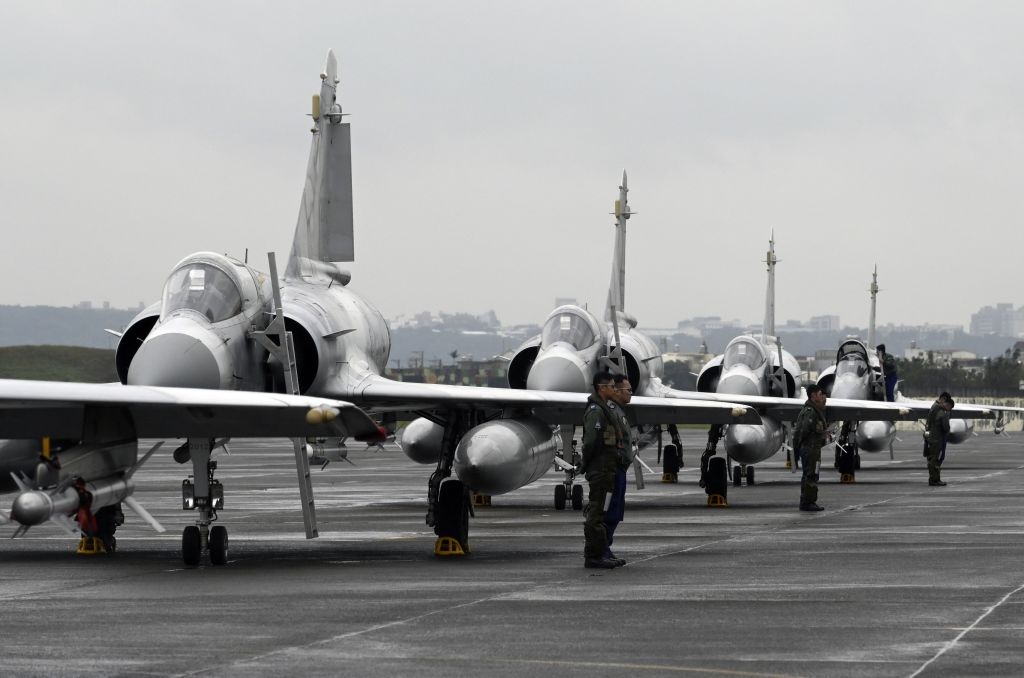
The inability of the Chinese military gives the U.S. the cost-free opportunity to arm Taiwan.
In December, the Trump administration approved a $11.1 billion package of weapons, the largest American arms package for Taiwan ever.
Yet Trump delivered a big gift to China by saying that a pending $14 billion sale is a "very good negotiating chip" for the U.S., a comment made to Fox News anchor Bret Baier in an interview aired after the summit. "I'm holding that in abeyance, and it depends on China," he said.
Taiwan, however, is not a "bargaining chip." Taiwan is absolutely critical to American security:
- The island has a "Silicon Shield": One of its companies, Taiwan Semiconductor Manufacturing Co., makes about 92% of the world's most sophisticated microchips.
- Taiwan prevents China's navy and air force from surging into the Pacific and threatening America close to home.
- Since the 1800s, Washington has drawn its western defense perimeter off the coast of East Asia, and Taiwan sits at the center of that line, where the South China Sea meets the East China Sea. Taiwan guards the approaches to two American treaty allies, Japan and the Philippines.
- After the catastrophic withdrawal from Afghanistan, Taiwan has become a key test of American credibility and resolve. Ceding the island would undoubtedly embolden a territorially hungry Beijing.
- Finally, the cause of democracy would suffer an enormous blow if totalitarian China were to take over democratic Taiwan.
"A failure to arm Taiwan will not only increase China's temptation to attack but also undermine U.S. strategic credibility in Tokyo, Seoul, and Manila, whose cooperation is essential for America to deter China," Richard Fisher of the International Assessment and Strategy Center told Gatestone. "Through his first term and into his second, Trump has exceeded the quality and quantity of weapons his predecessors sold to Taiwan. Not selling weapons will show Xi Jinping that America can be cowed by threats, and that will in turn help unravel the U.S. alliance structure in Asia."
In addition, Taiwan is the best counterargument to China in the information war that the CCP is waging against democracy. "The Communist Party cannot accept the optics of a thriving, democratic Taiwan on full display for the people of the mainland, oppressed, organ-harvested, and social credit-scored," Blaine Holt, a retired U.S. Air Force general and now China watcher, told this publication.
Defending Taiwan, therefore, is defending America.
The decisions on arms packages, most immediately, will show whether Trump is afraid of Xi Jinping. If the American president cannot do something in America's direct interest because it would anger China, Trump will implicitly admit that Beijing owns the White House.
Finally, a failure to sell arms would look like a violation of the Taiwan Relations Act of 1979, which requires the United States to, among other things, "provide Taiwan with arms of a defensive character."
Will Trump approve the $14 billion arms sale? After the summit, Trump adopted China's false framing of the Taiwan issue. "They have somebody there now that wants to go independent," he said to Baier, referring to Taiwan President Lai Ching-te.
Taiwan, however, already is independent. It is a state with all the attributes of sovereignty listed in the Montevideo Convention of 1933. Taiwan, after all, is the Republic of China, totally separate and apart from the People's Republic of China.
Taiwan, despite what Trump said after the summit, is not the party trying to change the status quo. In fact, the People's Republic has never exercised any control over Taiwan, and no Chinese regime has ever held indisputable sovereignty to the island.
There is, however, one thing we can agree on with Xi: America needs to handle the Taiwan issue "properly": It is time to tell him -- in public if necessary -- that Taiwan is none of his business.
Gordon G. Chang is the author of Plan Red: China's Project to Destroy America, a Gatestone Institute distinguished senior fellow, and a member of its Advisory Board.
 Jagdish N Singh