








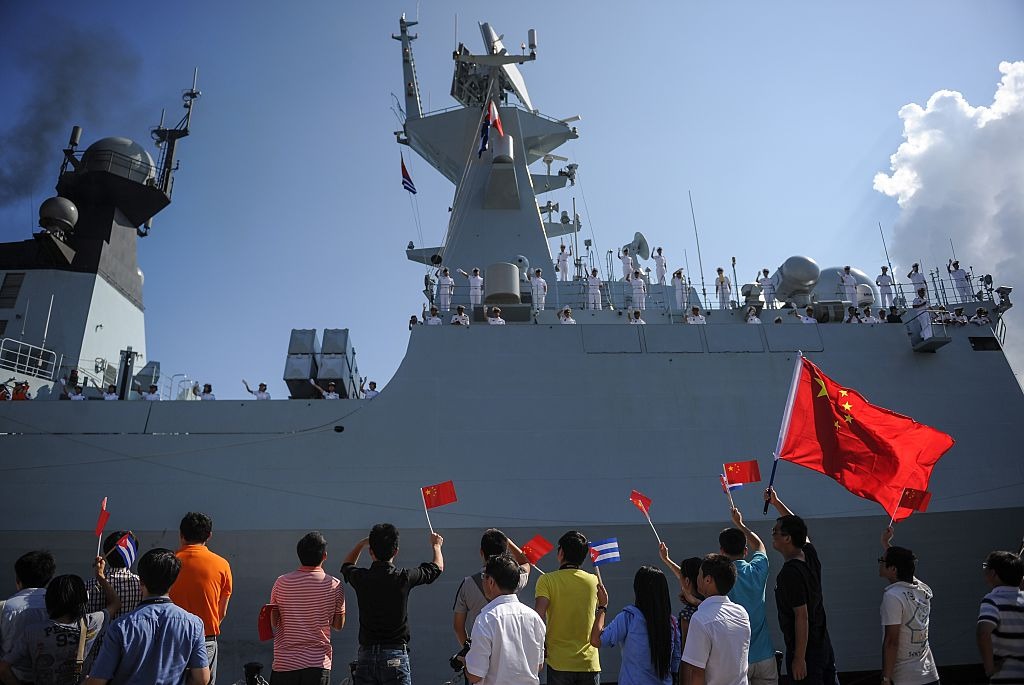
Cuban society, due to a U.S. naval embargo, is close to collapse.
Friends of Havana blame the U.S., but the Trump administration had to act before China turned the island into a military bastion.
America took control of Venezuela's national oil company, PDVSA, after the January 3 raid that resulted in the capture of Nicolás Maduro and his wife. Then the U.S. stopped the flow of Venezuelan oil to the Cuban regime.
At the same time, the Trump administration, by threatening tariffs on oil suppliers, imposed a de facto oil embargo on Havana. The U.S. Navy has deterred vessels from unloading cargo in Cuba.
To get through the American picket line, tankers have been employing deceptive tactics. For instance, the Hong Kong-flagged Sea Horse, carrying gasoil, was falsely broadcasting that it was "not under command" and drifting in the Sargasso Sea for almost three weeks. In reality, the ship spoofed its location and probably unloaded 190,000 barrels in Cuba in the early part of this month.
A delivery from the Sea Horse, according to the Windward site, would be "the first confirmed arrival of a refined products cargo at the island since early January."
As a result of the American actions, Cuba has almost run out of energy. The Cuban grid has collapsed three times so far this month, throwing the island into darkness.
"Why is the U.S. doing this?" asks Cambridge University's Jostein Hauge on X, referring to the blockade on Cuba. "For no reason other than its dislike of the Cuban regime. Cuba poses no threat to the U.S."
Really?
"China uses Cuba as a platform for many of its regional intelligence and security operations," Joseph Humire, then executive director of the Center for a Secure Free Society, told this author in 2021.
There is, most prominently, the Lourdes facility just west of Havana near Bejucal, once the Soviet Union's largest listening station outside its borders. The Chinese are thought to have taken over the facility shortly after the fall of the USSR.
China now has more than just Lourdes. A December 2024 Center for Strategic & International Studies report identifies three more likely Chinese listening posts in Cuba. There is the Soviet-era Calabazar, and a second, Wajay, appears to have been built after the fall of the Soviet Union. There is also a new station, El Salao.
The CSIS report notes that unconfirmed accounts of China's intelligence presence on the island began with the visit of China's Defense Minister General Chi Haotian in 1999.
The Chinese may have been operating listening posts in Cuba since 1993, R. Evan Ellis of the U.S. Army War College told Gatestone at the beginning of last year.
China and Cuba, the Wall Street Journal reported in June 2023, agreed in principle to establish a new listening site on Cuban soil. The Biden administration denied the report, but two days later declassified intelligence showing that Chinese signals-intelligence collection facilities had been operating in Cuba since at least 2019.
Cuba is an ideal location to surveil America. "Sitting less than 100 miles south of Florida, Cuba is well-positioned to keep watch on sensitive communications and activities, including those of the U.S. military," the CSIS report states. "The southeastern seaboard of the United States brims with military bases, combatant command headquarters, space launch centers, and military testing sites."
Moreover, Cuba is an ideal location for a Chinese military base. "China and Cuba are negotiating to establish a new joint military training facility on the island, sparking alarm in Washington that it could lead to the stationing of Chinese troops and other security and intelligence operations just 100 miles off Florida's coast," reported the Wall Street Journal in 2023.
China stated that the Wall Street Journal report was "totally mendacious and unfounded," but it is nonetheless evident that China wants an enhanced facility on Cuba, just as it has established de facto military sites throughout Latin America.
Moreover, President Donald Trump acted before the Chinese could base missiles in Cuba.
So, whatever one thinks of the harsh consequences of the U.S. naval embargo — there is a worsening humanitarian crisis in Cuba now — the Havana regime, by allowing the Chinese to have the run of the island, does pose a threat to the United States.
Gordon G. Chang is the author of Plan Red: China's Project to Destroy America, a Gatestone Institute distinguished senior fellow, and a member of its Advisory Board.