








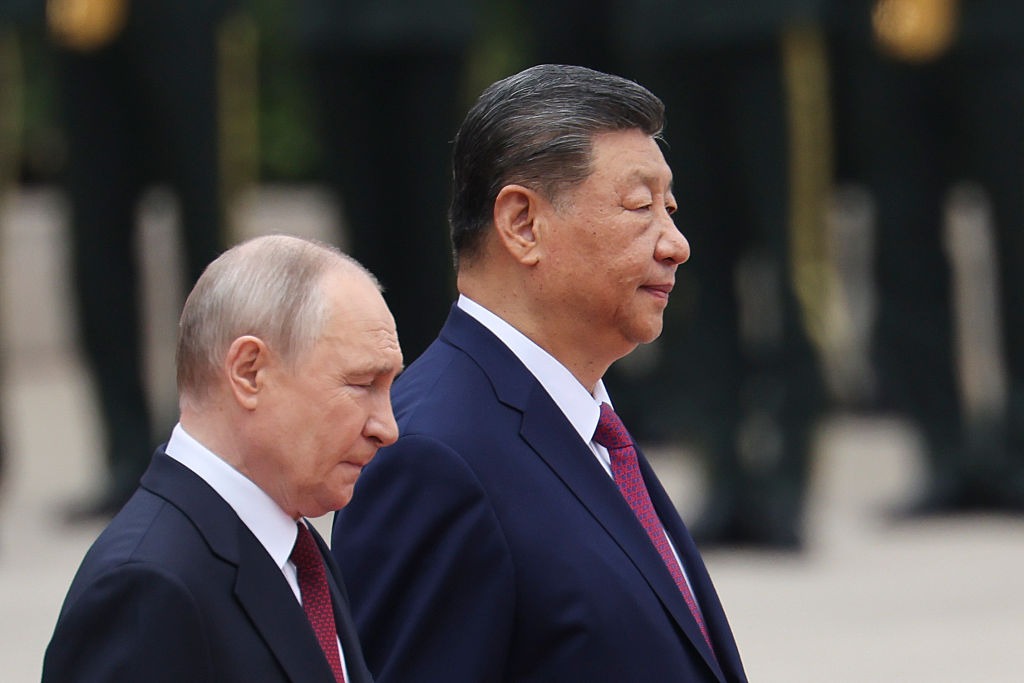
Vladimir Putin wrapped up his summit in Beijing with Xi Jinping on May 20, the Russian leader's 25th visit to China.
Putin walked away with more than 40 agreements, but he did not leave with the prize he has long sought.
As an initial matter, forget about the pacts that were inked. "When you look at all the 'agreements,' they are only memoranda of understanding," Dmitri Alperovitch, chairman of Silverado Policy Accelerator, said to Gatestone. "In other words, they are merely invitations to talk more."
Russia and China have talked a lot about the Power of Siberia 2 pipeline, some 12 years in fact. Putin traveled to the Chinese capital in May primarily to get the green light for the project, which will transport 1.77 trillion cubic feet of natural gas annually across thousands of miles from the Yamal Peninsula on the north coast of Siberia through Mongolia and then to Shanghai.
The pipeline is especially important to Russia because it will replace sales to Europe, lost because of its 2022 invasion of Ukraine.
On May 20, Moscow announced that Russia and China had reached a "shared understanding of the main parameters." "There is agreement on the route and on how the project will be built," Kremlin spokesman Dmitry Peskov said. "Some details still need to be finalized, but in general such an understanding is already in place."
There is no timetable for the finalization of the deal, Peskov stated.
Reports state that Russia and China continued to haggle over the price of pipeline gas.
That assessment is true, but the negotiations are more complex than that statement implies. "Russia is running out of capital," said Alperovitch, also co-author of World on the Brink: How America Can Beat China in the Race for the Twenty-First Century. "Putin does not have the cash to build Power of Siberia 2, and he has not been able to convince the Chinese to pay for it."
The Chinese think they have Putin over a barrel, but they are overestimating their strength. They need Russian energy as fast as they can get it.
"At the moment, the Chinese are short cargoes, so they have to buy in the spot market," Jonathan Bass, CEO of Louisiana-based Argent LNG, the developer of the largest liquefied natural gas (LNG) export facility in the United States. "The Chinese do not want to buy American energy, but they may have to."
China is the world's largest importer of natural gas and needs more secure sources of supply.
China faces two problems with LNG, however. First, much of China's LNG arrives in vessels passing chokepoints, the Strait of Hormuz and the more important Strait of Malacca.
"The Chinese think the blockage of the Strait of Hormuz is a fluke, so they do not believe the Power of Siberia 2 pipeline is strategically that important," Alperovitch noted.
Pipelines are not invulnerable, of course. According to an estimate of Senator John Kennedy, the Louisiana Republican, Ukraine has hit Russia's energy facilities more than a hundred times this year. Some of those strikes have been deep inside Russian territory.
Nonetheless, Russia's pipelines — the existing Power of Siberia 1 and the proposed new one — are not as vulnerable as ships making long passages at sea.
"China is the world's largest importer of energy," Bass added. "The Chinese need pipeline-supplied molecules because Ukraine can easily hit Russia's warm-water ports and because the U.S. Navy can cut off the seaborne supply of oil and gas anytime it wants."
"The world is getting dicey," Bass said this month. "The seas in a turbulent era may no longer be safe lanes of passage."
Second, LNG is delivered, Bass notes, through an "intricate global supply chain including many suppliers, port facilities, and shipping routes."
The Power of Siberia 2 pipeline, on the other hand, involves only two other parties, the Russian Federation and a tame Mongolia, which will be happy to passively collect hundreds of millions of dollars in transit fees.
Xi Jinping appears supremely confident that Russia will ultimately agree to his terms, but the Chinese have time constraints of their own.
After the Xi-Putin summit, the bickering over the price of gas that will flow through Power of Siberia 2 will continue.
Let them argue forever if they want. While they do, America continues to have a chokehold over China's imported energy supply.
Gordon G. Chang is the author of Plan Red: China's Project to Destroy America, a Gatestone Institute distinguished senior fellow, and a member of its Advisory Board.