








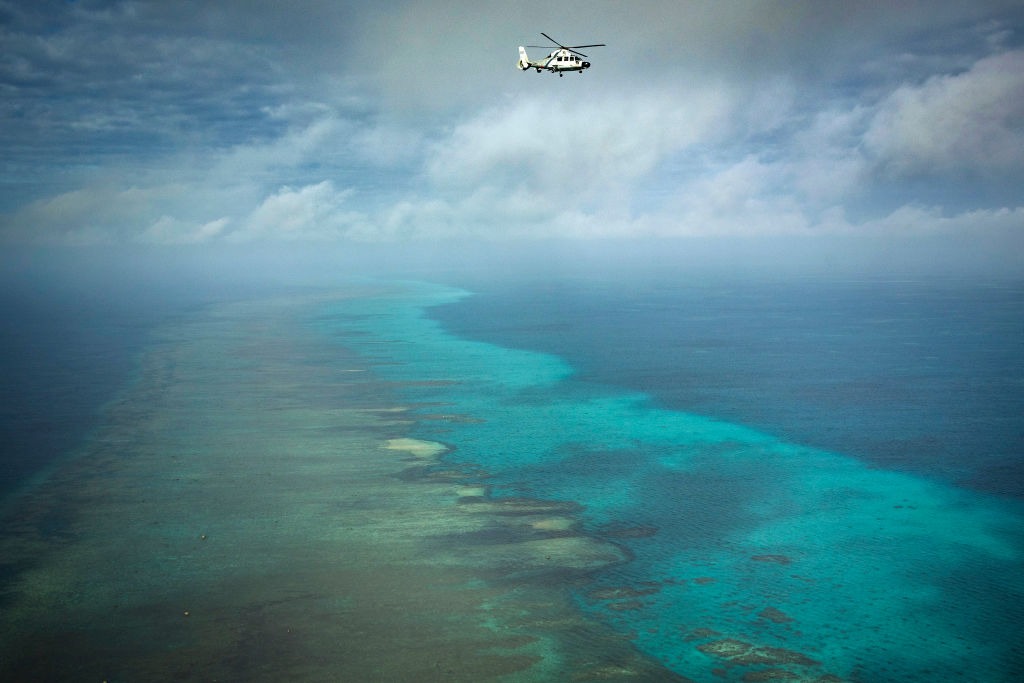
China on May 20 towed a "floating structure" to Scarborough Shoal in the South China Sea. The Chinese termed it a temporary facility and claimed it was carrying out activities "including scientific research."
The South China Sea Institute of Oceanology of the Chinese Academy of Sciences said it was using the platform for environmental monitoring and sampling and that it was supporting "ecological civilization development."
"More Chinese gray-zone shenanigans" is the way James Holmes, the first J.C. Wylie Chair of Maritime Strategy at the Naval War College, called the tactics, referring to Beijing's coercive moves that fall below the threshold of war.
The object has since been removed after vigorous protests from the Philippines, which called it an "illegal presence." The Financial Times reported on June 21 that Manila is concerned that China is seeking to take permanent control of Scarborough by reclaiming the sea and building a military base there.
Beijing, with this move and others at Scarborough, has been precipitating a crisis that can trigger the next war. At the moment, the shoal and nearby waters form the most dangerous hotspot in East Asia.
Scarborough Shoal is 124 nautical miles from the main Philippine island of Luzon and about 550 nautical miles from China's Hainan. As such, the shoal is well within Manila's exclusive economic zone, the band of international water between 12 to 200 nautical miles from the shoreline, where the coastal state has certain economic and other rights against others.
Despite the disparity in distances, Beijing, which calls the feature Huangyan Dao, claims the shoal as its own. "I wish to stress that any activities China conducts around Huangyan Dao, including scientific research, constitutes legitimate rights of a sovereign state, and no other country has the right to interfere," said Chinese Foreign Ministry spokesperson Lin Jian on the 17th of this month at the regular press briefing.
Scarborough is inside China's infamous "cow's tongue," now defined by ten dashes on official maps. The tongue encloses about 85 percent of the South China Sea.
Beijing claims as "blue national soil" all the waters inside the cow's tongue and claims as sovereign territory all the shoals, reefs, islands, islets, and other features in the tongue.
The Philippine claim to Scarborough Shoal is far stronger than China's. In 2016, an international arbitration panel in the Hague, interpreting the U.N. Convention on the Law of the Sea, invalidated Beijing's assertion of sovereignty to the South China Sea in general and to Scarborough by implication. China, with virtually no legal support, has consistently maintained that the decision "is illegal, null, and void."
Manila initiated the arbitration after Philippine authorities in early 2012 had lawfully detained Chinese poachers at Scarborough. China's vessels then immediately swarmed the feature.
Washington quickly brokered an agreement for both sides to withdraw their craft, but only Manila complied. Beijing has been in firm control of Scarborough ever since. The Obama administration, while Vice President Joe Biden was in charge of foreign policy, did not oppose China's audacious seizure.
"The People's Republic of China first demonstrated its intentions in 2012 when they effectively seized Scarborough Shoal from our treaty ally," James Fanell of the Geneva Center for Security Policy and co-author of Embracing Communist China: America's Greatest Strategic Failure told Gatestone. "Over the past 14 years the PRC has used a combination of maritime forces from the Coast Guard, fishing fleets, maritime militia, and navy to maintain control of the shoal. These actions have dangerously threatened Philippine efforts to reassert legitimate legal claims over this shoal."
Then, as now, vital American interests are also at stake. "The South China Sea is the key waterway that allows American naval forces to transit to and from allied nations in northeast Asia, southeast Asia, the Middle East, and Australia," Fanell said in 2025. "The lynchpin of control over that body of water today is Scarborough Shoal."
So what should America do now?
"The main thing is that we have to be on the scene to compete," said Holmes in comments to Gatestone. "The best we can probably do is mount a layered strategy with the Philippine and U.S. coast guards on the scene, backed up by the Philippine and U.S. navies, along with shore-based air and fire support."
"Moreover, the Marine Corps Warfighting Laboratory has been experimenting with 'intermediate force capabilities' centered on nonlethal weapons," Holmes added. "There might be some options there as well."
"The U.S. Seventh Fleet should conduct combined naval operations in and around Scarborough Shoal, to include anchoring outside the shoal's entrance and sending in combined U.S. and Philippine navy small boats and divers and special operations forces for security," said Fanell. "While these operations are being conducted, combined U.S. Air Force and Philippine Air Force aircraft should be providing combat air patrol over these forces in the shoal."
Why go to all this effort for what is essentially a rock in the sea?
When Beijing's leaders saw Washington's failure to protect a treaty ally in 2012 at Scarborough, they began moving against Second Thomas Shoal and other Philippine reefs and islets in the South China Sea, went after Japan's islets in the East China Sea, and began reclaiming and militarizing features in the Spratly chain. The Obama administration unintentionally legitimized the worst elements in the Chinese political system by showing everybody else that aggression worked.
Beijing then made the problem bigger. We cannot afford to let China do that again. Scarborough Shoal is strategic: It controls the mouths to Manila and Subic bays of the Philippines.
And China can use it to control the entire South China Sea.
Gordon G. Chang is the author of Plan Red: China's Project to Destroy America, a Gatestone Institute distinguished senior fellow, and a member of its Advisory Board.
