








The furious Palestinian reaction to the recent declaration by the so-called "Board of Peace" -- that the United Nations Relief and Work Agency for Palestine Refugees (UNRWA) "has no place in the new Gaza Strip" -- has once again exposed a fundamental truth that many in the international community continue to ignore: for the Palestinians, UNRWA is not just a humanitarian agency. It is a political institution that keeps alive the dream of the so-called "right of return" -- a demand that, by overwhelming Israel's population of roughly 10 million with millions of supposed "refugees" -- would effectively bring about the end of Israel as the nation-state of the Jewish people.
In announcing that "UNRWA has no place in the new Gaza... [w]e are turning the page on the complex of perpetual aid dependency and conflict. The people of Gaza deserve better," the "Board of Peace" touched on one of the most sensitive issues in Palestinian politics.
The immediate response from the Palestine Liberation Organization (PLO), Hamas, and various Palestinian organizations made clear that they are not primarily concerned about humanitarian services. They are evidently worried about losing the UN agency they regard as the guardian of the "right of return."
Ahmed Abu Holi, a member of the PLO Executive Committee and head of its Department of Refugee Affairs, denounced the "Board of Peace" for allegedly attempting to "liquidate the Palestinian refugee issue." He stressed that UNRWA "embodies the moral responsibility and strict legal obligation of the international community towards the rights of refugees, leading to their return [to Israel] and compensation."
Abu Holi warned that "any attack on UNRWA or attempt to dismantle it constitutes a direct assault on Palestinian national identity... and an undermining of the right of return."
Even more revealing was his threat that Palestinian refugees "will strongly resist" any attempt to dismantle the agency.
The Speaker of the Palestinian National Council, Rouhi Fattouh, echoed the same message:
"UNRWA... represents the legal and historical witness to the Nakba ['catastrophe,' the term Palestinians use to describe the establishment of Israel in 1948]... and embodies the international commitment to the rights of refugees until their right to return and compensation is implemented."
Ending UNRWA, according to Fattouh, would amount to eliminating "the legal status of Palestinian refugees."
Ahmed Majdalani, another PLO Executive Committee member, similarly declared that the "Board of Peace" statement "touches the core of the Palestinian issue, represented by the issue of the refugees and the right of return."
"The right of return," he added, "is a fundamental principle of the Palestinian people that no one... can tamper with."
Hamas, too, rushed to defend UNRWA.
The Iran-backed terrorist group condemned the "Board of Peace" for declaring that there is "no place" for UNRWA in Gaza and warned against "stopping the funding of the agency or reducing its mandate or replacing it," and called on the international community to ensure "the continuation of the agency's operations... until our people obtain their legitimate rights."
Those "legitimate rights," according to Hamas and the PLO, include the "right of return."
These statements remove any doubt about why Palestinian leaders are fighting hard to preserve UNRWA.
The issue is not schools, food distribution, or medical clinics. The issue is politics.
Unlike the UN High Commissioner for Refugees (UNHCR), which seeks durable solutions by resettling refugees and helping them rebuild their lives, UNRWA has institutionalized refugee status across generations.
More than seven decades after the 1948 war, the number of registered Palestinian refugees has expanded from roughly 700,000 to several million, because descendants continue to inherit refugee status.
Instead of solving the refugee problem, UNRWA's function is to perpetuate it.
Many Palestinians fled the country during the 1948 war, which five Arab armies waged on Israel and lost, then were refused entry back into Israel because they had not been loyal. For Palestinians, UNRWA has become the international symbol of their demand that the remaining Palestinian refugees of 1948 and millions of their descendants be allowed to settle inside Israel.1
Such a scenario would fundamentally alter Israel's demographic character, transforming the world's only Jewish state into one with a Muslim Arab majority. No Israeli government – left, right or center – is ever likely to agree to such national suicide.
The Palestinian insistence on the unrealistic "right of return" therefore remains one of the principal obstacles to any peace agreement.
Equally troubling are the mounting revelations concerning UNRWA's infiltration by terrorist organizations in the Gaza Strip.
According to a detailed report published by the Israel Defense Forces, at least 1,462 of UNRWA's 12,521 employees in the Gaza Strip – approximately 12 percent – are members of Hamas, Palestinian Islamic Jihad (PIJ), or other terrorist organizations.
Among UNRWA's 546 school principals and deputy principals, at least 80 were identified as members of designated terrorist organizations, including Hamas's military wing.
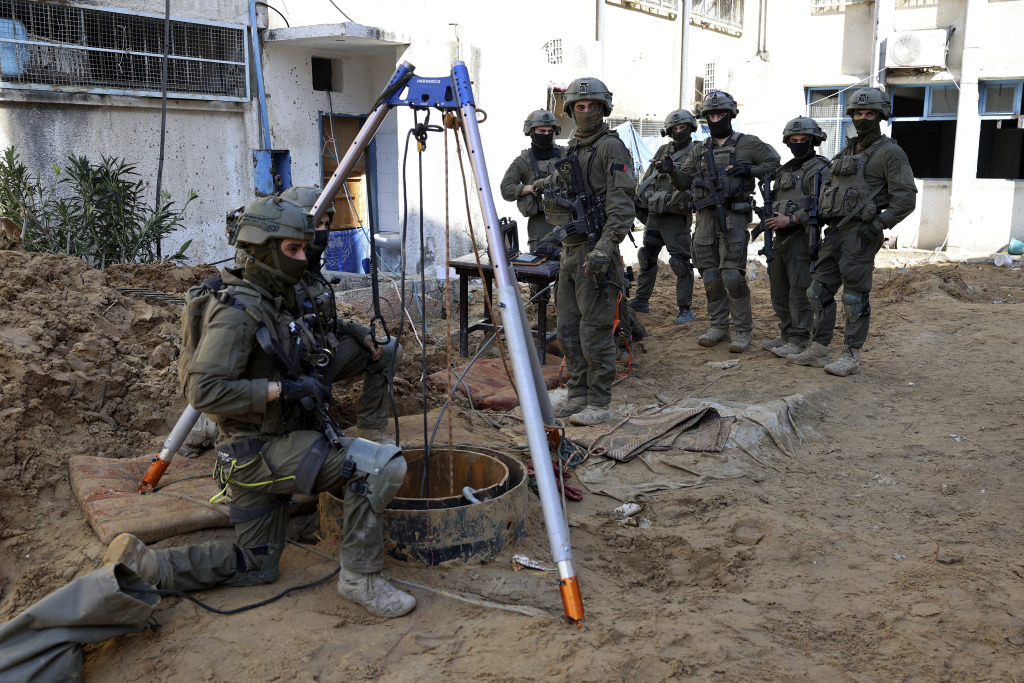
The report further states that Hamas systematically exploited UNRWA facilities by constructing terror tunnels beneath schools, storing weapons, establishing command centers, and launching rockets from areas adjacent to UN facilities.
It also reveals that Hamas operated an advanced server data center for its central intelligence office underneath UNRWA's Gaza headquarters while drawing electricity from the UN facility. The report continues:
"During the military operation to expose the terror infrastructure in UNRWA's compound, large quantities of weapons were found inside its buildings, including explosive drones, grenades, sniper rifles, rockets, mortar bombs and RPG launchers. Intelligence and documents discovered at the site confirmed that the offices had in fact also been used by Hamas terrorists. In addition, bodies of Hamas and PIJ terrorists were found on the premises."
The findings additionally state that UNRWA employees actively participated in the October 7, 2023 massacre in Israel, including in the abduction of Israelis and foreign nationals. One of the UNRWA employees, Faisal Ali Mussalem Al-Naami, was identified in Israeli territory that day via surveillance cameras and cellular phone activity, and he took part in kidnapping a man from Kibbutz Be'eri. Al-Naami was filmed in the kibbutz, loading the dead body of an Israeli into an SUV to abduct it.
Against this backdrop, UNRWA's recent announcement that it dismissed 70 employees in Gaza because of concerns regarding their connections to terrorist organizations is a welcome, if overdue, step. The UN agency, however, insists that the dismissals "do not constitute in any way a validation of the claims made against them."
The decision itself, however, amounts to an acknowledgment that the problem exists.
If UNRWA believed there were absolutely no security concerns, there would have been no reason to terminate dozens of employees. The dismissals also raise an obvious question: if 70 employees were considered too risky to retain, what about the many others identified by Israeli intelligence?
Instead of helping Palestinians move beyond a perpetual claim to refugee status, UNRWA appears committed to sustaining the conflict's central illusion: that Israel will one day absorb millions of Palestinians and thereby cease to exist as a Jewish state.
The "Board of Peace" is therefore correct in arguing that UNRWA has no place in the future Gaza Strip.
Humanitarian assistance should certainly continue. The Palestinians of the Gaza Strip who are not involved in terrorism deserve reconstruction, economic development, functioning schools, hospitals, and normal lives. These responsibilities, however, should be assumed by the "Board of Peace" together with Arab states that have repeatedly declared their solidarity with the Palestinians but done nothing to help them.
For decades, Arab governments have proclaimed unwavering support for the Palestinian cause. If Arab leaders genuinely care about the welfare of their Palestinian brethren, they should insist that Hamas lay down its weapons and relinquish control of the Gaza Strip.
The Trump Administration should insist that any future arrangement for Gaza exclude UNRWA and replace it with mechanisms that promote rehabilitation rather than dependency.
Most importantly, it is time for Palestinian leaders to abandon the fantasy of the "right of return." These leaders are lying to their own people by telling them that one day they will return to their families' former homes inside Israel.
So long as UNRWA continues to institutionalize that dream, it will remain part of the problem rather than part of the solution.
The angry Palestinian response to the "Board of Peace" announcement demonstrates precisely why an urgent change is needed. UNRWA has become far more than a humanitarian agency. It has evolved into a political institution dedicated to preserving an unrealistic objective that ensures that the conflict will continue for generations to come.
If the goal is a different future for the Gaza Strip – one based on reconstruction, coexistence, and stability rather than perpetual conflict – then eliminating UNRWA and replacing it with a new institution – one not obstructed by past conflicts of interest – is not only justified. It is long overdue.
Khaled Abu Toameh is an award-winning journalist based in Jerusalem.
1 The Arabs who chose to stay in 1948 and their descendants, known today as Arab Israelis, now number about 2 million, or 20% of Israel's population. They have the same rights as any Jewish citizen and are allowed to hold any position, whether as a judge on Israel's Supreme Court, a member of parliament, a university professor (such as here, here and here), or in the fields of banking, business and medicine. Although they are not required to serve in Israel's military, many often choose to.
 Harvey Lithwick