








The West has long nurtured the conviction that a regime dies with its ruler. On February 28, American and Israeli aircraft, in a joint operation prepared over months, killed Iran's Supreme Leader Ali Khamenei together with the chief of staff of the armed forces, the commander of the Revolutionary Guard Corps, the defense minister and Khamenei's closest adviser, thereby erasing the command structure of the Islamic Republic in a single morning. US President Donald Trump promised to "annihilate their navy" and level Iran's missile industry.
Across the West, and among Iranians whose January uprising had been drowned in blood only weeks earlier, an immense hope took hold. The theocracy, at last, seemed gone.
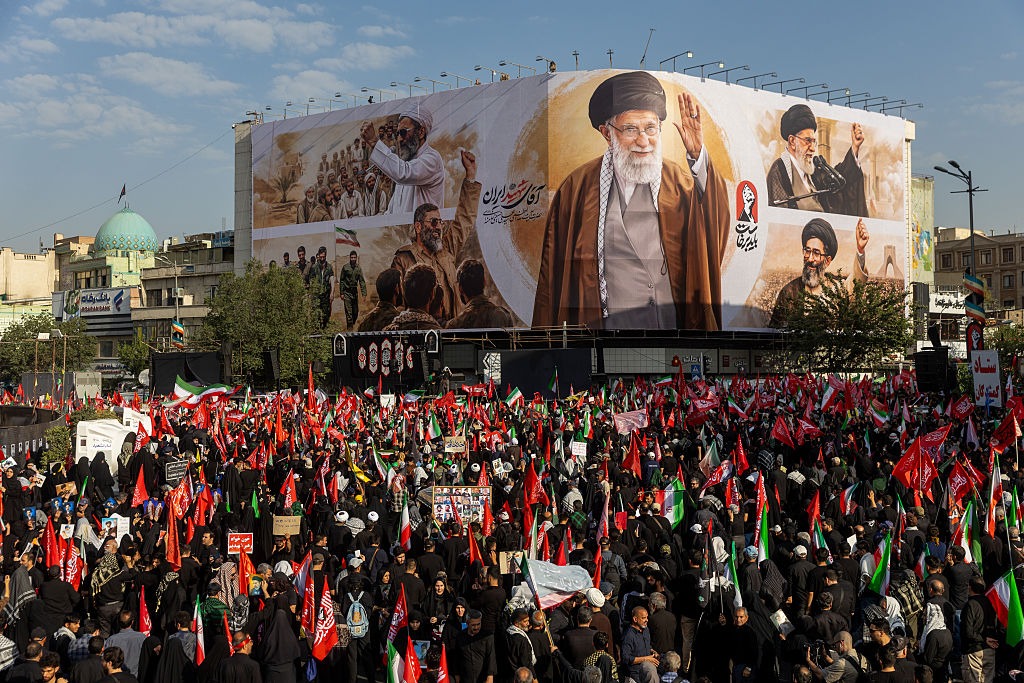
Ten days later, the Assembly of Experts installed Mojtaba Khamenei -- who was severely wounded or possibly "eliminated" as well -- in his father's chair. Since February 28, he has not been seen in public. The Islamic Republic, for its part, had transmitted itself like a monarchy, dynastically, while the missiles were still in the air. This week, as his father's coffin crossed Iran and Iraq in a six-day state funeral, with Mojtaba Khamenei still nowhere to be seen, crowds chanted for revenge and hanged the American president in effigy. The clerics always knew what Washington seems to have taken four months to accept: the regime was never lodged in one man but rather in a clergy, a security apparatus and a doctrine, and all three came through the bombs intact.
What followed inside Iran removed any remaining doubt. In June alone, 141 executions were recorded, the overwhelming majority carried out in silence, without announcement, without due process, and without notice to families or lawyers. Between mid-March and late April, at least 22 political prisoners were hanged, ten of them protesters seized during the January uprising, at a speed of one execution every two days, with 17-year-olds now on death row in addition to them. Since February 28, more than 6,000 people have been arbitrarily arrested under the official cover of "wartime conditions," while the population endured an 88-day internet shutdown, the longest ever recorded anywhere. Decapitated, the regime kills more than before.
Militarily, the Islamic Republic of Iran lost almost everything it was possible to lose: its leadership, its air defenses, its nuclear installations, its navy ships. Its answer was neither surrender nor counteroffensive but the clock. Tehran closed the Strait of Hormuz, mined it, installed "tolls" and fees -- for "protection" -- attacked shipping, then settled in to wait, reading the American calendar with more attention than Washington was reading Iran.
Trump wanted a deal, said so openly, and for four months gave Tehran every chance a negotiating partner has ever been given. Deadlines were set for March 21, then March 23, then April 7, and each time extended. Talks in Islamabad collapsed. A naval blockade followed, then an escort operation, announced and suspended within days. Tehran had learned to read the expiration date stamped on every American threat.
The non-binding Islamabad Memorandum of Understanding, signed on June 17 -- the American signature added during a dinner at Versailles -- reads less like terms imposed on a defeated enemy than like the wish list of a victorious Iran. Its 14 points commit the United States to lifting its naval blockade within 30 days, ending sanctions, releasing frozen Iranian assets, and assembling with regional partners a reconstruction plan worth at least $300 billion. Iran, in exchange, reaffirmed that it would not develop nuclear weapons and agreed to leave its nuclear program exactly as it stands -- meaning with its nuclear installations and centrifuges to enrich uranium safely under Pickaxe Mountain. Dismantling Iran's nuclear program appears nowhere in the text. In addition, 440 kgs (970lbs) of uranium enriched to 60% -- nearly at weapons grade -- are to be "blended down," presumably later to be enriched again. Enrichment was deferred to a final agreement to be negotiated within 60 days. The enforcement mechanism was summarized by the president himself: "If it doesn't get done in 60 days... we go back to bombing."
The ink was barely dry before the violations resumed. Three days after the signing, Iran, citing Israeli operations against Hezbollah in Lebanon, declared the Strait of Hormuz closed once more. The follow-up talks in Switzerland were postponed. When they finally opened, Iranian negotiators conceded nothing on enrichment. Hezbollah, which entered the war two days after Khamenei's death, kept attacking Israeli forces in Lebanon, thereby handing Tehran a permanent pretext to shut the strait whenever the negotiations required pressure.
Last week, the pattern ran its course. Iran asked the US for a special week of quiet for the funeral of Khamenei -- then began firing missiles at commercial ships in the strait. On June 6, Washington reimposed the oil sanctions it had waived. Iran launched missiles at American bases in Bahrain and Kuwait. At the NATO summit in Turkey, Trump finally said: "I think it's over. I don't want to deal with them anymore. They're scum." The Iranian foreign minister had spent the previous day invoking paragraph 13 of the MOU and demanding that Washington honor its signature: an arsonist quoting the fire code while the tankers burned.
The last four months were the exhaustion of a method rather than a failure of nerve. The Trump method flattered the adversary, let him believe he had won, dragged him to the table under threat of force, changed course without warning and staged unpredictability as strategy. All that might work remarkably well in the West, where leaders answer to electorates, markets and quarterly reports. It presupposes, however, an interlocutor who counts costs the way Washington counts costs.
The Islamic Republic counts by another arithmetic, drawn from its revolutionary jurisprudence. Time costs nothing, and survival itself, especially against a "Great Satan," the US, is a triumph. Deceiving the enemy across a negotiating table carries doctrinal sanction, not shame. Honor and pride outrank comfort, prosperity and the future itself, and above every calculation sits religion and a commitment to take down the West.
A power such as the US that cries wolf on Tuesday and extends the deadline on Thursday teaches a system such as Iran's exactly one lesson: that the wolf does not exist. Iran's rulers read the American desire for a deal, especially before a midterm election, as weakness, which by that arithmetic it was. Trump, who kept repeating that he wanted a deal -- in that way raising the price for one -- seemed genuinely trying to test ways not to destroy more of Iran. Last week, he gave up on that.
The return to peace through strength comes as a relief. Israel absorbed Trump's and Vice President JD Vance's insults while Washington negotiated. Each time Tehran wanted to make a point, Gulf capitals were struck. Thousands of sailors are still stranded aboard ships trapped in the Gulf. Brave Iranians who rose in January went to the gallows while the world discussed sanctions relief.
The Strait of Hormuz and no nuclear weapons for Iran -- ever -- remain key. The Pentagon has held the answer since March: plans to seize Kharg Island, the terminal through which 90% of Iranian crude oil passes. Marine expeditionary units were moved into the region seemingly for such operations, and the decision so long deferred is now the only card left. Round three has begun. After Khamenei, nothing has changed in Iran, where the doctrine, the gallows and the wager on Western fatigue are those of February. What finally changed, last week, is Washington.
Pierre Rehov, who holds a law degree from Paris-Assas, is a French reporter, novelist and documentary filmmaker. He is the author of six novels, including "Beyond Red Lines", "The Third Testament" and "Red Eden", translated from French. His latest essay on the aftermath of the October 7 massacre " 7 octobre - La riposte " became a bestseller in France. As a filmmaker, he has produced and directed 17 documentaries, many photographed at high risk in Middle Eastern war zones, and focusing on terrorism, media bias, and the persecution of Christians. His latest documentary, "Pogrom(s)" highlights the context of ancient Jew hatred within Muslim civilization as the main force behind the October 7 massacre.
 Harvey Lithwick