








For decades, governments of many Arab states have viewed Iran's aggression primarily through the prism of its conflict with Israel. That illusion has now been shattered.
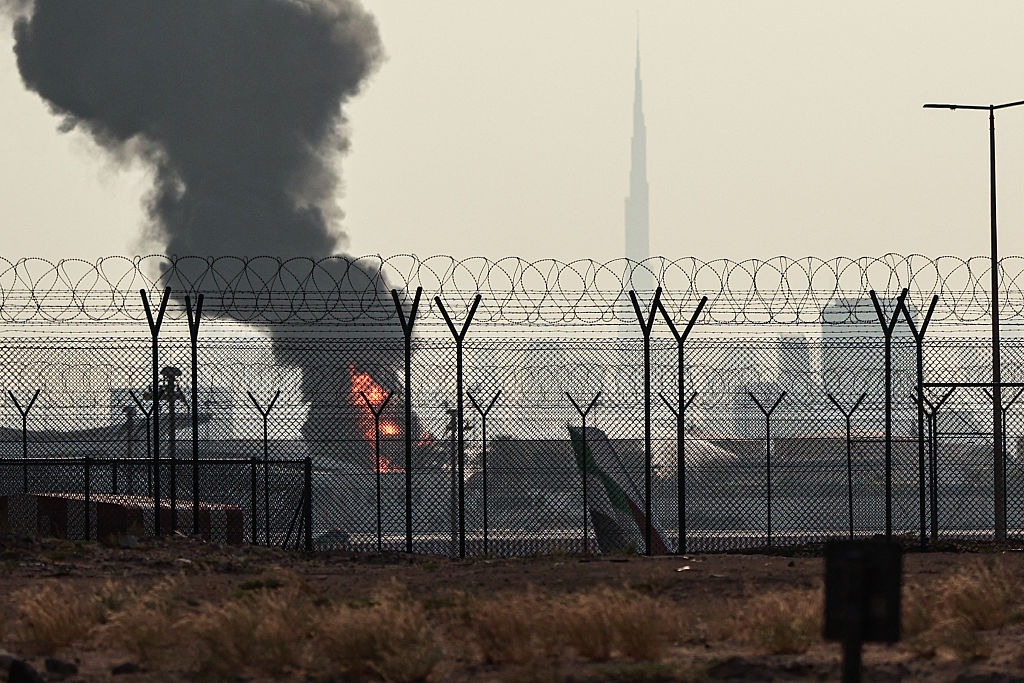
Over the past week, the Iranian regime has demonstrated once again that its ambitions extend far beyond destroying Israel. Tehran has launched an unprecedented campaign of missile and drone attacks against several Arab states, targeting critical infrastructure, ships, airports, oil facilities, power stations, desalination plants, ports and even residential neighborhoods.
These attacks should remove any doubt: Iran's war is not only against Israel. It is a war against the entire Middle East and, ultimately, against the United States and the West.
The latest escalation also exposes the fatal flaw in the Memorandum of Understanding signed between Washington and Tehran only weeks earlier. The agreement was supposed to reduce tensions and guarantee safe navigation through the Strait of Hormuz. Instead, Iran immediately violated its commitments.
Beginning on July 6, Iran resumed attacks on commercial ships in the Strait of Hormuz, despite pledging to ensure safe passage for international vessels. The attacks prompted American military strikes against Iranian targets. Tehran then launched missiles and drones not only against US assets but also against infrastructure in Arab countries across the Gulf, in addition to Jordan, presumably so they would pressure US President Donald J. Trump to call off US firepower and return instead to waste-of-time negotiations for a waste-of-time "deal" that Iran would not honor in the first place.
The Iranian regime has never demonstrated any willingness to abide by agreements if they conflict with its revolutionary ideology or strategic objectives. The latest memorandum of understanding between Iran and the US has gone the way of countless previous understandings with Tehran: reduced to little more than worthless paper.
In reality, the negotiations have been worse than a waste of time, except to see if any deal might be possible with a regime that just murdered more than 50,000 of its own citizens in January alone. The negotiations actually caused harm. They gave the regime time to retrieve missiles it had hidden and to resume firing, with targeting assistance from China and Russia, on US forces and allies in the Gulf.
This chain of events is hardly surprising, and the same disaster applies to Iran's terrorist proxies.
Hamas repeatedly violated ceasefire agreements before launching its October 7, 2023 invasion of Israel. Hezbollah has ignored international resolutions demanding its disarmament while repeatedly violating ceasefire agreements. Yemen's Houthis have continued attacking international shipping despite multiple diplomatic initiatives and understandings.
Negotiating with terrorist organizations or the regime that sponsors them has consistently produced the same result: more violence and terrorism.
The current wave of Iranian attacks illustrates precisely why.
Over the past few months, Iran has carried out sustained missile and drone attacks against at least seven Arab countries.
Commercial vessels in the Strait of Hormuz were struck. Kuwait, Bahrain, and Jordan came under coordinated missile and drone attacks. Qatar was targeted for a second time in one week. Kuwait suffered direct hits on an oil facility, a power station, and a desalination plant, and was forced to suspend flights at Kuwait International Airport. Saudi Arabia issued emergency missile alerts as Iranian projectiles threatened its territory.
Even Oman, which has long maintained cordial relations with Tehran and served as an intermediary between Iran and the US, was not spared.
Tehran claims that it targets only American military facilities. Reality tells a different story.
Civilians have been killed, residential areas struck, and airports, hotels, ports, oil facilities and other civilian infrastructure have suffered significant damage.
These are not attacks on military facilities. They are acts of state terrorism, targeting purely civilian infrastructure and designed to intimidate entire societies.
The Arab League was correct in condemning the attacks as "heinous and reckless" violations of Arab states' sovereignty. It warned that Iran's actions represent "a serious and unprecedented escalation threatening the security and stability of the entire region."
The Arab League also reaffirmed its "full solidarity and unwavering support" for the Arab countries targeted by Iran.
These statements are welcome, but words alone will not stop the Iranian regime.
For years, Iran has systematically built an empire of armed proxies across the Arab world. Iran dominates Lebanon through Hezbollah. It exercises enormous influence over Iraq through Shiite militias. It transformed Yemen's Houthis into a heavily armed force capable of threatening one of the world's most important maritime trade routes. It continues to bankroll Hamas and Palestinian Islamic Jihad in the Gaza Strip and the West Bank. Iran's influence extends deep into Syria as well.
Taken together, these terrorist organizations form what Tehran proudly calls the "Axis of Resistance." It is, in reality, an axis of terrorism. Its purpose is not just to destroy Israel. Its objective is to spread Iran's revolutionary Shiite Islamist ideology, undermine moderate Arab governments, expel American influence from the Middle East, and ultimately wage jihad (holy war) against the West.
That agenda was underscored this week in a statement attributed to Iran's Supreme Leader Mojtaba Khamenei, declaring that "the American enemy" should prepare for "unforgettable lessons" from Iran and the "Axis of Resistance."
This is not the language of a regime seeking peace. It is the language of a regime openly threatening continued war.
Iran's aggression is steadily eroding whatever sympathy it once enjoyed among many Arabs. The regime's true face has become impossible to conceal. This new belligerence should be a turning point for Arab governments.
According to the news website MBN:
"Ahmed Alkhuzei, a leading analyst in Bahrain, said that as the war drags on, people increasingly experience its consequences in their daily lives. As a result, he said, they are more likely to see Tehran not as a victim but as a destabilizing force whose actions directly threaten their security and prosperity.
"'Iran is being recast from a distant geopolitical actor into the immediate source of instability,' he told MBN."
Iran is not merely Israel's problem. Its missiles threaten Gulf capitals. Its proxies destabilize Arab governments. Its attacks endanger Arab economies. Iranian regime ideology rejects peaceful coexistence and normalization between Arabs and Israelis -- as does the ideology of the Muslim Brotherhood, currently embodied by Qatar and Turkey.
One of Tehran's principal strategic objectives has always been to sabotage the Abraham Accords and prevent further normalization between Israel and its Arab neighbors. Iran understands that regional peace and cooperation weaken its revolutionary narrative and diminish the influence of its terrorist proxies.
The Arab states therefore have every reason to openly align themselves with the United States and Israel in confronting the Iranian threat.
This is not about choosing sides in someone else's conflict. It is about defending their own sovereignty, their own interests, their own citizens, and their own future.
The lesson of the past week: So long as the regime in Tehran remains committed to exporting its "Islamic Revolution" and maintaining its network of terrorist proxies, there can be no genuine security or stability in the Middle East.
The Islamabad Memorandum of Understanding has already collapsed: it rested on the false assumption that the Iranian regime could be trusted to honor its commitments. The Islamic Republic's own history, and its latest missile and drone attacks against the Arab world, prove otherwise.
Peace cannot be built upon deals with a regime that views every agreement merely as another tactical pause in its long war against the US, Israel, and its Arab neighbors.
Until the Iranian regime abandons its expansionist ambitions or loses the capacity to pursue them, the Middle East will remain trapped in recurring cycles of violence. Until then, the Arab states would be wise to recognize that this is their fight as much as Israel's.
Khaled Abu Toameh is an award-winning journalist based in Jerusalem.
 Harvey Lithwick