








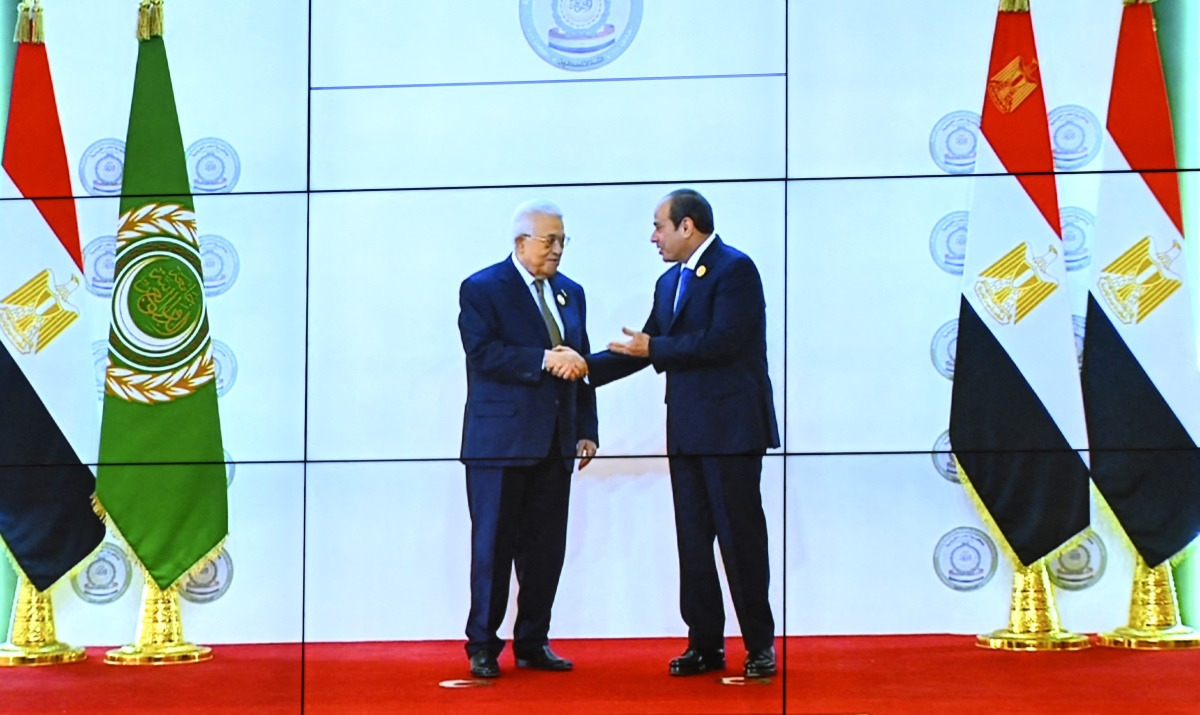
Egypt is reportedly preparing to host another round of talks between the Palestinian factions, including Palestinian Authority President Mahmoud Abbas's ruling Fatah faction and the Iran-backed Hamas terrorist group.
The stated goal sounds appealing: achieving Palestinian "national unity."
The real question, however, is: Unity with whom, and against whom?
Nearly three years after the Hamas-led October 7, 2023 massacre in Israel, why is anyone still talking about bringing Hamas back into the Palestinian political system? Why is Hamas being treated as a legitimate political organization rather than a terrorist group that needs to be disarmed, dismantled, and removed from power?
Egypt, a key ally of the United States, should be asking these questions. Instead, Cairo appears to be doing exactly the opposite.
According to an "informed source" quoted by the London-based Asharq Al-Awsat newspaper, the Egyptians are preparing for a broad "Palestinian-Palestinian dialogue" that could even be attended by Abbas. The unnamed source said that Egypt wants a comprehensive dialogue including all Palestinian factions, especially Fatah and Hamas.
The same source explained that Cairo is attempting to maintain a "delicate balance" between Hamas on the one hand and the Palestinian Authority (PA) and Fatah on the other, on the grounds that bringing together all the factions would prevent any one group from obstructing future arrangements.
That is precisely the problem.
Why should Egypt be maintaining a "balance" between Hamas and anyone?
Hamas is not just another Palestinian political faction with which Fatah happens to have disagreements. It is the terrorist group that staged a violent coup against the Fatah-dominated Palestinian Authority in 2007, seizing full control of the Gaza Strip. It is the terrorist group responsible for the October 7 atrocities against thousands of Israelis and foreign nationals. It continues to maintain its weapons and military infrastructure and has not abandoned its jihadist ideology or its long-standing goal of eliminating Israel.
The appropriate policy toward Hamas should therefore not be reconciliation. It should be disarmament.
Egypt is a member of the Board of Peace, whose mission includes ensuring the disarmament of Hamas and the demilitarization of the Gaza Strip in order to prevent another October 7-style attack against Israel.
How can Egypt supposedly support the disarmament and marginalization of Hamas while simultaneously working to reintegrate the terrorist group into Palestinian politics?
These are contradictory policies.
Egypt might wish to preserve its importance as a supposedly indispensable mediator between the Palestinians the Israelis, or perhaps it imagines that it might someday control a Palestinian process, or, because Hamas continues to retain weapons and fighters, that it would be prudent not to write off the terrorist group.
The Trump Administration and the Board of Peace might make it clear to Cairo that Hamas cannot be both a terrorist organization that needs to surrender its weapons and a political partner invited to negotiate the future of the Palestinians. One approach eliminates Hamas. The other rehabilitates it.
There should be no confusion about which approach is needed after October 7.
Reports about the Egyptian initiative are even more disturbing because the discussions appear connected to the upcoming Palestinian Legislative Council (PLC) elections, scheduled for November 28, 2026.
A report in the Lebanese newspaper Al-Akhbar notes that Egypt has intensified meetings with Palestinian factions in preparation for an extended dialogue and seeking understandings that could lead to a unified Palestinian Authority and elections.
Egypt had reportedly planned to host a Fatah-Hamas meeting last week to discuss arrangements for the elections, although the meeting was canceled at the last minute for reasons that are still unknown.
Even more alarming are reports of a possible electoral alliance involving former Fatah leader Mohammed Dahlan's Democratic Reform Current, Hamas, Palestinian Islamic Jihad, and other factions such as the Popular Front for the Liberation of Palestine – all terrorist groups that do not recognize Israel's right to exist. According to Al-Akhbar, the Egyptians suggest that such an understanding could contribute to establishing a unified political authority in the West Bank and Gaza Strip.
If this proposition is true, the situation is even more unacceptable. What possible role should these terrorist organizations have in Palestinian elections or a future Palestinian government?
Egypt and the rest of the international community should have learned this lesson 20 years ago. In the 2006 elections for PLC, Hamas ran under the banner of "Change and Reform." Allowing Hamas to participate did not transform the terrorist group into a peaceful democratic movement. It simply unleashed, supported and legitimized a terrorist one.
The result was Hamas rule in the Gaza Strip, years of terrorism and warfare, and eventually the October 7 massacre. Repeating this experiment after what we now know would be even more reckless.
There is another odd dimension to Egypt's approach. Hamas emerged from the Muslim Brotherhood, the Islamist organization outlawed by the government of Egyptian President Abdel Fattah al-Sisi. The Muslim Brotherhood regards Sisi's government as an enemy. Egypt has spent years confronting Islamist terrorism and extremist organizations, especially the Muslim Brotherhood, that threaten its national security.
In January 2026, the United States designated the Egyptian branch of the Muslim Brotherhood as a terrorist organization. Egypt welcomed the decision, saying the Muslim Brotherhood's ideology posed a regional and international security threat.
If Egypt welcomes the designation of the Egyptian Muslim Brotherhood as a terrorist organization, why is it simultaneously trying to give Hamas – which emerged from the same organization – renewed political legitimacy?
Egypt should be especially concerned about any attempt to rehabilitate Hamas. A stronger Hamas would not only threaten Israel. Islamist organizations inspired by the Muslim Brotherhood's ideology have long posed challenges to Egypt itself.
Harakat Sawa'd Misr, for instance, is an Egyptian terrorist organization that emerged after the military overthrew President Mohamed Morsi in 2013. The organization carried out a series of attacks against Egyptian police, security officials, and government targets. Egypt has also battled a long and bloody jihadist insurgency in the Sinai Peninsula.
Additionally, Ansar Bayt al-Maqdis, which later pledged allegiance to ISIS and became ISIS-Sinai Province, carried out countless attacks against Egyptian military and security forces.
Reports over the years have also pointed to contacts and transactional cooperation between Hamas operatives in the Gaza Strip and jihadists in Sinai, including weapons trafficking, training, and logistical assistance.
This situation makes Cairo's current approach toward Hamas all the more puzzling. Egypt, of all countries, after enduring the Muslim Brotherhood's "Arab Spring" takeover in 2011, knows better than most countries that Islamist organizations do not become moderate just because they participate in elections, join political institutions, or sit at negotiating tables.
The Trump Administration would do itself a great service to tell Cairo that Palestinian reconciliation cannot include organizations that retain weapons, embrace terrorism, and seek the destruction of Israel. There is no need to unify the Palestinian ranks around Hamas. There is a need immediately to remove Hamas from those ranks.
Egypt should be using its considerable influence not to persuade Fatah to reconcile with Hamas, but to pressure Hamas and other terrorist groups to surrender their weapons and permanently leave the Palestinian political arena. A politically rehabilitated Hamas, still armed and still committed to its Islamist ideology, will only strengthen the very ideological current that the Egyptian government has spent more than a decade trying to suppress.
Khaled Abu Toameh is an award-winning journalist based in Jerusalem.