








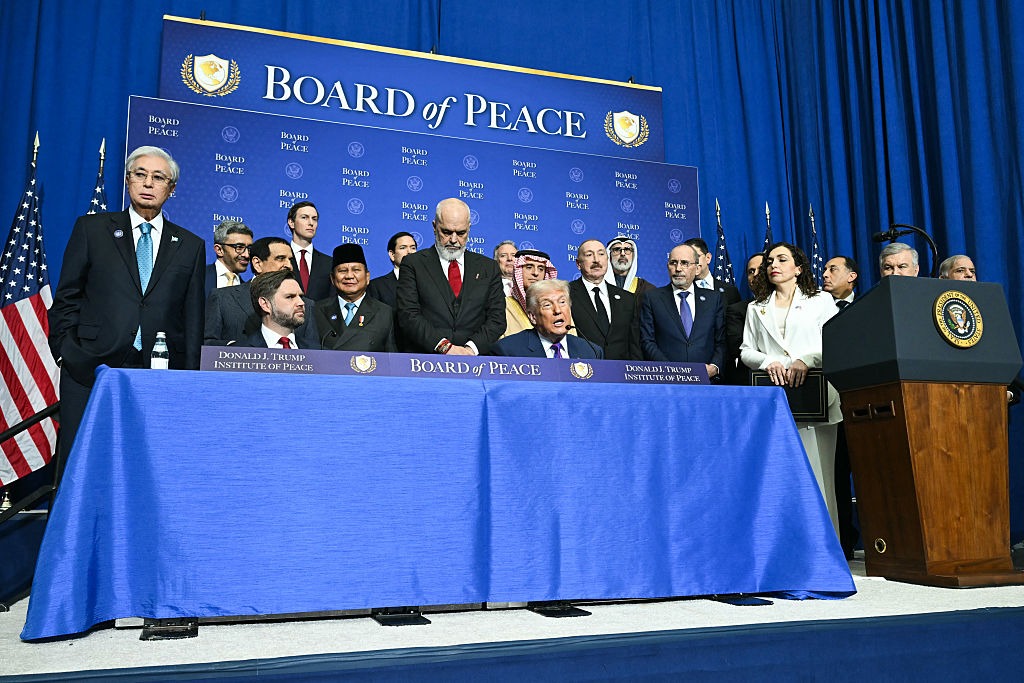
On July 30, the Board of Peace announced an agreement for the staged decommissioning of Hamas weapons in the Gaza Strip. Heavy arms and tunnel networks are to be surrendered under international verification while Israeli forces are to withdraw in phases.
Now, however, Hamas says it will hand over nothing until Israel first pulls back. Israeli Prime Minister Benjamin Netanyahu notes that Israel never accepted those terms. The sequencing is unresolved and may remain unresolved for months. The shape of the deal is not. Hamas is being offered political survival in exchange for its guns.
There is little reason to believe the movement that built Hamas, the Muslim Brotherhood, regards this trade as a defeat. The Muslim Brotherhood, which has given up armed branches before, has outlived every government that forced it to. Its Syrian insurrection ended in the ruins of Hama in 1982, and the organization spent the following four decades rebuilding everywhere except Syria. In 2013, when the Egyptian army deposed President Mohamed Morsi (a member of the Muslim Brotherhood) and began mass arrests, the network dispersed abroad rather than dissolved. Weapons have always been the part of the enterprise it could afford to lose.
Hamas has never disguised its parentage. Its 1988 founding charter describes the group as "one of the wings of [the] Muslim Brotherhood in Palestine." Britain reached the same conclusion after a two-year internal review whose findings Prime Minister David Cameron laid before Parliament in December 2015. The review found that the Brotherhood's foundational texts call for the moral purification of Muslim societies and their eventual unification in a caliphate under Islamic sharia law. The movement itself is "deliberately opaque, and habitually secretive." London recommended no proscription. It settled on the formula that association with the Brotherhood should be treated as a possible indicator of extremism -- the language of a government that has located something it cannot quite reach.
The Brotherhood's opacity is deliberate. Muhammad Akef, the movement's "General Guide" in Egypt from 2004 to 2010, explained:
"We do not have an international organization; we have an organization through our perception of things (ideology). We are present in every country – wherever there are people who believe in the message of the Muslim Brotherhood."
Muhammad Habib, the former first deputy chairman of the Muslim Brotherhood in Egypt, said in 2008:
"There are entities that exist in many countries across the world. These entities share the same ideology, principles, and objectives, but they operate under different circumstances and contexts... each entity operates in accordance with its own circumstances and the challenges it faces, and within its own framework."
Every Western government that has since tried to act against the Brotherhood has collided with this ethereal architecture.
Washington ran into it in January 2026. Acting under an executive order signed the previous November, the US State Department on January 13 designated the Lebanese Muslim Brotherhood a foreign terrorist organization, while the Treasury Department listed the Egyptian and Jordanian chapters as global terrorists for providing Hamas with material support.
The evidence in every instance was military. Lebanon's branch, reactivating its al-Fajr Forces after the Hamas massacre of October 7, 2023, fired rockets into northern Israel. Jordanian elements had been implicated in the production of rockets, explosives and drones. Egyptian networks had moved foreign fighters into Gaza and kept Hamas informed of their arrival times. Three chapters of the Brotherhood -- in Jordan, Egypt and Lebanon -- proved reachable because three chapters had picked up weapons.
France collided with the movement nine days later. The National Assembly adopted a resolution on January 22, by 157 votes to 101, asking the European Commission to place the Muslim Brotherhood and its leaders on the EU terrorist list. The most instructive remark of that five-hour session came from a deputy who voted in favor. Maud Petit warned that the absence of a unified chain of command could weaken any such listing before the Court of Justice of the European Union. She was describing the movement's actual defense. Decades of deliberate decentralization have produced an adversary that European law is not equipped to name.
What that law would have to reach is now on paper. Israel's Ministry for Diaspora Affairs and Combating Antisemitism published a survey of the Brotherhood's European wing in February, identifying five organizations at the core of its continental structure: an umbrella council of national federations, a body issuing religious rulings for Muslims living in Europe, a youth and student federation that has received more than a million euros from Qatar since 2016, a seminary, and a property trust whose real estate holdings finance the others.
Austrian intelligence had already reached the operative conclusion in 2021. It found the Muslim Brotherhood's activities legal but not legitimate. The Israeli report names Jewish communities as the exposed party, which is the reason the file sits on a Jerusalem desk at all.
American campuses supplied their own measure of how far the movement had already traveled. On the October 7, 2023, as Hamas was still massacring Israelis and before Israel had fired a shot into the Gaza Strip, 34 Harvard student organizations signed a statement holding "the Israeli regime entirely responsible for all unfolding violence." Several signatories withdrew their names within days, some pleading that they had not read the text before endorsing it. The speed is the point. A declaration drafted, circulated and signed by three dozen organizations within hours of a massacre draws on arguments assembled long beforehand, in seminars and student unions and advocacy campaigns that no air force can reach.
Jordan, which understands the movement better than any European parliament, moved only when weapons could be seen. On April 23, 2025, its interior ministry outlawed the Muslim Brotherhood outright and confiscated its property eight days after security services arrested 16 men trained and financed in Lebanon who had planned rocket and drone attacks inside the kingdom. The Brotherhood had operated openly in Jordan for decades through charities, professional syndicates and the largest party in parliament. None of that produced a ban. Explosives did.
The distinction that makes this argument possible is also the one most easily surrendered. Éric Pauget, who carried the French resolution, told the Assembly that France is not at war with a religion. Conflating violence and religion has always been the Brotherhood's most dependable shield. The movement's earliest victims were Muslims who opposed it: Egyptian journalists, Syrian professionals, and Jordanian reformers who watched their own unions taken over from the inside.
The verification committee established under the Board of Peace's roadmap for Gaza will count what can be counted. Rifles carry serial numbers. Tunnels have entrance shafts. Weapons production lines occupy floor space and can be photographed before and after they are destroyed. Nothing in the framework obliges anyone to inventory a fatwa council, a property portfolio or a student federation in Brussels receiving Qatari subsidies. Hamas will sign for the rifles. The buildings, the trusts and the curricula will appear on no one's list.
Pierre Rehov, who holds a law degree from Paris-Assas, is a French reporter, novelist and documentary filmmaker. He is the author of six novels, including "Beyond Red Lines", "The Third Testament" and "Red Eden", translated from French. His latest essay on the aftermath of the October 7 massacre " 7 octobre - La riposte " became a bestseller in France. As a filmmaker, he has produced and directed 17 documentaries, many photographed at high risk in Middle Eastern war zones, and focusing on terrorism, media bias, and the persecution of Christians. His latest documentary, "Pogrom(s)" highlights the context of ancient Jew hatred within Muslim civilization as the main force behind the October 7 massacre.
