








Most Americans, particularly Jews in America, might believe that the Israelis' primary concern is the never-ending military confrontations in Iran, Gaza, and Lebanon. Perhaps, perhaps not.
What matters most to Israelis at this time, according to Israel's former ambassador to the United States, Michael Oren, is a domestic matter: that of the forthcoming October elections. These elections will decisively direct the future of the nation, for better or worse.
Israel's turbulent social discord has flared up many times in the recent past, notably in the immediate period before the horrific October 7, 2023 invasion by the terrorist group Hamas. There is evidence that those conflicts gave the impression of internal weakness and military discord to Israel's enemies, Iran, Hamas and Hezbollah. Hamas reportedly viewed the situation as the perfect time to launch their bloodthirsty attack on a nation uninterested in battle. The outcome resulted in the worst slaughter of Jewish civilians since the Holocaust.
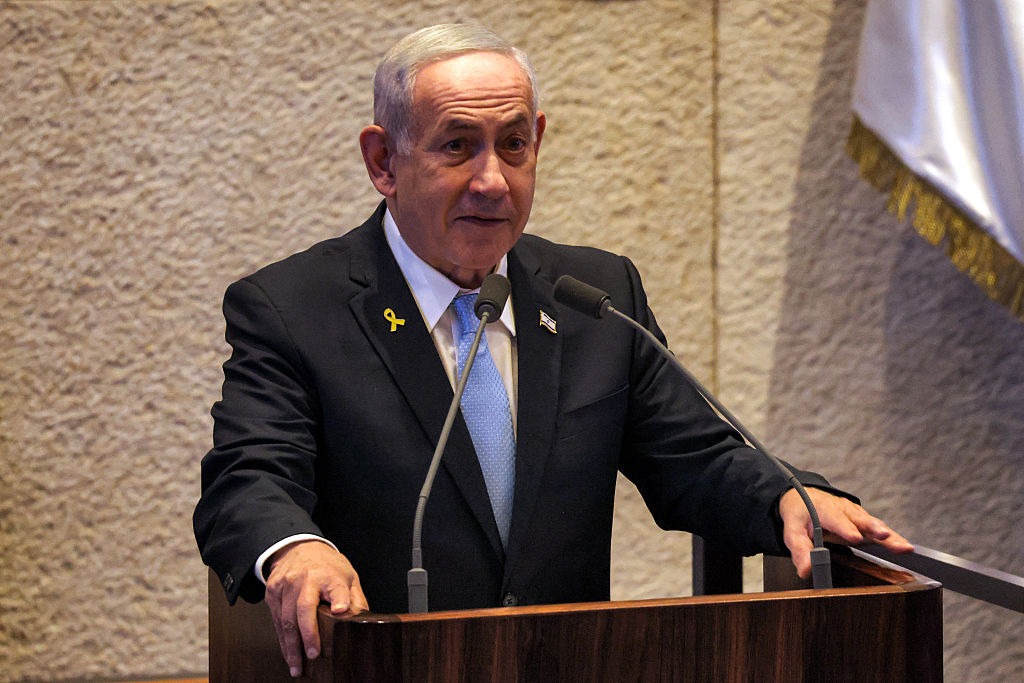
There seem to be three more concerns at present among the Israeli public. First, the choice of a future governing party and of the prime minister. While many parties in Israel criticize Prime Minister Benjamin Netanyahu for political gain and do their best to unseat him, it is to be hoped that he will once again emerge as prime minister of a new government following the elections. There does not appear to be a candidate of his stature or experience – or Churchillian determination to protect both Israel and the West.
Any politician who has been in leadership for many years can expect criticism and adverse press, at home and internationally. Contrary to the Biden administration, there is no discernible pressure from the Trump administration for Netanyahu not to win, despite unwarranted comments from time to time. Much can be said about Netanyahu, but one factor is beyond credible dispute: he has for the most part tried to act in the best interests of his nation – whether strengthening Israel's economy into that of a world-class giant, or refusing to buckle to pressure from any U.S. administration, irrespective of the high personal cost.
The Gaza scenario comes to mind here. As leader of the coalition government's largest party, Likud, Netanyahu saw that the policy of former Israeli governments towards terrorism from Gaza -- "mowing the lawn" every few years in an effort to contain constant Hamas attacks -- had proved to be a devastating miscalculation.
The context to this policy can be briefly explained as follows. In 2005, Israel's Prime Minister Ariel Sharon made a controversial decision to exit the Gaza Strip, expelled the thousands of Jews who had been living there, and handed it over to the Palestinian Authority (PA) to manage independently. Hamas soon ousted the Palestinian Authority from power in Gaza – sometimes by throwing its members from high buildings
Since that time, and only when proven necessary to maintain a semblance of order, the Israel Defense Forces (IDF) have hit Hamas through carefully targeted aerial strikes -- with no soldiers actually entering Gaza. This strategy was a massive failure. Hamas simply rebuilt its forces again -- as future developments disclosed in October 2023.
A prime minister only knows what he is told by the intelligence services. General Omar Bradley never told President Harry S. Truman that the Soviet Union had the atom bomb; Bradley apparently did not think that the president "needed" to know. Israel's senior military and intelligence service commanders failed dismally in their task to believe or to act on the warnings they received from their own soldiers, agents and analysts, yet blame for the disaster is unfairly leveled against Netanyahu. Israel's entire establishment -- the IDF, intelligence services, politicians and legacy media -- were equally culpable for the fiasco.
In 1946, Israel's future founding prime minister, David Ben-Gurion, explained to a young Shimon Peres – a future prime minister and president of Israel himself, and an inveterate compromiser for the sake of peace – that the Russian Jewish intellectual and Marxist revolutionary, Leon Trotsky, had been "no statesman." He elaborated that Trotsky's formula for settling issues of conflict had been simply to "walk out of the negotiations, declare the fighting over, and decide nothing."
Ben-Gurion then described what a real statesman would have done:
"A statesman must decide, one way or the other: to go for peace and pay the price, or to make war, knowing what the risks and dangers are."
That is precisely what Netanyahu did after decades of Hamas terrorism, Iranian proxy battles, and a massive military build-up by Hezbollah along Israel's northern border with Lebanon. Netanyahu made hard decisions, generally in the face of opposition from the US, Europe, so-called "human rights" organizations, and Israel's loud opposition, partially backed and funded by the Obama and Biden Administrations. Netanyahu nevertheless achieved his objectives: to secure his people against enemies determined to eliminate them and to preserve the nation for coming generations. Is everything about him perfect? Probably not. Is he a towering wartime leader and statesman? Absolutely.
The second socio-political concern is that of applying Israel's compulsory military draft to Haredi ("ultra-Orthodox") men. Israel's Supreme Court, after decades of delay, finally ordered eligible Haredi men to be conscripted in line with those from all other eligible sectors of Israel's population. Although such a ruling appears fair and just, the vast majority of the Haredi population believes that full-time Torah study for young men takes precedence over military service, while the community's religious and political leaderships demand that even young Haredi men who are not engaged in Torah study should be exempt from IDF service because they believe it poses a threat to the Haredi lifestyle and religious practice.
Although each year hundreds of young Haredi men enter IDF service in defiance of their community's leaders, they represent only about 9% of the annual draft-eligible Haredi cohort, compared to a roughly 88% conscription rate among secular and religious non-Haredi Jewish men. While other young Israeli men spend almost three years of their lives in full-time military service, and may be wounded or killed fighting to defend their nation, 91% of their Haredi peers spend those years studying, working, or even idling.
With the number of 18- to 19-year-old Haredi youths annually becoming eligible for conscription numbering more than 14,000 (and growing), a significant sector of the Haredi community objects, sometimes violently, to the conscription of their men. During mass protests of Haredi men and boys, some of them declare, "we will rather die than be drafted." The issue continues to divide Israeli society.
The third concern pertains to the problematic omnipotence of Israel's Supreme Court, in a country where there is no constitution and no enumerated separation of powers.
In his book, Rogue Justice: The Rise of Judicial Supremacy in Israel, Israeli-American lawyer Yonatan Green has produced a work on "the appropriate balance of power between the Knesset and the Supreme Court," according to commentator Neville Teller.
"Green believes that for some 40 years, power in the State of Israel has been deliberately, consistently, and illegally usurped by the judiciary.... [and] scrutinizes how the Supreme Court has misled itself into unbalancing the proper relationship between the judiciary and the government."
Teller writes of Green's assertion that the Court believes "its power over Israel's governance is absolute and cannot be challenged" -- indeed a serious situation for the social and political stability of a nation. A crucial doctrine of democracy -- the separation of powers between the three branches of government -- has been disregarded by Israel's Supreme Court, which does not require a plaintiff's standing to hear a case, and makes inroads into the domains of the executive and the legislature (the Knesset).
Whenever Netanyahu's government objects or opposes the Court's unwarranted interference in the executive branch's governance -- aided and abetted by the politically biased Attorney-General Gali Baharav-Miara, in whom the government evidently lacks confidence -- allegations are made by some Israelis that the government is subverting democracy and destroying the country. In reality the reverse is true. Unfortunately, many in Israel's media, as well as its politicians, have stirred up their supporters to demonstrate, sometimes violently, against proposed curtailments to virtually absolute -- unchecked and uncheckable -- judicial authority.
These three concerns, with a starkly polarized electorate, promise little change or compromise. The political area appears split into left and right with no true centrist party to mediate matters. The Haredi conscription situation pits most of the population against a privilege, considered by many unacceptable, afforded to young men well able to defend their nation but unwilling to do so – at a time when IDF conscripts as well as reservists have been giving more than their all in deadly war zones. Meanwhile, the Supreme Court shows no sign of curtailing its authoritarian forays into the mandate given to the Knesset and the executive branch to govern as they see best.
All who value Western civilization and freedom might pray for brave Israel and its defense of our freedoms in the words of the ancient Psalmist:
"For the sake of the house of the Lord our God,
I will seek your good."
— Psalm 122: 6-9
Nils A. Haug is an author and columnist. A lawyer by profession, he is member of the International Bar Association, the National Association of Scholars, a faculty member at Intercollegiate Studies Institute, the Academy of Philosophy and Letters. Dr Haug's particular field of interest is political theory connected to current events. Among degrees in Philosophy, English Literature, and Law, he holds an M.A. in Jewish Studies (cum laude) and a Ph.D. in Apologetical Theology. He is author of 'Politics, Law, and Disorder in the Garden of Eden – the Quest for Identity'; and 'Enemies of the Innocent – Life, Truth, and Meaning in a Dark Age.'. His work has been published by First Things Journal, The American Mind, Quadrant, Minding the Campus, Gatestone Institute, National Association of Scholars, Document Danmark, World Israel News, Israel Hayom, Jewish News Syndicate, Tribune Juive, Document Danmark, Zwiedzaj Polske,Schlaglicht Israel, Anglican Mainstream, Jewish Journal, The James Wilson Institute, The Australian Jurist, and others.