








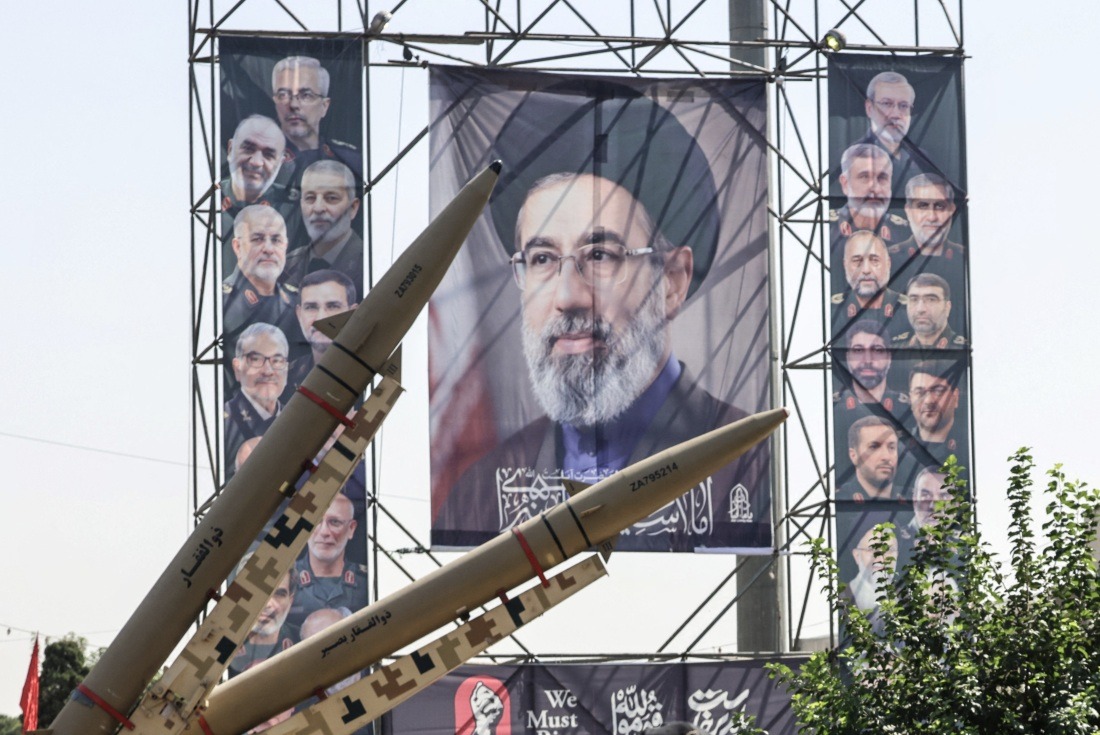
Any notion that Iran is serious about reaching a long-term peace deal with the US and its allies should be dismissed after the ayatollahs unveiled a new underground missile city designed for the specific purpose of attacking American forces in the Middle East and beyond.
With US President Donald Trump indicating a willingness to revive peace talks with Tehran, the Iranian regime has revealed its true intentions towards the West by releasing a six-minute film from the subterranean missile base, which belongs to the air force of the Islamic Revolutionary Guard Corps (IRGC). The branch also controls Iran's ballistic missiles.
The video is designed to demonstrate Iran's continuing defiance in the wake of the devastation it suffered during Operation Epic Fury, when joint military operations conducted by the US and Israel succeeded in destroying Iran's nuclear facilities and much of the country's military infrastructure.
Despite these significant setbacks, the IRGC has continued to attack the US and its allies throughout the Middle East and has made no serious effort to engage in peace efforts to end the conflict.
The release of the new video showing the underground bunker storing Iran's new ballistic and cruise missiles and their launchers demonstrates that, far from seeking to end the conflict through peaceful means, the ayatollahs are instead preparing for a new round of hostilities against the US.
In one recent attack, the IRGC announced its forces had struck and destroyed a US early-warning radar installation in Bahrain, according to the IRGC-affiliated Fars news agency.
"In response to the enemy's aerial aggression against a telecommunications tower in Sirik, IRGC Aerospace Force fighters targeted and destroyed the American aggressors' early-warning radar on the island of Bahrain a few hours ago," the IRGC said in a statement carried by Fars.
The video released of the underground missile complex displays some of the country's most powerful weapons, including the Fattah – which Iran describes as a hypersonic missile – and the long-range Khorramshahr missile.
A portrait of Hassan Tehrani Moghaddam, the "father" of Iran's missile programme, is clearly visible hanging inside the bunker, alongside images of Iran's Supreme Leader Mojtaba Khamenei. One missile is daubed with a slogan in Persian reading "You will be made wretched".
Unveiling the base, Brig Gen Seyyed Majid Mousavi, the commander of the IRGC's aerospace division, said Iran was ready "to confront any threat in the region and beyond".
He warned: "If necessary, we will bring all of their capacities in the region and beyond under our fire, and leave nothing for the enemy but defeat."
Iran's increasingly aggressive behaviour comes at a time when the Trump administration appears to have been giving serious consideration to reviving stalled peace talks aimed at ending the Iran conflict.
After the Republican Party's disastrous showing in the recent midterm elections, which many analysts have blamed on rising energy prices caused by the Iran conflict, the American president is under pressure to end the conflict, even though it could result in a deal which leaves the ayatollahs in power.
Trump's willingness to give serious consideration to the latest diplomatic talks aimed at bringing hostilities to an end was evident in comments he made after meeting with Qatari Prime Minister Sheikh Mohammed bin Abdulrahman Al Thani, who is leading efforts to resolve the crisis diplomatically.
Following talks with the Qatari leader, Trump declared the US-Iran war "effectively over" from a military perspective, while cautioning the US military remained "locked and loaded" should the negotiations fail.
While details of the Qatari-led initiative to end the conflict have not been forthcoming, the Trump administration has taken an enormous risk by relying on Qatar, which openly backs Islamist groups such as the Muslim Brotherhood, to negotiate a deal that is in the United States' best interests.
The Trump Administration, for example, has made it abundantly clear that it will not sign up to any agreement that enables the ayatollahs to pursue their efforts to develop nuclear weapons. Other key issues include Iran renouncing its claim to control the Strait of Hormuz and agreeing to end its support for Islamist terrorist operations throughout the Middle East.
As the Qataris themselves are no strangers to backing Islamist terror groups in the region, it is doubtful in the extreme that they can be relied upon to negotiate a deal that adequately addresses American concerns.
The Qataris have also made it clear that they do not share the desire among many within the Trump Administration to achieve wholesale regime change in Tehran, which would be the only effective way of ending hostilities between the US and Iran which have been ongoing, at varying levels of intensity, since the ayatollahs first seized power in Tehran in 1979.
For the brutal truth is that, so long as the ayatollahs remain in power in Tehran, Iran will continue to threaten the US and its allies in the Middle East and beyond, a consideration Trump should take on board as he weighs any future "peace deal" with Tehran. The Iranian regime has also shown that they will not comply with any "deal" to which they agree for more than a few minutes.
Even though Iran is supposed to be engaged in diplomatic efforts to end the war, Iranian forces continue to attack shipping in the Strait of Hormuz, while at the same time supporting efforts by Houthi terrorists in Yemen to cause similar disruption in the Red Sea.
Iran's Supreme National Security Council Secretary Mohsen Rezaei said in a post on social media that Trump was only taking an interest in the peace talks because of the losses the Republicans suffered in the midterm elections.
"The war on Iran has already wrecked the US government," Rezaei wrote. "But Washington flails like a desperate gambler," "FOLD YOUR HAND. STOP manufacturing FAKE NEWS about imaginary talks."
Comments such as this demonstrate that, so long as the ayatollahs remain in power, there is absolutely no chance of the US negotiating a real long-term peace deal with the Iranian regime.
Con Coughlin is the Telegraph's Defence and Foreign Affairs Editor and a Distinguished Senior Fellow at Gatestone Institute.