








When the United States and Israel launched their joint operation against the Iranian regime this month, the geopolitical map of the Middle East shifted within hours. Iran's leadership, strategic targets, command centers of the Islamic Revolutionary Guard Corps, ballistic missile launchers and nuclear facilities have been targeted in coordinated strikes aimed at dismantling Tehran's terror machine.
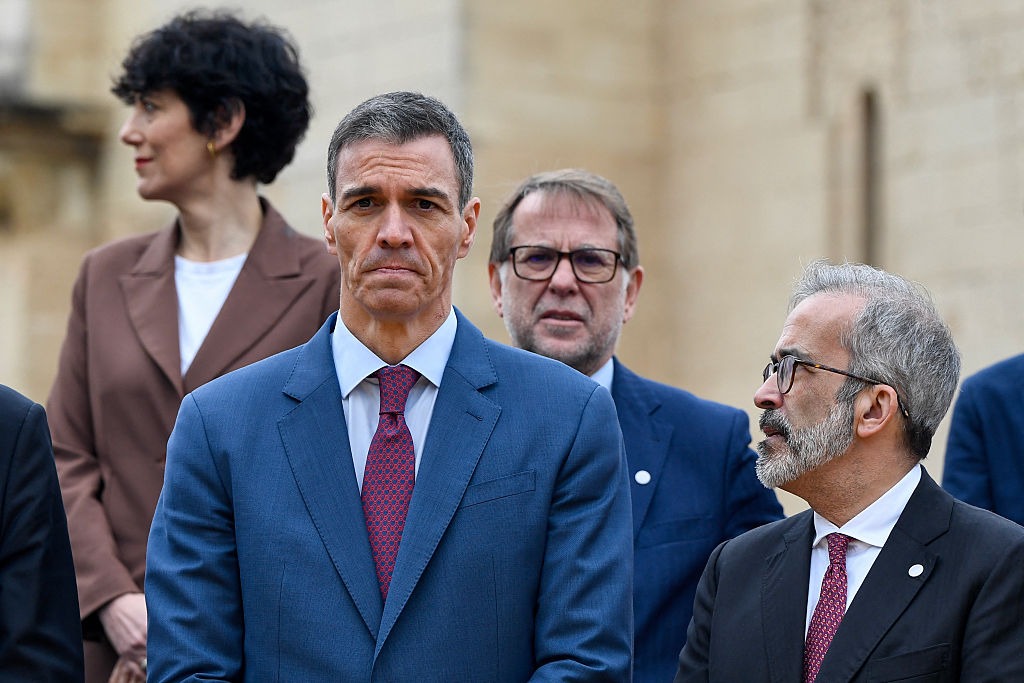
Yet there have been unexpected obstacles — not in Tehran, but in Madrid. Prime Minister Pedro Sánchez's government flatly refused to authorize the use of Spanish airspace or the joint bases at Rota and Morón for American forces. For decades, these installations have been vital logistical hubs for US military operations in the Mediterranean and the Middle East. This time, Madrid said no.
President Donald Trump reacted with fury, warning of serious economic consequences for a NATO ally that chose to obstruct a critical operation against one of the world's most dangerous regimes. The White House message was blunt: when the US confronts a regime openly dedicated to America's destruction and which is responsible for decades of terrorism, "neutrality" is not neutrality — it is a political choice that aids the enemy.
Spain's refusal was no isolated incident. It was the logical climax of a long ideological trajectory that has turned the Sánchez government into one of the most hostile to the US and Israel in Europe.
Madrid's Growing Hostility Toward Israel
Under Sánchez, Spain has repeatedly accused Israel of "disproportionate" and even "genocidal" responses to Hamas while staying noticeably silent on Iran's central role in arming and directing this terrorist group. Spain has also championed diplomatic initiatives to isolate Israel internationally, tolerated and sometimes echoed BDS (boycott, divestment, sanctions) rhetoric, and blurred the line between policy criticism and outright hostility toward the Jewish state. Israeli officials have repeatedly warned that Madrid's language now mirrors narratives promoted not by democratic partners, but by regimes that openly call for Israel's elimination.
The hostility reached a new low in September 2025, when Sánchez announced a total arms embargo on Israel — banning all exports and imports of defense equipment and dual-use technology — and prohibited ships or aircraft carrying fuel or military material bound for Israel from using Spanish ports or airspace. In the same speech, he openly lamented Spain's military limitations: "Spain, as you know, does not have nuclear bombs... We alone cannot stop the Israeli offensive." Critics rightly interpreted the remark as a chilling admission that if Spain did have nuclear bombs, it would have used them against Israel. That a European head of government uttered such a threat against the Middle East's only democracy speaks volumes about the moral rot at the heart of Sánchez's government.
The Coalition That Keeps Sánchez in Power
Sánchez's posture is hardly accidental. It flows directly from the fragile coalition that props up his Socialist Party government. To remain in office, he depends on the even further-left Podemos, a party born of radical activism whose founders have long been entangled in troubling financial networks linked to regimes hostile to the West — in particular Venezuela under Hugo Chávez and Nicolás Maduro.
The Venezuela Connection: CEPS, Millions from Chávez and the Bolivarian Project in Europe
The epicenter of the links between Podemos and Venezuela is the Centro de Estudios Políticos y Sociales (CEPS), the foundation where key Podemos founders — Pablo Iglesias (responsible for strategic analysis), Juan Carlos Monedero, Íñigo Errejón and others —worked for years. CEPS openly advised leftist Latin American governments, including Chávez's Venezuela.
According to official records from Spain's Ministry of Culture (Registro de Fundaciones), CEPS received at least 3.7 million euros from the Venezuelan government between 2002 and 2012 — often representing over 80% of its annual income in certain years. Investigative reports and leaked documents (including one signed by Venezuelan Finance Minister Rafael Isea in 2008) push the total to 7.16 million euros between 2003 and 2011, earmarked for "advisory services," policy analysis, and — crucially — the promotion of the Bolivarian movement in Spain and Europe.
A former high-ranking Venezuelan official cooperating with America's DEA has confirmed that Caracas and Tehran coordinated efforts to fund emerging radical-left forces in Europe, with Podemos as a prime target. The goal: weaken Western alliances from within by nurturing anti-American, anti-Israeli voices.
Direct payments to individuals have also been alleged. UDEF investigations pointed to $272,325 allegedly paid to Pablo Iglesias in 2014 via an offshore account in the Grenadines linked to the Venezuelan regime (though these claims led to a 2025 Supreme Court ruling against OkDiario for defamation, the underlying financial patterns via CEPS remain undisputed). Other founders like Carolina Bescansa, Jorge Lago and Ariel Jerez reportedly received $142,000 through subcontracts tied to Venezuela's state-owned oil and gas company.
CEPS quietly ceased operations in 2016 amid mounting scrutiny. Podemos has consistently denied any illicit funding, instead framing the payments as legitimate consulting fees for academic and advisory work. Yet the scale, the timing (peaking just before Podemos' 2014 launch) and the beneficiaries raise unavoidable questions: was this mere intellectual exchange, or seed money for a political project designed to echo Venezuela's "anti-imperialist" rhetoric in the heart of the European Union?
The Venezuelan link is not isolated — it intersects directly with the Iranian network, forming a Caracas-Tehran axis that funneled resources to the same ecosystem.
The Deep Iranian Penetration: HispanTV, Millions in Cash, and a Propaganda Machine
The Iranian connection is structural and documented by multiple police investigations. The central vector was HispanTV, the Spanish-language propaganda channel created and fully funded by the Iranian regime to spread its narrative across Spain and Latin America. The Iranian businessman in charge of its Spanish operations, Mahmoud Alizadeh Azimi, also controlled the production company 360 Global Media (later renamed Ziba Talents).
According to reports, between 2012 and 2015 alone, approximately 9.3 million euros were injected from Iran into 360 Global Media through 16 shell companies suspected of money laundering. The funds arrived via 67 suspicious transfers, mostly routed through opaque jurisdictions to bypass sanctions. Police sources estimated that 25% of these Iranian funds — 2.4 million euros, or between 600,000 and 700,000 euros per year — was diverted to the "audiovisual communication network" of Podemos: direct payments to Pablo Iglesias, his closest collaborators, and the production companies they controlled.
Iglesias himself hosted and directed the flagship program Fort Apache on HispanTV. Official police figures: 93,000 euros paid to him personally between 2013 and 2015 through 23 separate transfers from the Iranian-linked company. Even more damning: in February 2025, new judicial documents revealed that Iglesias continued to invoice the same Iranian producer in 2016—12,600 euros in six payments between February and July—after he had already become a deputy in the Spanish Congress. The mechanism was as simple as it was effective: inflated invoices for "production services" that allowed Tehran to channel money discreetly to its European political allies.
Podemos has always denied any wrongdoing, calling the revelations "politically motivated smears" by the right. Yet no court has ever cleared the party of these massive financial flows. The pattern remains: millions of euros from the Iranian regime — and parallel flows from Venezuela — landed precisely in the pockets and production companies of the men who founded Podemos and who later became the kingmakers of the Sánchez government.
From Ideology to Foreign Policy
By the time Sánchez formed Spain's governing coalition, anti-American and anti-Israeli positions had moved from the fringes to the heart of government policy. Spain now frames its stance as "principled multilateralism" while displaying selective outrage: furious condemnation of Israel's self-defense, striking leniency toward the Iranian regime, and silence on Venezuela's dictatorship. The refusal to let American forces use Spanish bases during the current Iran operation is therefore not a sudden surprise — it was the predictable outcome of years of ideological and financial capture.
When Anti-Zionism Becomes Something Else
In parts of Europe's radical left, Israel is no longer merely criticized; it is portrayed as a uniquely illegitimate, colonial, genocidal entity. Within this worldview, Tehran's explicit calls for Israel's destruction were downplayed as mere rhetoric. Sánchez's nuclear weapons remark perfectly illustrates how anti-Zionism can slide into something far darker: the open fantasy of possessing weapons of mass destruction to coerce the Jewish state. When the prime minister of a NATO member state publicly regrets not having nuclear weapons to "stop Israel," the mask slips. What remains is not diplomacy, but a dangerous alignment with the eliminationist camp.
A Strategic Question for the Western Alliance
None of this proves direct corruption inside Sánchez's inner circle, but the convergence of ideological sympathy along with documented millions of euros from Tehran and Caracas flowing into his coalition partners' networks, and concrete policy decisions that undermine the West is impossible to ignore. A European government that blocks a vital operation against Iran while maintaining alliances with movements historically tied to Iranian and Venezuelan influence networks has placed itself outside the democratic consensus.
For the US, this is unacceptable. For Israel, it is alarming. For Europe, it raises a question that is actually existential: how deeply have the ideological and financial tentacles of Tehran and Caracas penetrated the continent's political class?
Spain's decision is more than a diplomatic spat. It reveals how far the shadow of the ayatollahs — and their Bolivarian allies — now stretches into the heart of the Western alliance.
When a NATO member obstructs action against a regime sworn to the destruction of America and Israel, the question is no longer whether influence exists. The question is how far it reaches — and how much damage it has already done and is planning to do.
Finally, frightened by the prospect of the measures promised by Trump, particularly regarding the threat of tariffs, the Sánchez government has temporarily abandoned ideology in favor of a provisional form of rationality: Spanish airspace — however late and, to borrow Trump's remarks, "after we've already won" — is once again open to US forces.
Pierre Rehov, who holds a law degree from Paris-Assas, is a French reporter, novelist and documentary filmmaker. He is the author of six novels, including "Beyond Red Lines", "The Third Testament" and "Red Eden", translated from French. His latest essay on the aftermath of the October 7 massacre " 7 octobre - La riposte " became a bestseller in France. As a filmmaker, he has produced and directed 17 documentaries, many photographed at high risk in Middle Eastern war zones, and focusing on terrorism, media bias, and the persecution of Christians. His latest documentary, "Pogrom(s)" highlights the context of ancient Jew hatred within Muslim civilization as the main force behind the October 7 massacre.
 Harvey Lithwick