








On May 11 and 12, the Palestinian Authority organized mass rallies across the West Bank to commemorate the "Nakba" ("catastrophe") -- the term Palestinians use to describe the establishment of the State of Israel in 1948.
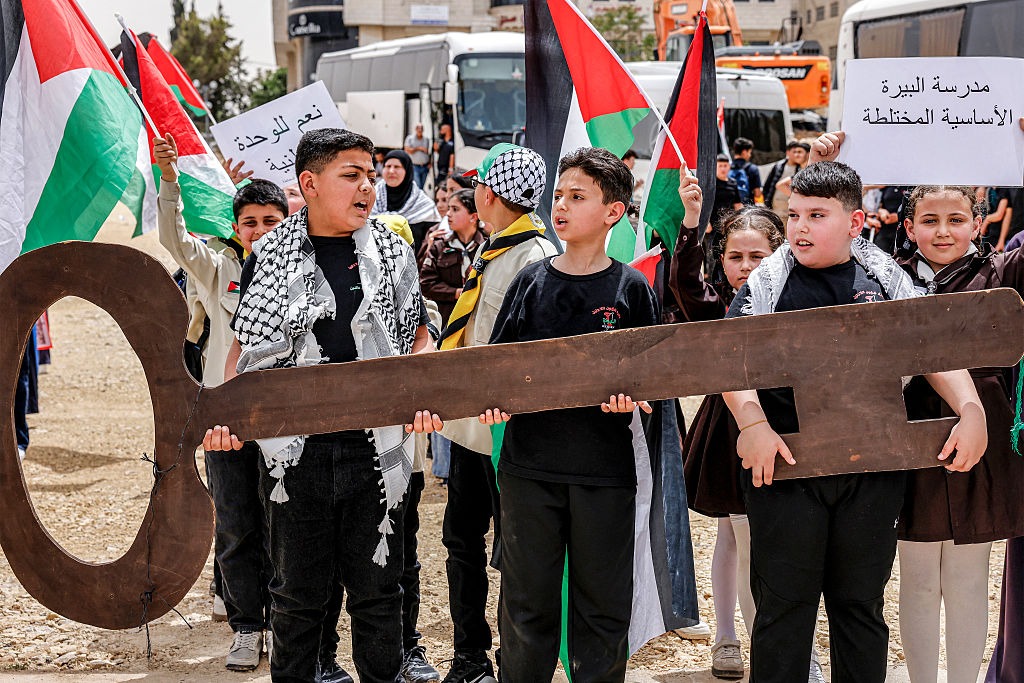
Hundreds of Palestinians marched through the streets of Ramallah, the de facto capital of the Palestinians, waving flags, carrying "keys of return," and chanting slogans such as "We live a new Nakba every day" and "We will never forget the right of return."
Senior Palestinian officials, including top figures from the ruling Fatah faction and the Palestine Liberation Organization (PLO), participated in the event, once again reaffirming their commitment to the Palestinian refugee issue and the so-called "right of return."
PLO Executive Committee member Wasel Abu Yousef said that after 78 years, "the occupation [Israel] is trying to undermine the sacred right of return."
He added that the "right of return" for refugees will remain "a historical constant that cannot be forfeited by the passage of time."
At first glance, the "right of return" may sound humanitarian and symbolic. In reality, however, it represents one of the most extreme demands in the Israeli-Palestinian conflict.
When Palestinian leaders speak about the "right of return," they are not talking about resettling refugees in a future Palestinian state in the West Bank or Gaza Strip. They are demanding that millions of Palestinians classified as "refugees" – including descendants of the original refugees from 1948-49 – be allowed to settle inside Israel itself. The goal is to flood Israel with millions of Palestinians and transform Jews into a minority in their own country.
This demand fundamentally contradicts the idea of a "two-state solution." Under a genuine "two-state solution," Palestinians would establish their own independent state alongside Israel. Yet Palestinian leaders are effectively saying that they want not only a Palestinian state, but also the demographic destruction of Israel through mass migration.
No Israeli government – left, right, or center – could ever agree to national suicide.
This is why the "right of return" has remained one of the core obstacles to peace negotiations since the signing of the Oslo Accord between Israel and the PLO in 1993.
The continued glorification of the "Nakba" and the insistence on the "right of return" demonstrate that many Palestinians have not abandoned their long-term dream of replacing Israel rather than living peacefully beside it.
For many in the West, "Nakba Day" often is portrayed as a day of mourning and remembrance for Palestinian refugees who lost their homes during the 1948-49 Arab-Israeli war. What is frequently ignored, however, is the political message behind such commemorations and the dangerous implications they carry for any future peace between Palestinians and Israelis.
By defining Israel's establishment as a "catastrophe," the Palestinian leadership is effectively telling its people that the very existence of Israel is illegitimate. This is not the language of reconciliation, coexistence, or compromise. It is the language of rejectionism and extremism.
Imagine if, every year, one side of the conflict commemorated the creation of the other side's country as a disaster that must be reversed. Would anyone seriously believe that such rhetoric prepares people for peace and compromise?
The annual Nakba commemorations do not merely express grief over historical events. They reinforce the narrative that Jews are foreign colonialists with no legitimate historical or national connection to the land. This narrative erases thousands of years of Jewish history in Jerusalem, Hebron, Judea, Safed, Tiberias, and elsewhere in Israel.
The message Palestinians hear from their leaders is unambiguous: Israel was born in sin, has no right to exist, and one day should disappear. This schooling explains why peace efforts have repeatedly failed over the past decades.
One of the greatest obstacles to peace has always been the failure of Palestinian leaders to prepare their people for compromise with Israel. There is, bluntly, no will whatsoever to do that. While some Westerners continue to speak about a "two-state solution," Palestinian leaders continue to educate their people that all of Israel is "Occupied Palestine."
Palestinian school textbooks, official media, speeches, and public events do not prepare Palestinians for the idea that Jews are a legitimate people with national rights in the Middle East. Instead, Palestinians are taught to view Israel as a temporary, illegitimate entity. Maps used in geography and history textbooks usually omit the State of Israel entirely. The entire region between the Jordan River and the Mediterranean Sea is labeled as "Palestine," erasing Israeli cities or renaming them as Palestinian localities.
What makes the latest Nakba events especially significant is their timing.
These rallies come at a moment when the Trump administration is demanding reforms from the Palestinian Authority, particularly in the areas of education, incitement, and governance.
For years, Western governments have pressured the Palestinian Authority to revise its school curricula, stop incitement against Israel, combat antisemitism, and prepare Palestinians for peaceful coexistence. Palestinian officials most often respond by promising reform and moderation.
The scenes from Ramallah and other Palestinian cities, however, tell a very different story.
How can a leadership that celebrates Israel's creation as a "catastrophe" be serious about peace? How can leaders who continue promoting the fantasy of the "right of return" claim to support coexistence? How can the international community expect real reform while Palestinian leaders continue indoctrinating their people with narratives of rejection and victimhood?
Or does the international community not expect any reform and secretly hope that the Palestinians might "take care of the Jewish problem" without them having to get their own hands dirty?
The Trump administration and Western donors should pay close attention to the messages emerging from Ramallah. The problem is not just Hamas or Palestinian Islamic Jihad. The problem is far deeper and more widespread.
Even the supposedly "moderate" Palestinian Authority leaders continue to promote narratives that erase Israel's existence and deny Jewish historical rights.
A leadership that seeks peace would educate its people for compromise, mutual recognition, respect and coexistence. It would teach Palestinians that Jews are not foreign invaders, but a people with nearly 4,000 years of deep historical roots in the land. In addition, it would prepare Palestinians to build their own future rather than dream of reversing the outcome of the 1948 war. Instead, Palestinian leaders continue to commemorate Israel's birth as a tragedy and promise that the struggle against its existence is not over. So long as this narrative dominates the Palestinian political culture, peace will remain not possible.
Khaled Abu Toameh is an award-winning journalist based in Jerusalem.
 Crazy Charlie