








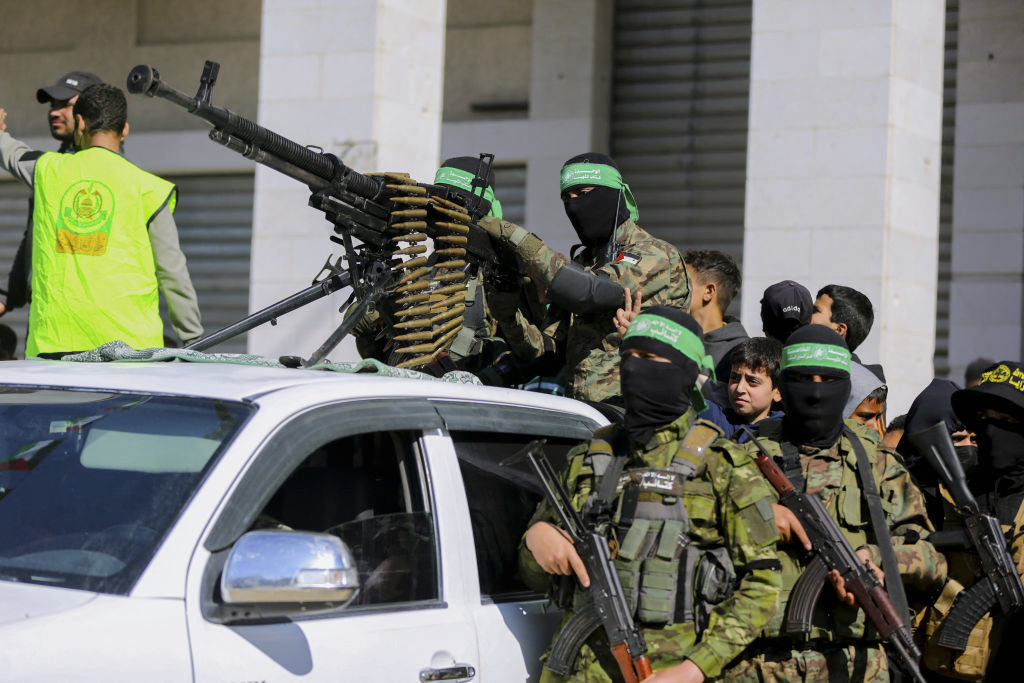
Six months after US President Donald J. Trump unveiled his ambitious ceasefire and reconstruction plan for the Gaza Strip, the Iran-backed Hamas terrorist group remains more armed, entrenched, and openly defiant than ever. Far from disarming, the Islamist group now controls roughly half the Gaza Strip and much of its population, while making a mockery of Trump's "Board of Peace" initiative and the international mediators sponsoring it.
It is now clear that the Trump administration's strategy was based on a misguided assumption that Hamas (a theocratic terror regime like Iran's) could somehow be persuaded through negotiations, incentives, and diplomatic pressure to voluntarily surrender its weapons and abandon its jihadist ideology.
The exact opposite has happened. Hamas not only rejected disarmament, but also used the ceasefire periods to solidify control, regroup politically and militarily, and humiliate the people negotiating with them.
According to Palestinian and Israeli sources, talks between Hamas and representatives of the "Board of Peace," headed by former United Nations official Nickolay Mladenov, recently reached a dead end in Cairo after Hamas again rejected the central demand of Trump's 20-point plan: total disarmament.
"No one was surprised six months ago, and no one is surprised today that Hamas refuses to disarm," an Israeli source familiar with the negotiations told i24 News.
Indeed, no one should be surprised.
Expecting Hamas to disarm voluntarily is like expecting ISIS or Al-Qaeda to renounce jihad (holy war) and become peaceful political movements.
Hamas's weapons are not merely military tools; they are the foundation of its ideology, identity, and power. Asking Hamas to hand over its weapons is essentially asking the group to sign its own death warrant.
Hamas leaders themselves are not hiding their position. Recently, an unnamed Hamas official declared bluntly that his group "will not accept disarmament." Another insisted that the issue of weapons could only be discussed within the framework of a future Palestinian state and broader political arrangements.
Hamas, in other words, is clearly saying: no disarmament now, no disarmament later, no disarmament ever.
Yet, despite these repeated rejections, the "Board of Peace" continues its embarrassing efforts to negotiate with Hamas over the surrender of its weapons. The entire spectacle has become surreal. Instead of confronting Hamas with meaningful consequences, the international mediators appear to be pleading with the terrorist group to cooperate.
What happened to all the deadlines, ultimatums and threats issued by Trump and his administration over the past year? What happened to the repeated warnings that Hamas would face devastating consequences if it refused to disarm?
So far, Hamas has paid no meaningful price for its defiance.
On the contrary, Hamas seems to interpret the continued negotiations as a sign of weakness and desperation. Every new round of talks in Cairo reinforces Hamas's belief that the international community lacks either the will or the courage to confront it decisively.
The mediators, especially Qatar, Egypt and Turkey -- all of which maintain direct channels with Hamas and present themselves as key brokers in the negotiations -- also deserve scrutiny. These countries, unsurprisingly, are not exerting serious pressure on Hamas to disarm.
Qatar has spent years funding the Hamas-controlled Gaza Strip while hosting the terror group's leaders in luxury hotels in Doha. Turkey openly supports Hamas politically and ideologically. Egypt periodically pressures Hamas on border-security issues, yet still treats it as a legitimate political actor rather than as a terrorist group committed to Israel's destruction.
If these mediators truly wanted to disarm Hamas, they possess significant leverage. The reality is that none of them appear genuinely committed to dismantling Hamas militarily or politically.
Meanwhile, Hamas continues to exploit the negotiations to buy time.
Reports indicate that Hamas may be willing to discuss only limited, phased restrictions on certain heavy weapons while retaining light weapons and preserving its core military infrastructure. This is not disarmament. It is a tactical maneuver designed to preserve Hamas's rule while extracting concessions from Israel and the international community.
Hamas reportedly seeks reciprocal Israeli withdrawals and additional humanitarian and economic benefits for partial limitations on some of its weapons. Hamas wants all the advantages of remaining armed while receiving the benefits of reconstruction and international legitimacy. The current negotiations in Cairo are fundamentally detached from reality.
Islamist groups and regimes do not surrender because of diplomatic persuasion. Hezbollah did not lay down its weapons after becoming part of the Lebanese political system. The Taliban in Afghanistan did not moderate after negotiations with the US. Iran's regime has not abandoned its nuclear weapons program or its revolutionary ideology despite decades of diplomacy and sanctions relief. Hamas is no different.
For Hamas, armed "resistance" is not negotiable: it is the group's very reason for existence. Disarmament would mean losing control over the Gaza Strip, losing its ability to intimidate rivals, and losing the ideological narrative that sustains it: jihad until Hamas replaces Israel with an Islamist state.
Hamas leaders are also apparently worried that disarmament would expose their members to revenge attacks from rival clans and angry civilians inside the Gaza Strip. Hamas leaders understand that many Palestinians blame their organization for bringing catastrophe upon the Gaza Strip through its October 7, 2023 invasion of Israel, which started the war.
This is why Hamas will never voluntarily surrender its weapons or power.
The failure of Trump's Gaza plan is now becoming increasingly difficult to hide. The "International Stabilization Force" envisioned under the peace plan has not materialized. Funding commitments remain incomplete. The technocratic Palestinian committee meant to govern the Gaza Strip is dysfunctional.
Most importantly, Hamas remains armed and in control.
The continued failure to enforce disarmament damages US credibility throughout the Middle East. America now appears unable to impose its own conditions even after using repeated threats and ultimatums to Hamas. America's allies are watching closely, as are Iran and its other terror proxies.
Trump's "Board of Peace" should stop humiliating itself by chasing fantasies about Hamas moderation. The longer the negotiations continue without results, the stronger Hamas appears -- and the weaker the US appears.
Khaled Abu Toameh is an award-winning journalist based in Jerusalem.
 Sandra Smith