








The Islamic Republic of Iran has long mastered the art of deception, particularly when it comes to its nuclear program. Many times, it has been caught advancing its nuclear ambitions behind closed doors -- from covert enrichment facilities to undeclared sites -- only, when exposed, to delay, deflect and deny.
Now, the regime is not even hiding it.
Iran, like the rest of us, saw President Donald Trump foolishly change his mind from prohibiting Iran's regime from having ballistic missiles to permitting them -- supposedly to defend themselves in a neighborhood that has been relatively peaceful except for them. The Times of Israel reported Trump's decision:
"If other countries have them, it's a little bit unfair for them not to have some," Trump said. "If Saudi Arabia and Qatar, and they all have some, I would say that in relative proportion, I think it's okay" for Iran to have ballistic missiles as well.
"Missiles aren't the problem... They hurt a little location, but they don't blow up the planet [like nuclear weapons do]," Trump said.
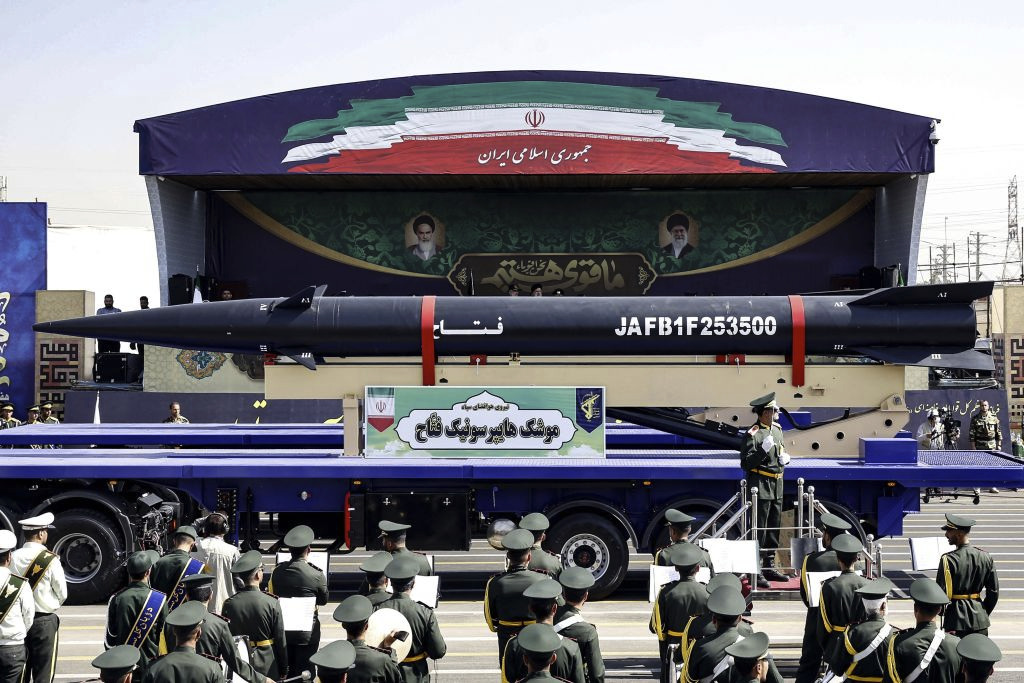
Ballistic missiles may not be able to "blow up the planet," but they do seem to have been the reason Trump declared a fatal premature ceasefire on April 8. Saudi Arabia and presumably other Arab Gulf States let it be known that they were not happy about being victims of them. Iran's missiles can now reach Europe. Soon they will undoubtedly have even longer ranges, to target America's east coast cities, and be even more precise. Just wait until they are tipped with nuclear warheads.
Iran saw Trump's turn-around on permission to have ballistic missiles and – largely using Trump's own logic, implied deterrence – must have thought, "Why not nuclear weapons too?"
After the recent Islamabad Memorandum of Understanding with the United States that followed devastating blows from Israeli and US strikes, Iran's state media outlet Fars News published a striking commentary, titled along the lines of "No Choice but to Build the Nuclear Bomb." Such a statement does not appear in such an outlet without high-level approval. This marks a shift; the regime is openly declaring its intentions.
Fars argued that Iran must achieve "nuclear deterrence" to negotiate from strength. It framed this as essential amid a changing world order. This is not rogue commentary. Fars reflects hardline thinking from the Islamic Revolutionary Guard Corps (IRGC). Its publication underscores that the regime feels emboldened enough to voice what it has long pursued in the shadows.
The goal seems to be to outlast the current US administration and then openly march toward nuclear bombs.
This is an ideological, fundamentalist regime founded on exporting revolution. The Islamic Republic's founding "Supreme Leader," Ayatollah Ruhollah Khomeini, declared:
"We shall export our revolution to the whole world. Until the cry 'There is no god but Allah' resounds over the whole world, there will be struggle."
Iran's constitution enshrines the duty to spread this theocratic ideology. The regime views itself as a vanguard against perceived enemies, with ambitions that transcend borders invented by infidels. One look at Libya and Ukraine, which gave up their nuclear weapons with catastrophic results, and then at North Korea, which did not, tells the regime everything it needs to know. A nuclear deterrent is the ultimate insurance for survival -- and expansion.
The International Atomic Energy Agency, repeatedly struggling with Iran's restrictions on monitoring and inspection of nuclear sites, missed presumably most clandestine advances. Even after the strikes, and pledges in recent understandings to allow inspectors back, the regime has an ostentatious track record of using diplomacy as a cover to advance its nuclear weapons programs in secret while talking peace. Post-Trump, or after any perceived lapse in resolve, the path to weaponization will rapidly accelerate.
This critical moment is not helped by wishful thinking. Flawed agreements, or even ones that look firm, will simply wait until the US has turned its attention somewhere else.
So long as Iran's ruthless IRGC military regime is in place, there will not be real compliance or real peace.
First, the current regime needs to be weakened even further. The US and Israel may have levelled several of the "top layers" but there are apparently many more to go.
The regime cannot sustain indefinite pressure on multiple fronts — economic collapse, internal unrest, and external isolation — while pursuing grand ideological goals. Before a US administration that was resolute, the Iranian regime's days could be numbered. Giving it oxygen now risks a nuclear-armed Iran emboldened to pursue domination, and threatening Israel, Gulf states and the United States. Targeted military responses against renewed ballistic missile, nuclear, and proxy activities -- or members of the regime who are not helpful -- remain on the table. There are no shortcuts.
For the sake of the Iranian people and international stability, the focus must be on finishing the job: unrelenting pressure and denying the regime any tools that might threaten the world. Anything less perpetuates an Iran openly bent on destruction.
Dr. Majid Rafizadeh is a political scientist, Harvard-educated analyst, and board member of Harvard International Review. He has authored several books on the US foreign policy. He can be reached at dr.rafizadeh@post.harvard.edu
 Tom Fitzpatrick