








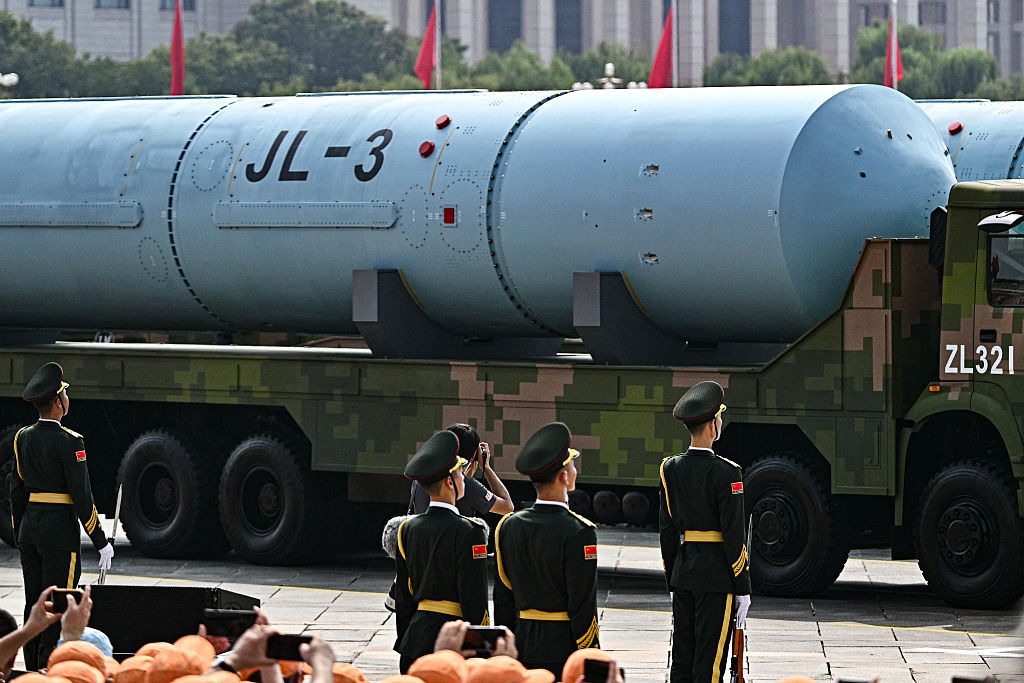
On July 6, a Chinese Navy submarine launched either a JL-2 or JL-3 nuclear-capable, intercontinental ballistic missile.
The missile, traveling in a southeasterly direction and carrying a mock warhead, landed in the Pacific Ocean, in the South Pacific Nuclear Free Zone.
The launch was the first known Chinese submarine-launched missile test since 1982 and the first ever from a Chinese nuclear-powered sub.
"China's long-range ballistic missile launch wasn't just a routine drill," the House Select Committee on China posted on X on July 6. "It was yet another act of CCP aggression toward our allies and like-minded partners in the Indo-Pacific."
"Beijing is testing global patience to its absolute limit with an alarming nuclear-capable escalation directly in the Pacific," commented the UnveiledChina site on X.
The official Xinhua News Agency called the launch "a routine arrangement of the annual training of the PLA Navy" and declared it was "not directed at any specific country or target."
Whether targeting any specific country or not, China's military activities have become far more brazen. Some Americans, unfortunately, have not noticed. For instance, Senators Edward Markey and Bernie Sanders introduced the Smarter Approach to Nuclear Expenditures Act last September.
The SANE Act, as they call it, "would reduce wasteful nuclear weapons programs and generate tens of billions of dollars in cost savings."
"It is time to halt the proliferation of wasteful nuclear weapons programs and create a future that is safe from the dangers of nuclear conflict," Markey stated. "Under Trump, the United States is inviting a new nuclear arms race that will endanger the lives of Americans as well as all those around the world."
The United States is "inviting a new nuclear arms race"? The number of deployed warheads of China, Russia, and North Korea — perhaps 6,100 — outstrips that of the U.S., Britain, and France by about 460.
China, for one, is on a tear. It could possess far more than the 620 warheads as currently estimated.
The current number, however, is not the issue. "I don't think I've seen anything more disturbing in my career than the Chinese ongoing expansion of their nuclear force," said Frank Kendall when he was secretary of the Air Force in House testimony in March 2023.
"We are witnessing a strategic breakout by China," Admiral Charles Richard, then commander of U.S. Strategic Command in 2021, said.
The Pentagon, in a November 2022 report, forecast that China would quadruple warheads from about 400 then to 1,500 by 2035.
That is an underestimation. James Howe, the noted nuclear analyst, predicts China will have between 3,390 and 3,740 weapons by that year. Richard Fisher of the International Assessment and Strategy Center looks at the rapid increase in delivery platforms, such as missiles and submarines, and believes China will have 7,000.
Whatever estimate turns out to be correct, it is simply wrong to think, as Markey does, that the United States is to blame for an arms race. In fact, America has not been looking to increase the number of warheads.
America does plan to spend substantial sums on its arsenal. Markey reports "approximately $1 trillion over the next decade." But if the United States is to possess a deterrent, it will have to carry through with existing plans to simultaneously modernize all three legs of its nuclear "triad": missiles housed in land-based silos, weapons launched from submarines, and nukes carried by bombers and fighters.
All three legs of the U.S. nuclear deterrent are aging; in many cases delivery systems are already beyond useful lives. Parts of the arsenal now cost more to sustain than to replace.
The big spend is not "wasteful," and it is not driven by Washington. It is driven by Beijing.
There are now no more bilateral arms agreements with Russia. The last one, known as "New START," expired in February. The U.S. did not renew it because of blatant Russian violations and China's refusal to engage in arms-control talks. With Russia and China cooperating militarily, the U.S. is outnumbered.
The U.S. does not need to match the number of China's and Russia's nukes or delivery systems, but it does need to maintain a credible deterrent. Markey proposes to reduce "deployed strategic warheads from approximately 1,500 to 1,000."
Markey's proposal would create an imbalance that might tempt a bold or desperate aggressor to think it could, by making threats to launch, intimidate the U.S. into not defending an ally or friend. Russian President Vladimir Putin made such threats both before and after the start of his ongoing "special military operation" against Ukraine.
Is China also thinking of making threats of this sort? Beijing could have tested this missile anywhere, but its choice says much about its intentions. As the Lexington Institute's Rebecca Grant told Gatestone, "Beijing could not have picked a more obnoxious flight path."
The missile, for instance, overflew what the Chinese call the First Island and Second Island Chains and was aimed in the general direction of Fiji, which on the same day signed a landmark defense pact with Australia. The agreement had angered Beijing.
More ominously, the test told the world of Chinese plans. Various publications have said that the test showed China's second-strike — retaliatory — ability, but it also demonstrated something else. "This test clearly indicates China's intent to obtain a first-strike capability," said James Fanell, a former U.S. Navy captain who served as director of Intelligence and Information Operations for the U.S. Pacific Fleet, to this publication.
What will deter our enemies from launching nuke first-strikes? Perhaps a sea-launched nuclear-armed cruise missile, a Golden Dome missile-defense system, or "any number of new technologies and strategies," Peter Huessy of the National Institute for Deterrence Studies wrote shortly before China's missile launch.
One thing Huessy knows will not work: "unilateral restraint that does not take such threats seriously in the first place."
Gordon G. Chang is the author of Plan Red: China's Project to Destroy America, a Gatestone Institute distinguished senior fellow, and a member of its Advisory Board.
