









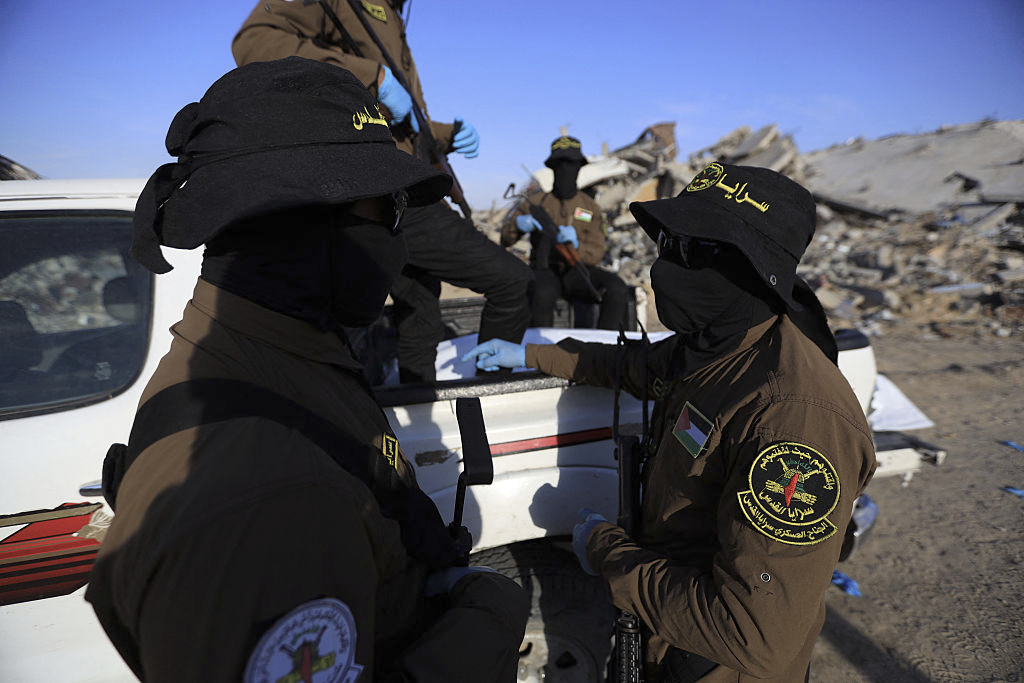
US President Donald J. Trump's plan for ending the Israel-Hamas war in the Gaza Strip is not a "peace plan." In the eyes of Hamas and other Palestinian terror groups, the plan is nothing but another temporary ceasefire, not different than previous ones reached between Israel and Hamas over the past two decades.
It is a mistake even to call it a "peace plan": Hamas has not yet abandoned its stated goal of destroying Israel and replacing it with an Islamist state.
Hamas, moreover, has never -- to this day -- recognized Israel's right to exist. Instead, Hamas continues to hold onto the idea that:
"The land of Palestine is an Islamic Waqf consecrated for future Muslim generations until Judgement Day. It, or any part of it, should not be squandered; it, or any part of it, should not be given up. Neither a single Arab country nor all Arab countries, neither any king or president, nor all kings and presidents, neither any organization nor all of them, be they Palestinian or Arab, possess the right to do that." (Hamas Charter, Article 11).
Those who think that Hamas, by agreeing to Trump's "peace plan," has abandoned its desire to eliminate Israel or has softened its position toward Israel are unfortunately dead wrong.
Hamas, after suffering heavy casualties in the war it initiated on October 7, 2023, was desperate for a pause in the fighting. In Hamas's attack that day, more than 1,200 Israelis and foreign nationals were murdered and thousands wounded. Hamas terrorists and "ordinary" Palestinians kidnapped another 251 Israelis and foreign nationals and secreted them to underground tunnels in Gaza, where the remains of two are still held.
Despite the death and destruction Hamas has brought on the Palestinians from its reckless decision to invade Israel, the terror group seems determined to thwart the implementation of the remaining phases of Trump's plan, especially in establishing an international transitional governing body and deploying an international security force in the Gaza Strip.
Hamas leaders have stressed their opposition to the involvement of any non-Palestinians in the future administration of the Gaza Strip.
Hamas has also made it clear that the role of any international troops should be limited to monitoring the ceasefire and safeguarding the borders of the Gaza Strip, not to disarming the terror groups and their military infrastructure. Hamas argued in a recent statement:
"Assigning the international force with tasks and roles inside the Gaza Strip, including disarming the resistance, strips it of its neutrality, and turns it into a party to the conflict in favor of the [Israeli] occupation."
Hamas's remarks are a not-so-veiled threat that they intend to launch terrorist attacks against members of any international force that tries to disarm the terror groups in the Gaza Strip.
That is doubtless the major reason most Arabs and Muslims appear reluctant to dispatch soldiers to the Gaza Strip: they do not want a direct confrontation with Hamas and the other terror groups operating there.
Hamas's leaders are at least being honest about their intentions and goals. Senior Hamas official Mohammed Nazzal told Reuters that his group aims to keep a grip on security in the Gaza Strip and cannot commit to laying down its weapons. Asked if Hamas would give up its arms, Nazzal said:
"I can't answer with a yes or no. Frankly, it depends on the nature of the project. The disarmament project you're talking about, what does it mean? To whom will the weapons be handed over?"
Such statements show that Hamas views itself as a primary, legitimate partner in the civilian and security administration of post-war Gaza. The statements also demonstrate that Hamas is ready to resort to terrorism to foil Trump's plan.
To understand the mindset and intentions of Hamas, it is crucial that one pay attention to what the terror group says in Arabic, not what some of its leaders tell US envoys in meetings behind closed doors.
In Arabic, Hamas sounds even more sincere and determined. In English, Hamas seems to have persuaded some Americans that it is ready to lay down its weapons and relinquish control of the Gaza Strip. They are not.
Just this week, Hamas and Palestinian Islamic Jihad, the second largest terror group in the Gaza Strip, repeated (in Arabic) their call to Palestinians to continue the "resistance" against Israel. The two Iran-backed groups praised Palestinian terror attacks against Israelis in the West Bank as "heroic" and urged Palestinians to step up the fight against Israel. A third Palestinian terror group, the Popular Front for the Liberation of Palestine (PFLP), also hailed the perpetrators of the recent terror attacks (a stabbing and a car-ramming) against Israelis in the West Bank:
"The PFLP salutes with pride and honor the two heroic martyrs who carried out the two operations, and notes that the blood of these heroes will continue to illuminate the path of freedom and serve as the spark that will fuel the resistance and make it continue and escalate."
The Palestinian terror groups evidently feel that the death and destruction they brought on the Gaza Strip was not enough. They apparently want to sacrifice even more Palestinians for the sake of advancing their goal of removing the Jews from their perceived Muslim-owned land.
Regrettably, there can be no peace, security, or stability in the area if Hamas and its allies are left standing on their feet and preparing for more massacres against Israel. The terrorists must not be allowed to take advantage of the current ceasefire to rearm, regroup and rebuild their military capabilities.
Khaled Abu Toameh is an award-winning journalist based in Jerusalem.
 Eliot Schickler