









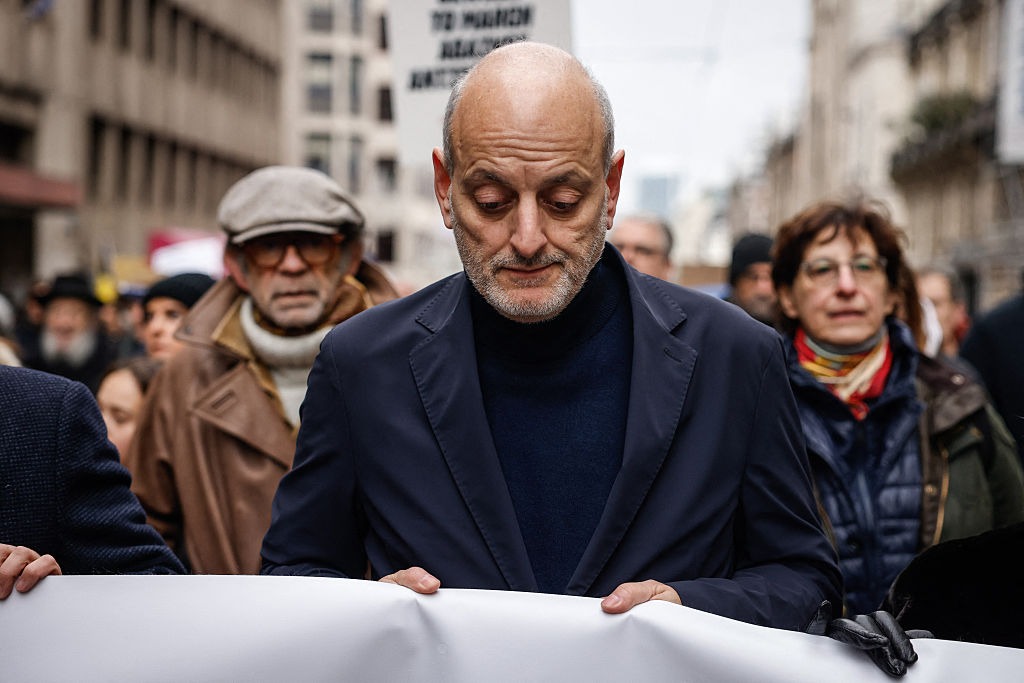
Joël Rubinfeld is a founding member and president of the Belgian League Against Antisemitism and president of the Jewish Coalition for Kurdistan. He was president of the Coordinating Committee of Jewish Organizations in Belgium, vice-president of the European Jewish Congress, and co-chairman of the European Jewish Parliament.
- Read Part II: 'There Is a Serious Problem in My Country'
- Read Part III: 'This Is Not Off to a Good Start': Trump's 'Board of Peace,' Double-Standards, the UN, and the Kurds
Canlorbe: You have described Israel as the "Dreyfus of nations." What does that mean?
Rubinfeld: Since October 7, 2023, we have been living through a kind of endless "Dreyfus trial," but with one major difference: the state has replaced the person. In the past, Dreyfus stood on trial; today, the Jewish state has taken his place.
The "prosecutors" in this permanent trial are UN agencies, "rapporteurs," Amnesty International, Human Rights Watch, Oxfam, the Human Rights League — which, ironically, was founded in 1901 in the wake of the Dreyfus Affair. There is also a whole ecosystem of organizations claiming to speak in the name of human rights, along with their relays in the newsrooms, in academia, in activist and cultural circles, and on the street.
When I see these so-called "pro-Palestinian" demonstrators, it seems as if many of them could not care less about the Palestinians. If they were truly pro-Palestinian, they would first call for the eradication of Hamas, which is the poison and the nightmare first of all of the Palestinian people. The poison, unfortunately, was widely embraced by Hamas's absolute majority (56%) in the last Palestinian legislative elections in 2006.
These demonstrations in Europe — 300,000 people in London, 100,000 in Brussels, and hundreds of thousands in France—remind me, of the marches in the early 1930s in Germany. Of course, it is not an exact historical equivalence, but there seems a resemblance in the occupation of public space, crowd dynamics, and the pressure exerted on political life. There are also the hateful slogans, yesterday targeting Jews; today the Jewish state and its supporters: "Death to the Jews" becomes "Death to Israel," "Boycott the Jews" becomes "Boycott the Zionists," the new polite, "politically correct" word for hating Jews.
This fever in the streets weighs on political leaders. The great problem is that many of them think in purely arithmetical terms. They tend to hold a simplistic, and therefore racist, view of communities: "Jews" equals "Israel," and "Muslims" equals "Palestine." Once they do the math, conclusions follow.
In Belgium, there are about 30,000 Jews and 900,000 Muslims—a ratio of one to thirty. Cynics conclude: "I have everything to lose by defending Jews or Israel, and everything to gain by supporting 'Palestine'—by riding the wave of what Hamas has become in the activist imagination—because it wins me votes."
In Brussels, given its specific demographics, antisemitism has become an electoral asset. Not the "old" antisemitism of those nostalgic for Auschwitz, but a revised, contemporary form—one that equates Gaza with Auschwitz.
For months, I have been warning that we may be living through the last time there is a "significant" Jewish community in Belgium. It is already tiny: 0.25% of the Belgian population. Possibly, by 2050 it will no longer be 30,000, but under 10,000. The exodus is already underway—and accelerating.
Canlorbe: How do you explain those Jews who join the prosecutors in this "Dreyfus trial" against Israel?
Rubinfeld: It is an intriguing question. My interpretation of "Jewish self-hatred"—a concept popularized a century ago by Theodor Lessing in Der jüdische Selbsthaß (Jewish Self-Hatred)—is that the history of the Jewish people is anything but quiet. To be a Jew has meant, for 4,000 years, being confronted with the most delirious accusations: causing famines, poisoning wells, desecrating the host, spreading epidemics, "ritual murder," controlling the world... However deranged they may be, any accusations, it seems, can find an audience, at times even a majority one. As someone put it: "The problem is not what Jews are, but what you are ready to believe they are."
To live as a Jew in an environment where one is blamed for everything requires resilience, self-denial, and a spirit of resistance. Not everyone is capable of that. Rather than holding firm, some might hope, out of terror and a wish to survive, that if they are just nice to their tormentor, he will soon come around and see how "good" they are. They can even convince themselves that if they agree with their tormentor, he will appreciate and admire them – then they will no longer be in danger. They might even adopt his point of view, like a child whose parent is angry with him. It is easier for him to think that the parent is right and the problem must be with himself. It is an attempt to cope with, or somehow get through, a terrifying situation -- and it usually does not work. Tormentors torment; it is what they like to do. As the psychiatrist Dr. Kenneth Levin noted in his important book, The Oslo Syndrome: The Delusions of a People Under Siege, a child is dependent on his parent, and wants to feel safe. "If I just stop wetting my bed," the child might think, "then maybe he will like me." It is too terrifying to see that, say, the bed-wetting may not be the problem, just a pretext. We saw in World War II that people can rationalize anything.
Sometimes one finds individuals born Jewish who break with their heritage, decide to "no longer be Jewish," and become antisemites to prove their "good faith."
Deep down, I think they know that this break amounts to a surrender: they leave Judaism to escape the pressure, to gain social respectability, sometimes to protect their descendants. But from that point on, the Jews who remain—those who continue to embrace their identity despite the attacks—become an unbearable mirror for them.
Every Jew who stands firm reflects back to them an uncomfortable image: "I stay, I take the blows, but I remain what I am." The one who has broken away sees himself as a coward. That tension turns into aggression: he gives way to antisemitism, adopting a scorched-earth policy. He has left Judaism — so now turns against the Jews to show everyone else. "See? I am not like them. I am good! Now do you like me?"
This pattern appears in several historical examples: Nicholas Donin (13th century), a convert from Judaism and the instigator of the trial that led to the burning of the Talmud in Paris; Pablo Christiani (Paul Christian), a converted Jew who became a Dominican and took part in religious campaigns against the Jews in the 13th century, persuading Louis IX to restore the use of the rouelle—the precursor of the yellow star; Bernard Lazare, an interesting case: he authored an antisemitic work before the Dreyfus Affair, but later became one of the earliest and most steadfast defenders of the Jewish captain, stating that the affair had "saved his life"; Gilad Atzmon, a British pro-Palestinian jazz musician born in Israel and a virulent antisemite who later claimed to have converted to Christianity—without this preventing him from continuing his attacks; Karl Kraus, an Austrian anti-Dreyfusard writer who broke with Judaism and developed an obsessive critique of what he called the "Jewish press."
At bottom, all of this points to a simple idea: it is not easy to be Jewish. Some experience their identity as a burden. In the 19th century, even after emancipation and access to citizenship, strong social barriers remained. Many chose conversion not out of hostility, but out of a longing to get along, to be "like everyone else" – like the child, to be loved.
For me, to be clear, leaving Judaism is not reprehensible. I take a liberal view of the matter: one may enter, leave, choose—everyone does as they wish with their life. That being said, leaving Judaism is one thing; sliding into antisemitism is another. At that point, it becomes my problem: we are no longer dealing with a personal choice, but one has crossed over into active, sometimes fierce hostility directed at others—in this instance, against what one once was before.
Read Part II: 'There Is a Serious Problem in My Country'
Grégoire Canlorbe, a journalist, currently lives in Paris. He has conducted interviews for journals such as Man and the Economy, founded by Nobel Prize-winning economist Ronald Coase, and think tanks such as Mises Institute and Gatestone Institute. Contact: gregoire.canlorbe@wanadoo.fr
 cammo99