








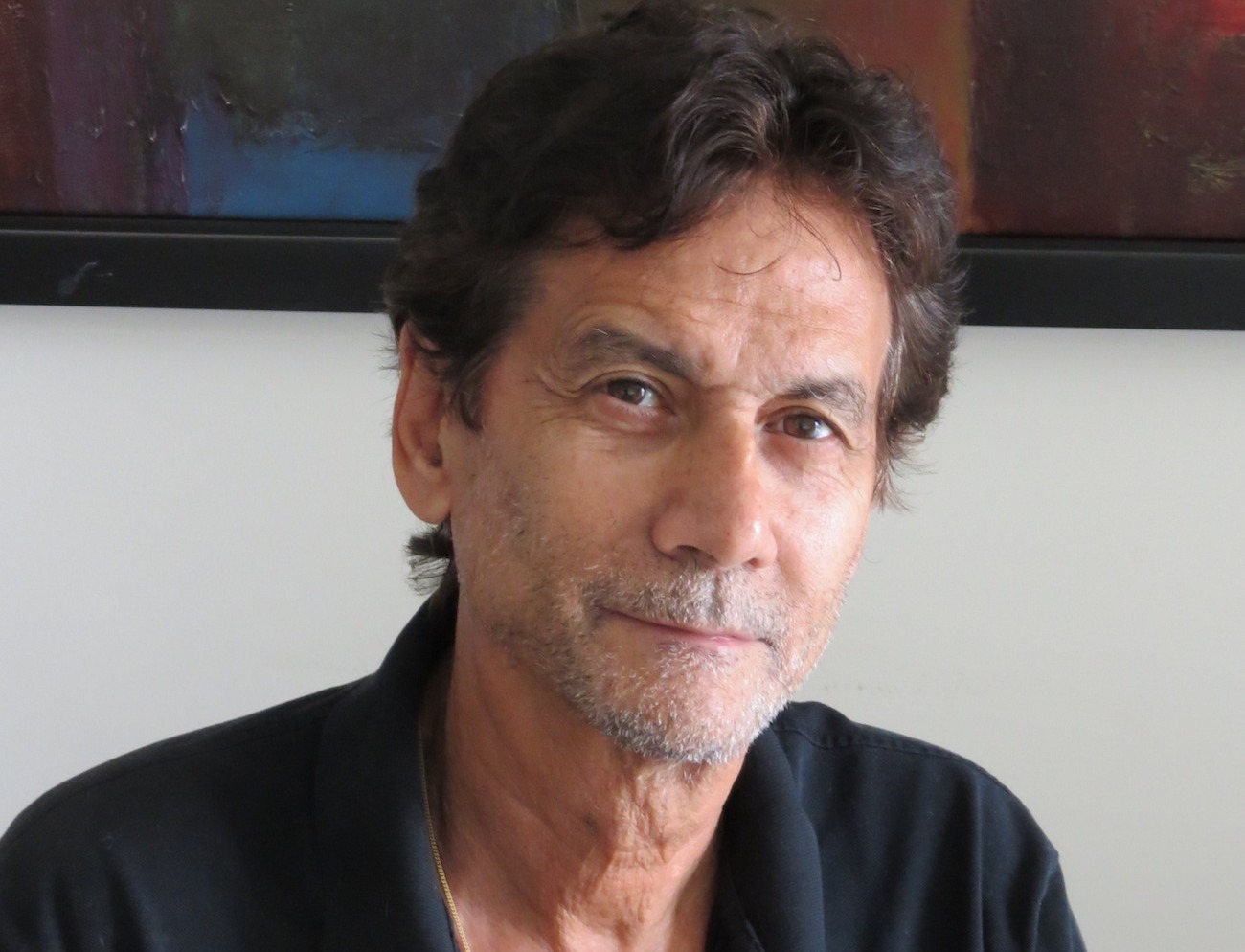
Pierre Rehov is a French documentary filmmaker, director, and novelist. He is known for his movies about the Arab-Israeli conflict and Israeli–Palestinian conflict, its treatment in the media, and about terrorism.
Grégoire Canlorbe: Are Iran's and Hamas's October 7, 2023 jihadi attacks on Israel responses to what they claim, that Israel is on their land?
Pierre Rehov: Jews have lived on that land for nearly 4,000 years. Palestinians, by contrast, contrary to myth, actually do not exist. As the late PLO senior official Zoheir Mohsen openly stated in an interview with the Dutch daily Trouw on March 31, 1977:
"The Palestinian people does not exist. The creation of a Palestinian state is only a means for continuing our struggle against the state of Israel for our Arab unity. In reality, today there is no difference between Jordanians, Palestinians, Syrians and Lebanese. Only for political and tactical reasons do we speak today about the existence of a Palestinian people, since Arab national interests demand that we posit the existence of a distinct Palestinian people to oppose Zionism."
In modern times, the Palestinians are really just assorted Arabs who happened to be in Israel in 1948. They chose to leave after five Arab armies invaded the new nation on the day of its birth, either to avoid being in the middle of a war, or often at the urging of their fellow Arabs, who told them to get out of the way to make it easier to kill the Jews. When these often self-exiled Arabs tried to return to Israel after the Arabs lost the war -- an event in Arabic called the nakba, the catastrophe – Israel refused to admit them based on their earlier disloyalty. Arabs who did not leave Israel now make up just over 20% of Israel's population of nearly 10 million, are called Israeli Arabs, and have equal rights with the Jews, except for not being required to serve in the Israeli army unless they so choose.
After losing the war, to pressure Israel, Arab countries refused to admit their approximately roughly 700,000 Arab brethren as well, even though Israel, the size of New Jersey, made room for a commensurate number of Jews who had fled Arab countries.
In short, the Palestinian attacks on Israel on October 7, 2023 were not "in retaliation" for anything. In fact, they had just pledged a ceasefire with Israel, and Israel had recently issued 27,000 new daily work permits to enable Gazans to enter Israel, where they could earn a better wage. October 7 was not a "reaction." It was just the latest episode in a multi-millenary history of attacks on Jews. It was a declaration of intent, of ideology, and of a civilizational fault line that many in the West have spent decades refusing to see.
A pogrom or a jihad is not defined by a map; it is defined by a mindset: the idea that Jews may be hunted as such—women, children, the elderly—because their very existence is deemed illegitimate. That is why I titled my 2025 film Pogrom(s). Hamas did not attack military targets to "end an occupation." It attacked families to affirm an old doctrine: the Jew is not an opponent; the Jew is a problem to be erased.
If you want to understand October 7, forget the comforting story of "desperation turning violent." Pogroms are not born from desperation; they are born from permission — social, religious, political permission to commit the unthinkable and feel righteous doing it.
What happened that day also exposed the West's moral confusion. Many people looked at videos of barbarity and still rushed to "contextualize," rationalize, excuse. This reflex is precisely what keeps pogroms returning throughout history: the world's temptation to treat Jewish blood as a negotiable detail in a political narrative.
Canlorbe: How do you relate the birth and development of the anti-Israel movie industry, especially after the film Exodus portrayed Israelis as heroic?
Rehov: It may have started after the alleged death of a young Arab boy, Muhammad al-Durrah, in 2000. Israel was accused of shooting him to death even though in film clips there was no blood to be seen, and after his supposed death, he can be seen lifting a hand to look out from under it. The episode became a turning point. The images, broadcast worldwide, showed a child allegedly shot deliberately by Israeli soldiers. The narrative was immediate, emotional, definitive. Israel was guilty. End of story.
The case was never as clear as presented. Serious doubts emerged about the staging, the angles of fire, the editing, the absence of forensic transparency. Whether one believes the child was killed in crossfire or not, what mattered is that the footage became a weapon before it became a fact.
More importantly, it revived something ancient: the blood libel — the accusation that Jews murder children. This medieval myth, responsible for countless pogroms, was simply updated for the satellite era.
The term "Pallywood" – anti-Israel films, frequently built on falsehoods, and masquerading as pro-Palestinian -- is not about denying suffering. It is about exposing the systematic staging, scripting, and amplification of imagery designed to fit a predetermined accusation.
You could see this machinery yourself in any investigation of the Battle of Jenin in 2002. At the time, international headlines were speaking of a "massacre." Hundreds killed. Entire neighborhoods razed. The emotional narrative was already fixed.
There, I encountered individuals presenting themselves as medical authorities and witnesses. One of them, Dr. Abu Raley, claimed that the Israeli army had destroyed a building belonging to his hospital. He described it in dramatic detail. The story was powerful. It was ready for cameras.
There was only one problem: the building was intact. Standing. Undamaged. The alleged ruin simply did not exist.
In the Battle of Jenin, there was never any "confusion in the fog of war." The story that part of a hospital had been destroyed was a total fabrication. It revealed something essential: a good story has priority over reality.
Anti-Israel films are a method: a communication strategy in which scenes are rehearsed, ambulances are summoned for choreography, children are positioned for optimum publicity, and Western journalists — sometimes naive, sometimes ideologically predisposed — broadcast it without verification.
The genius of the system is psychological. Once the image circulates, correction becomes irrelevant. The emotional verdict has already been delivered.
In modern warfare, the camera is no longer documenting the battle. It is part of the battlefield. The objective is not only to accuse Israel. It is to morally disarm the West. If you can persuade democratic societies that defending themselves equals murdering children, you have already won half the war.
Canlorbe: Are the Israelis fighting only for themselves? What are they really fighting for besides? For the whole of Western civilization?
Rehov: Israel is fighting — obviously — for its survival, but not only that. Israel is fighting to preserve Western civilization, and at a frontier the West prefers not to name: Islamic extremism and its call for global political control. Hamas, Islamic Jihad, Hezbollah, and the Iranian regime do not hate Israel for what it does. They hate Israel for what it is: an infidel state – and in their midst. If Israel were a Christian state, the same problem would exist. Just look at the genocide in Nigeria – with more than 52,000 Christians killed in just 14 years – in a free society, which is a visible rejection of the Islamic totalitarian dream.
The Palestinian project is not a "two-state solution" or "a better border." The project is a world where religious and political absolutism rules, where minorities submit or vanish, where women are controlled, where dissent is crushed. Israel is the laboratory target. If the West rewards October 7 with political gains, it teaches a lesson to every violent movement on earth: massacre pays. So yes — Israel is defending itself, and in doing so, it is also defending the principle that civilization cannot survive if it negotiates with barbarity as if it were a partner who is misunderstood.
Canlorbe: You mention the Nazi and Soviet origins of modern political Islam and of the so-called Palestinian cause. Please, what do you mean?
Rehov: Let's be precise: Political Islam was not "created" by Nazis or Soviets. It has its own religious roots. Modern jihadist politics borrowed heavily from 20th-century totalitarian toolkits — Nazi and Soviet alike: mass indoctrination, the cult of death, scapegoating, manipulating crowds through grievance and myth. Historically, there has also been direct contact and ideological cross-pollination. The Mufti of Jerusalem, Haj Amin al-Husseini, collaborated with Nazi Germany. He met with Hitler in 1941 — an emblematic moment showing that radical anti-Jewish mobilization in the region was not only "local," but plugged into Europe's genocidal imagination.
As for the "Palestinian cause" as a modern political brand, the Soviet model of the USSR perfected exporting "liberation" narratives, packaging conflicts into revolutionary frames, and the use of proxy groups for strategic warfare. When Russia's leaders saw that Israel had no interest in adopting its brand of socialism or communism, it seems to have turned its attention to supporting Israel's opponents. PLO and Palestinian Authority leader Yasser Arafat first, and later the Palestinian Authority's current President Mahmoud Abbas -- now in the 21st year of his four-year term -- were groomed in Moscow by the KGB and its satellites. A lieutenant general in the Socialist Republic of Romania's Securitate, the secret police, Ion Mihai Pacepa, who defected to the West in 1978, wrote:
"In March 1978 I secretly brought Arafat to Bucharest for final instructions on how to behave in Washington. "You simply have to keep on pretending that you'll break with terrorism and that you'll recognize Israel -- over, and over, and over," Ceausescu told him for the umpteenth time. Ceauşescu was euphoric over the prospect that both Arafat and he might be able to snag a Nobel Peace Prize with their fake displays of the olive branch."
Whether through training, arms flows, or propaganda doctrine, the Cold War era shaped a whole ecosystem in which anti-Western agitation could be sold as virtue. The result is what we see today: a hybrid ideology — religious absolutism wearing the clothes of revolutionary victimhood — distributed to Western audiences through media and academia.
Canlorbe: What are your findings on "esoteric," or religious, Nazism?
Rehov: Nazism was not merely political; it aspired to be metaphysical. It tried to replace Judaism and Christianity with a racial religion — an occultized worldview in which blood becomes sacred, cruelty becomes purification, and conquest becomes destiny. The religious flavor of Nazism served two functions: it offered a mythic justification for domination, and it insulated followers from moral reality. When you turn history into myth, you no longer need ethics — you only need obedience to the "mission."
While I was writing The Third Testament, a novel published in English, it became clear that Hitler regularly consulted mediums. Even more striking was Heinrich Himmler's obsession with magic, witches and demons. Recently, his personal library was found in a warehouse near Prague. It contained more than 6,000 esoteric works, including rare volumes on witchcraft. The initiation ritual required to become a member of the SS drew directly from these occult beliefs. Many Nazi symbols — the SS runes, the Nazi salute, the swastika — were rooted in "esoteric" symbolism. This dimension of Nazism is often minimized, yet it reveals that the regime did not see itself merely as a political movement, but as a quasi-religious order claiming spiritual legitimacy for its crimes.
That is why the Nazi project felt to many like a perverse religion or spiritual movement: it provided meaning, ritual, identity, and a transcendent excuse for the worst crimes.
Canlorbe: How does that "religion" thought, which led to Nazism, differ from other religions' thought, such as Judeo-Christian?
Rehov: The difference is enormous, of course. Nazi "religiosity" basically promotes anti-ethics that masquerade as transcendence. It is essentially racial pagan mysticism that glorifies force, status and "purity." It dissolves the individual into the tribe and turns the "other" into a dangerous contaminant. Judeo-Christian spiritual traditions — even when they explore mysteries, symbols and initiations — remain anchored in the dignity of the individual person, moral responsibility, and the idea that facts are inseparable from conscience. Christian thinkers are usually not about exterminating imperfection; they are about elevating the human being — fallible, free and accountable. In the Nazi vision and in many Middle Eastern interpretations of religion, it exists to justify domination. In the Judeo-Christian vision, religion exists to deepen humility and love.
Canlorbe: How do you assess the Arab policy of the French Republic?
Rehov: France's Arab policy under the Fifth Republic has seemed to oscillate between grandeur and blindness. From President Charles de Gaulle onward, there was a strategic aim: to cultivate oil as energy and diplomatic leverage, to secure influence in the Arab world, which during the 1975 "oil crisis" looked as if it had most of the world's oil, and to position France as a mediator distinct from Washington. Too often, however, this stance became a reflex of moral equivalence — treating democracies and terror movements as two symmetrical parties in a "conflict," rather than distinguishing defense from aggression.
The culmination is the contemporary temptation to adopt diplomatic gestures that may flatter French self-image but can also reward intransigence, disinformation and terrorism. France's announcement that it recognized a non-existent Palestinian state in July 2025 is a prime example: a move presented as "peace" that instead rewards terror and confirms that "terrorism works, so let's keep on doing it!" — thereby encouraging actors who see concessions as weakness and what they are doing as delivering success. It reinforces the sales pitch that jihad and terrorism are the fastest ways to get what you want. France could have been a voice for realism and the values of civilization. Instead, it keeps choosing the comfort of theatrical posing
Canlorbe: Trump's foreign policy is centered on dealmaking and pointed, short-run military intervention. Do you fear that those factors may prevent the US and Israel from settling, for good, the Hamas or Iranian regime issues?
Rehov: I do not fear "dealmaking" as such. I fear deals that confuse calm with peace. If a deal buys time for the "wrong" side, it is not a deal — it is an extension of the threat. Hamas and the Iranian regime have proven that they interpret restraint as opportunity. So, the question is not whether America prefers short operations or long wars. The question is whether America draws lines that are credible, and whether it enforces them. As for domestic political constraints, every administration has them. The point is that Israel cannot outsource its survival, and the United States cannot pretend that totalitarian jihadism can be "managed" indefinitely. Either you dismantle the infrastructure of terror, or it regrows.
Yes, Vice President JD Vance represents a strand of American skepticism toward foreign entanglements. That is a legitimate debate. Israel's enemies, however, are not about "entanglements." They are imposing a war on civilization.
Canlorbe: If a diplomatic solution were to be found to the Ukrainian issue, would it be beneficial to the West?
Rehov: Diplomacy is beneficial only if it restores deterrence. A settlement that rewards aggression teaches the world that borders are temporary and violence is profitable. Such a lesson would not stay in Eastern Europe; it would travel — into the Middle East, into Asia, into every contested frontier. So yes, a diplomatic outcome can be good — if it protects sovereignty, if it prevents repetition, and if it signals strength rather than fatigue. Peace that is built on amnesia is not peace; it is a pause before the next war.
We are living through a war of reality. Weapons kill bodies. Propaganda kills judgment. When judgment collapses, democracies begin to hate themselves, to doubt their right to defend their citizens, and to romanticize forces that would destroy them.
My work is not about "taking sides" in a political quarrel. It is about refusing the lie — because when the lie wins, the innocent pay, and history repeats its darkest chapters with updated slogans.
The West will not be defeated by lack of power. It will be defeated — if it is defeated — by the refusal to oppose danger when they see it.
Grégoire Canlorbe, a journalist, currently lives in Paris. He has conducted interviews for journals such as Man and the Economy, founded by Nobel Prize-winning economist Ronald Coase, and think tanks such as Mises Institute and Gatestone Institute. Contact: gregoire.canlorbe@wanadoo.fr
 Rob Porter