








For years, Palestinian Authority President Mahmoud Abbas has promised the US, Europe, and Arab donors that he is committed to reforming Palestinian institutions, fighting corruption, introducing transparency, and preparing the ground for a new generation of Palestinian leadership. The recent elections for his ruling Fatah faction, however, prove otherwise.
Instead of meaningful reform, Fatah has once again chosen stagnation, recycled leadership, security domination, and the glorification of terrorism. Most troubling of all, the election of Abbas's son, Yasser Abbas, to Fatah's Central Committee has revived growing fears that the Palestinian leadership is moving toward a system of dynastic succession and family rule.
The results of Fatah's eighth general conference, held in Ramallah in mid-May, exposed the widening gap between Abbas's reform rhetoric and the political reality inside the Palestinian political system.
Speaking after casting his vote, Abbas attempted to present the conference as part of a broader effort to "renew institutions" and prepare for future parliamentary and presidential elections. He repeated familiar promises regarding constitutional reform and political restructuring while portraying the gathering as proof of Fatah's historical legitimacy during one of the most dangerous periods facing the Palestinian cause. "This year is the year of democracy," Abbas said.
"Today is the Eighth Conference of Fatah, and we are preparing for the elections of the general and presidential elections, staring with the drafting of the constitution, the political parties law, and the general elections law."
As usual, however, there was no timetable, no enforcement mechanism, and no concrete political roadmap. Once again, reform appeared to function more as a slogan aimed at reassuring Western governments than as a serious political process.
The Fatah conference simply appeared as an early battle over the post-Abbas era.
At the age of 90, Abbas has now led the Palestinian Authority, the Palestine Liberation Organization (PLO), and Fatah for more than two decades. His presidential term officially expired in 2009; nonetheless, in the absence of presidential and parliamentary elections, he continues ruling by decree.
Against this backdrop, the election of his son Yasser Abbas to Fatah's highest decision-making body was seen by many Palestinians as politically significant far beyond a routine internal reshuffle.
Although Yasser Abbas, 64, has never traditionally been among the most prominent Fatah figures, in recent years his political profile has steadily expanded.
Five years ago, his father appointed him as a "special representative," enabling him to become involved in political, diplomatic, and economic affairs. At the same time, he has maintained extensive business interests in telecommunications, energy, and investment sectors in the West Bank, increasing his influence inside Palestinian political and economic circles. His rise reinforces growing perceptions that Mahmoud Abbas is attempting to preserve family influence within the Palestinian political system.
These concerns are particularly acute because Palestinians have not held presidential or parliamentary elections for more than 20 years.
Would elections solve the problem? Many Western officials continue insisting that elections are the answer to the Palestinian crisis. Recent Palestinian history, however, suggests otherwise. The last parliamentary elections, held in 2006, brought Hamas to power. One year later, Hamas violently seized control of the Gaza Strip after executing opponents, throwing Fatah rivals off rooftops, and establishing an Islamist dictatorship that remains in place to this day.
Public opinion polls in recent years have repeatedly shown strong Palestinian support for Hamas, especially after the October 7, 2023 Hamas-led invasion of Israel. In several polls, Hamas leaders have enjoyed greater popularity than Abbas and Fatah.
This raises an uncomfortable but necessary question: If elections were held today, would they produce democratic reform – or another Hamas victory? The problem facing Palestinians is therefore much deeper than the absence of elections. It is a crisis of extremism, corruption and failed leadership.
Meanwhile, the Palestinian Authority continues facing accusations of financial and administrative corruption, concentration of power, and political paralysis. Many Palestinians now openly fear that succession inside Fatah is being managed behind closed doors rather than through democratic competition.
Comparisons with hereditary Arab political systems continue to grow. Such comparisons carry particular sensitivity in the Palestinian arena because the Palestinian national movement historically presented itself as a collective "liberation struggle" rather than a family-based political enterprise. The rise of Yasser Abbas, therefore, symbolizes for many Palestinians not renewal, but the deepening personal entrenchment of power.
Equally troubling is the continued glorification of violence and terrorism inside Fatah.
For years, Fatah officials have repeatedly honored their terrorists as "heroes," "martyrs," and "fighters." The Palestinian Authority continues every year to pay hundreds of millions of dollars, now disguised as "social welfare," to Palestinians and their families involved in terrorist attacks against Israeli civilians.
Among the many terrorists still celebrated, for instance, is Dalal al-Mughrabi, a Palestinian woman from Lebanon who led the 1978 Coastal Road Massacre, in which 38 Israelis were murdered, including 13 children. Fatah and the Palestinian Authority regularly host memorial ceremonies on the anniversary of her death and praise her courage and dedication to the Palestinian cause. Public squares and sports tournaments are named after her, and in schools she is portrayed to students as a person to be emulated.
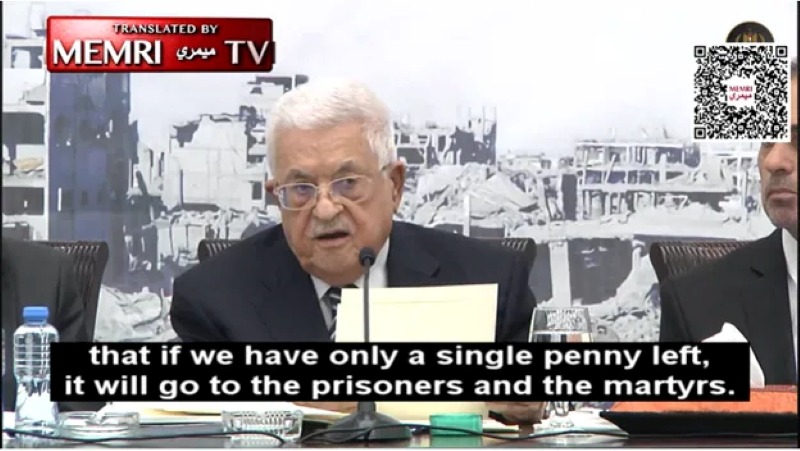
The Palestinian Authority, as mentioned, still pays monthly stipends to Palestinians imprisoned in Israel for their involvement in terror attacks. Mahmoud Abbas frequently refers to these prisoners as national heroes who made significant sacrifices for the Palestinian cause. "[If] we have only a single penny left," he said in February 2025, "it will go to the prisoners and the martyrs. I will not allow a reduction in our commitments to them."
In the recent Fatah elections, another terrorist hero, Marwan Barghouti -- currently serving five life sentences in an Israeli prison for involvement in terror attacks that murdered Israeli civilians -- received the highest number of votes.
Zakaria Zubeidi, the former commander of Fatah's Al-Aqsa Martyrs Brigades in the West Bank city of Jenin – and who organized numerous terror attacks against Israelis -- also won a seat on the Central Committee. Zubeidi became internationally known after escaping from an Israeli prison in 2021 before being recaptured.
The election of Barghouti and Zubeidi to the Fatah Central Committee sends a dangerous message: that inside Fatah, terrorism and "armed struggle" continue to confer political legitimacy.
The Palestinian movement, rather than distancing itself from violence, continues to celebrate and glorify individuals associated with attacks against Israeli civilians. It is a reality that should finally put a stop to all idiotic Western claims that Fatah represents a "moderate" alternative to Hamas.
The latest elections inside Fatah, in fact, suggest that the ideological differences between Hamas and Fatah are largely tactical rather than fundamental. Hamas openly calls for Israel's destruction through jihad and terrorism. Fatah, meanwhile, speaks to Western audiences about diplomacy and peace while internally glorifying terrorists, honoring "martyrs," rewarding militants, and continuing to promote the concepts of "resistance" and "armed struggle" as legitimate tools. The difference between the two movements often concerns strategy and international presentation, not the ultimate goal.
The Fatah election results also highlighted the continued dominance of the Palestinian security establishment.
Senior officials including Hussein al-Sheikh, Mahmoud al-Aloul, Jibril Rajoub, Tawfik Tirawi, and intelligence chief Majed Faraj either retained or strengthened their positions within the movement's leadership.
The resulting structure combines aging political veterans, security officials, Abbas loyalists, wealthy insiders, and figures associated with militancy. This is not reform. It is carefully controlled continuity. Some Palestinians had hoped the conference would introduce young leaders, new political ideas, and genuine institutional restructuring. Instead, results reflect the survival goals of a political system determined to preserve itself.
Increasing American, European, and Arab pressure for reform is closely linked to discussions about the future of the Gaza Strip after the October 7, 2023 Hamas-led invasion of Israel.
The Trump administration and other international actors view reform of the Palestinian Authority as a prerequisite for restoring political legitimacy and enabling it to play any future governing role in the Gaza Strip. Regrettably, the latest Fatah conference demonstrated the exact opposite of meaningful reform.
The dominance of longstanding elites, the rise of Mahmoud Abbas's son, the empowerment of security officials, and the election of convicted terrorists all reinforce skepticism regarding whether any genuine political change is even remotely possible within the current Palestinian system.
For the US and Europe, which continue to discuss plans to "revitalize" the Palestinian Authority, the latest developments should serve as another harsh prod out of a deep sleep – or more likely a secret long-term wish in much of Europe to have the Arabs "exterminate" Israel so that they will not have to. Europe would then have Israel out of the way without getting its own hands dirty.
A leadership that recycles aging elites, promotes family influence, rewards extremism and corruption, and suppresses democratic renewal is clearly not preparing its people for reform, accountability, democracy or peace.
The latest Fatah elections did not mark the beginning of a new political era. They only exposed the deepening decay at the heart of the Palestinian leadership and a continuation of the grinding, punishing life for the Palestinian people held hostage there.
Khaled Abu Toameh is an award-winning journalist based in Jerusalem.
