





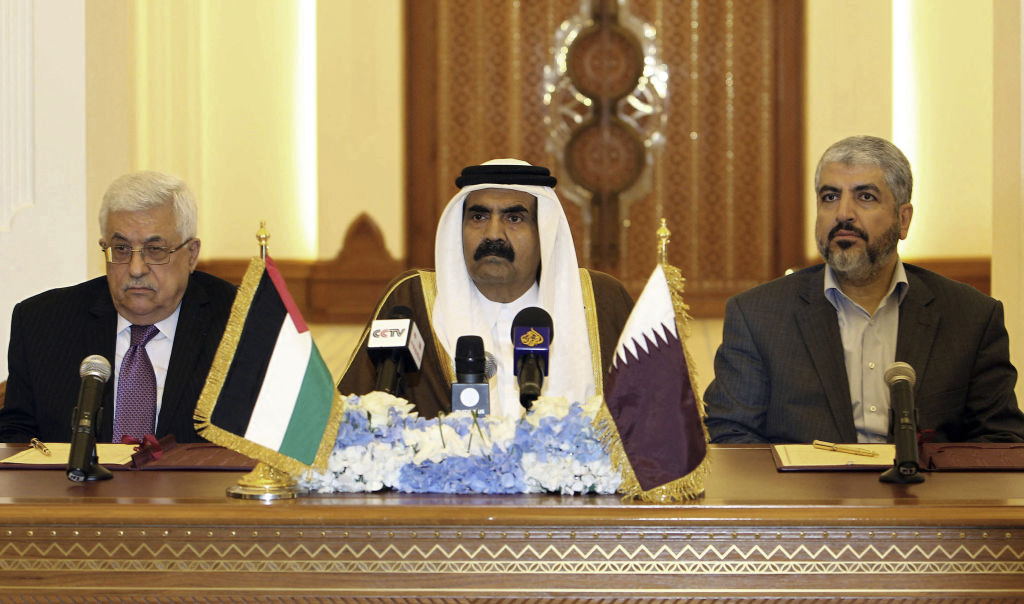
The Palestinians remain trapped between two bad choices: the Fatah-dominated Palestinian Authority (PA) and the Iran-backed Hamas terrorist group.
The Palestinians have tried both.
The result has been corruption, authoritarianism, political repression, terrorism, violence, division and, ultimately, immense suffering for the Palestinian people.
Yet, as the Palestinians prepare for another parliamentary election, they are once again being offered essentially the same political choice.
The latest quarrel between Fatah and Hamas illustrates the problem.
Majed Faraj, director of the PA's General Intelligence Service, recently called on Hamas to apologize to the Palestinian people for the catastrophe that has befallen them since Hamas's October 7, 2023 invasion of Israel. Faraj, who was recently elected as a member of the Fatah Central Committee, a key decision-making body, said that such an apology should be a precondition for Hamas to return to participating in Palestinian political life.
At first glance, demanding accountability from Hamas may appear reasonable. Hamas launched the October 7 attack, in which 1,200 Israelis and foreign nationals were murdered and more than 250 abducted and held as hostages. The attack triggered a devastating war whose consequences have been catastrophic for Palestinians in the Gaza Strip.
There was, however, something revealing about Faraj's demand. He did not ask that Hamas apologize to the families of the Israelis and foreign nationals who were murdered by the terrorist group on October 7 and after, or to the surviving hostages. He only requested that Hamas apologize to the Palestinians for the disaster that befell them.
The distinction is telling. For many Palestinian leaders, the main problem with October 7 is not what Hamas did to its Israeli and foreign victims, but what happened to the Palestinians afterwards.
Hamas, predictably, rejected Faraj's demand. Senior Hamas official Bassem Naim responded that if Hamas must apologize for October 7, then Fatah and the late Palestinian Authority President Yasser Arafat should also apologize for the "disasters" that have befallen the Palestinian people over the decades.
Naim was most likely referring to major episodes in Palestinian history, including the 1970-71 Black September conflict in Jordan, when the PLO attempted to overthrow the government of Jordanian King Hussein, who ultimately expelled the PLO from Jordan; the PLO's instigation of the Lebanese civil war between 1975 and 1990; and the 1990-91 Gulf War, particularly Arafat's decision to align with Iraqi leader Saddam Hussein when Iraq invaded Kuwait, even though for decades, Kuwait had generously welcomed and employed hundreds of thousands of Palestinians.
These hostile initiatives led to severe consequences for the PLO and Palestinians, including the loss of financial and political support from Gulf states and the expulsion of roughly 400,000 Palestinians from Kuwait.
In short, Hamas's answer to the PA's Fatah was essentially: If we are guilty, so are you.
This response illustrates the fundamental problem with Palestinian politics. Fatah points to Hamas's crimes and failures. Hamas points to Fatah's crimes and failures. Each side demands accountability from the other while refusing to undertake any serious examination of its own record.
Both Hamas and the Palestinian Authority owe the Palestinian people – as well as Israelis and other victims – countless apologies. They owe apologies for corruption and mismanagement. They owe apologies for failing to build transparent and accountable institutions. They owe apologies for suppressing dissent and freedom of expression and for persecuting political opponents, journalists, human rights activists, and critics. They owe apologies for repeatedly rejecting compromises and peace initiatives and for policies that have contributed to decades of Israeli and Palestinian bloodshed. They owe apologies for failing to use international assistance to build a functioning economy and institutions that serve ordinary Palestinians. They owe their people an honest explanation for why Palestinians remain divided between two rival governments and without a functioning democratic political system.
The timing of this latest dispute is particularly significant.
It comes less than two months before the parliamentary elections scheduled for November 28. Hamas has decided to participate, although it has not yet announced its own electoral list or candidates.
Reports that Hamas may participate through affiliated candidates who are not formally or openly identified as Hamas raise even more serious questions. If true, such an arrangement would allow Hamas to re-enter Palestinian politics through the back door.
Palestinian Authority Vice President Husein al-Sheikh recently told Palestinian journalists that Hamas's "participation would take a different form, and that it would not participate under its current name or structure." He claimed that Hamas had reached an agreement with the United States not to participate in Palestinian political life in its current form. Al-Sheikh indicated the possibility of figures affiliated with Hamas participating under a new political framework.
So, instead of changing its goals – brutally ruling Gaza and destroying Israel – Hamas will simply change its "name, structure and framework"?
Changing the label does not change the organization. A Hamas-affiliated candidate does not cease to be affiliated with Hamas simply because the word "Hamas" does not appear next to his name on the ballot.
Such a maneuver would turn the election into a political fiction: Hamas would be permitted to obtain parliamentary representation while avoiding the political consequences of openly running as Hamas. Allowing Hamas— in disguise or not – to run in the election would also legitimize the terrorist group without requiring it fundamentally to change.
That would be a serious mistake. The Palestinians have already seen what happens when Hamas acquires political power.
In the 2006 parliamentary election, Hamas won a stunning victory over Fatah. The results were not simply the product of Hamas's popularity. They also reflected widespread Palestinian frustration with Fatah's corruption, incompetence, internal divisions, and failure to deliver good governance.
If the same conditions that helped Hamas win remain in place, another election could simply reproduce the same cycle. This is why the Palestinian Authority cannot credibly present itself as the answer to Hamas. Hamas is bad, but who said that the PA is any better?
The PA remains dominated by an aging leadership that has repeatedly failed to establish genuine democratic accountability. Palestinians have experienced corruption, political repression, and an absence of meaningful political renewal.
For almost two decades, Fatah and Hamas have fought each other, arrested each other's supporters, and accused each other of betraying the Palestinian cause. Yet neither has succeeded in building a political system that serves the Palestinian people. Now, they are preparing to compete for parliamentary seats again.
This should not inspire excessive optimism. At the end of the day, the new parliament could once again be dominated by loyalists of Abbas and Fatah on one side and Hamas-affiliated figures on the other.
Where is the alternative?
In the past, Palestinians were offered a "Third Way." Former PA Prime Minister Salam Fayyad ran in the 2006 election at the head of the Third Way list. It won only two seats. Fayyad represented a radically different model from both Fatah and Hamas. He was associated with institution-building, economic development, administrative reform, and international engagement rather than armed struggle.
Fayyad, nevertheless, created a "Fayyad Plan" for the surreptitious takeover of the West Bank by Palestinians, apparently with the goal of creating a Palestinian state on land that the Palestinians had agreed was to be negotiated. The plan consisted of building illegal "facts on the ground" in Area C — land that is, by mutual agreement, under the control of Israel and waiting to be negotiated.
The problem is: What if one of the negotiating parties decides never to come to the table? Is the other party just supposed to hold everything in abeyance – unsettled forever – in case one day the other party might change its mind?
The acquisitive Fayyad Plan was financed largely by the European Union, whose members evidently do not see anything wrong with illegally seizing land, or with "illegal construction,"
Fayyad did not spend years in an Israeli prison. He did not encourage his son to attack Israel. He studied at the University of Texas at Austin.
In Palestinian culture, graduating from an Israeli prison carries greater political prestige than graduating from an American university. This is precisely the culture that needs to change.
The Palestinians need a genuine third way – not merely another faction with a different name. They need leaders who are prepared to challenge the entrenched political culture of Fatah and Hamas. They need leaders who believe that the Palestinian national interest is more important than factional interests. They need leaders willing to confront corruption, reject authoritarianism, protect freedom of expression, build functioning institutions, and end the glorification of violence.
Above all, Palestinians need leaders courageous enough to tell their people an uncomfortable truth: there can be no genuine progress so long as the political choice remains confined to Fatah and Hamas, and that the primary objective of both groups remains the obliteration of Israel.
The Palestinians do not need another election contest between Fatah and Hamas. They need an escape from this political monopoly.
Bassam Tawil is a Muslim Arab based in the Middle East. His work is made possible through the generous donation of a couple who wish to remain anonymous. Gatestone is most grateful.