








The African National Congress (ANC) government in South Africa has a shameful record in its response to the worst genocidal and racist crisis now continuing in Africa.
"Is South Africa's voice... loud enough in addressing the recent conflict in Sudan?" asked journalist Nkanyezi Ndlovu recently. "While condemnation [of the war in Sudan] is noted, what other diplomatic steps has South Africa taken, not only as an African superpower but also as the current G20 President?"
These are crucial points, but reflecting on the people of South Africa's response to what Ndlovu accurately calls the "humanitarian crisis" in Sudan, the reality is far more damning.
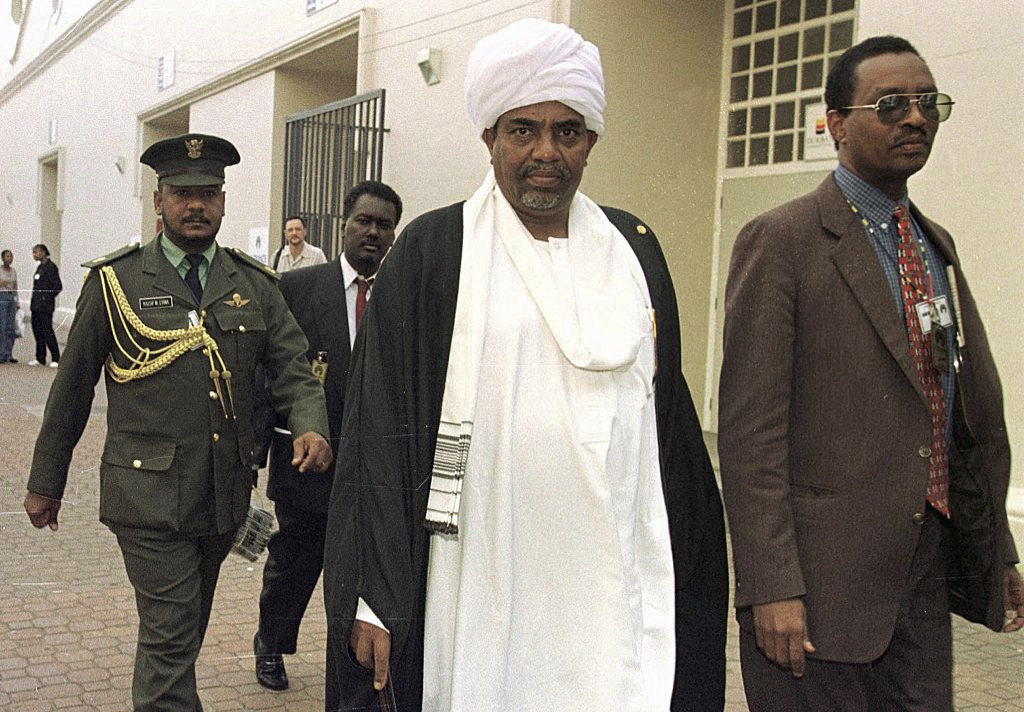
First, it is essential to remember that when Jacob Zuma was president between 2009-2018, with Cyril Ramaphosa his deputy president (2014-2018), the ANC government refused to implement the arrest warrant issued for genocide by the International Criminal Court against Sudan's then President Omar Al-Bashir when he visited South Africa in June 2015 -- a "shameful failure", as reported by Amnesty International. Effectively, on this issue, the ANC government aligned itself with Bashir in opposition to the ICC.
On January 4, 2024, President Cyril Ramaphosa continued this effective political alliance when, in Pretoria, he welcomed Bashir's military appointee, General Mohamed Hamdan Dagalo (known as "Hemedti"), the commander of Sudan's murderous and genocidal militia, the Rapid Support Forces.
The British historian Justin Marozzi in 2025 published an essential book, Captives and Companions: A History of Slavery and the Slave Trade in the Islamic World. Marozzi, quite fluent in Arabic, summed up his understanding of the Sudan issue in "The shocking truth about slavery in the Islamic world today", published in London's Daily Telegraph on July 3, 2025. The article begins:
"Up to 17 million people have passed through the slave trade in the Muslim world since the 7th century. Tragically, the practice lives on."
In his book, Marozzi makes it clear that nowhere else on the continent more than Sudan -- right up to today -- have black Africans suffered for so long under a foreign colonialist and imperialist power, and its descendants. The following is a long but crucial passage from Captives and Companions (pp. 332-34):
"Slavery in Sudan long preceded the Ottomans [masters of Turkey and the Ottoman empire since the 15th century]. It antedated Islam by more than a millennium. One of the earliest references to it comes from Herodotus, writing in the fifth century BCE. Discussing the Persian Great King Cambyses' invasion of Egypt in 525 BCE, the Greek historian recorded that the biennial tribute imposed on the ancient kingdom of Kush (northern Sudan and southern Egypt) included five 'Ethiopian' slave boys.
"In 652, almost 1,200 years later, the conquering, faith-spreading Muslim Arabs struck their first diplomatic treaty in this region. According to Al Maqrizi, the fifteenth century Egyptian historian, the Baqt treaty ... imposed an annual payment of 360 slaves on the Christian kingdom of Nubia [based along the Nile river].... By 1877, when there were said to be upwards of 6,000 slave-traders operating in the region, the British government estimated in a report to the Egyptian authoriities that around 30,000 slaves per annum were being sent across the Red Sea from the East African coast to the Arabian peninsula alone.
"In the mid-tenth century, the Coptic [Christian] Bishop of Al Ashmunain, Severus Ibn al Muqaffa (d. 987), reported that Muslims were plundering and enslaving and selling their captives in Egyptian markets....
"When Muslim states started to be established along the central Nile and Sudanic states from the sixteenth century, they took up where their pagan and Christian predecessors left off, raiding along their borders and enslaving their neighbours. For Arabic-speakers along the Nile Valley, both the terms Nubi (Nubian) and Sudani (Sudanese), meaning black, were synonymous with 'slave'. Bilad al Sudan, the Land of the Blacks, referred to all sub-Saharan territories in general, but it is from that Arabic term that the nation of Sudan takes its name.
"A lasting and painful irony, which has had baleful consequences, is that the northern Arab Sudanese do not consider themselves black, reserving that pejorative term for their dark-skinned Sudanese and South Sudanese compatriots, in addition to Africans from further afield, who for centuries they enslaved.
"The great arterial link between Egypt and Sudan, the enduring commercial thread that bound these two states together in a nexus of slaving as the market and source for enslaved Africans respectively, was the Darb al Arbain, as the Arabs knew it, the Forty Days' Road. The easternmost of the great north-south trans-Saharan routes, this was an 1,100-mile road from Kobbei in Darfur to Upper Egypt, running through a string of oases so that water was always available within two to three days.
"Like slavery itself, the Darb al Arbain long predated Muslim Arabs and was trodden successively by Egyptian pharaohs, Persian temple-planners, Macedonian invaders, fort-building Romans and Ottoman traders. Caravans of camels - groaning under loads of elephant and hippopotamus ivory, rhinoceros horn, gold, ostrich feathers and eggs, animals skins, plants, civet, aromatic oils, incense and gum Arabic, salt, alum, natron and cowrie shells - dutifully padded alongside lines of African slaves on foot, often in chains, togther with the odd 'exotic' animals destined for a royal court. They plied the track towards Egypt....
"Conditions for the slaves along the Darb al Arbain varied from humane to appalling."
Then followed the disgraceful betrayal of the black Africans of Sudan by the government of the African National Congress, with Cyril Ramaphosa both as deputy president (2014-2018) and as president, up to today.
"By the dying years of the twentieth century... slavery was once again thriving in Sudan.
"For the National Islamic Front of Omar al-Bashir, the then president of Sudan (in office 1993-2019), it was an effective weapon of war against his black southern Sudanese compatriots. From 1989 to 2011 he presided over the systematic enslavement of Sudanese and South Sudanese from the border region, arming, financing, transporting and supporting slave-taking militia raids into the Nuba Mountains, Abyei and [19th century Arab slave-master] Zubayr's former stronghold of Bahr al Ghazal.
"Men were routinely killed, women and children enslaved. Boys were trafficked to Libya, Qatar and Saudi Arabia. Non-Muslims were forcibly converted to Islam, and existing Muslims were forcibly Arabized. They were sold into the slave trade, renamed and forced to travel hundreds of miles from home, separated from their families, beaten, abused and foced to work for no pay. Many of the women and children were subjected to sexual abuse and torture.
"When the country split in 2011, it was estimated that over 35,000 South Sudanese people remained enslaved in Sudan. In Darfur the Janjaweed militia ran amok, committing numerous atrocities. One eyewitness, Neimat al Mahdi, recalled how the Janjaweed would enter the village of an African tribe, kill all the men and rape the women, mocking them afterwards with the age-old racial slur: 'You should celebrate, you slave. You are going to give birth to an Arab.'
"The International Criminal Court issued two arrest warrants for Bashir in 2009 and 2010, the first time a sitting head of state had been indicted by the ICC. The court quoted the perpetrators of attacks aganst civilians, especially from the Fur, Masaalit and Zaghawa tribes, telling their victims: 'the Fur are slaves, we will kill them'; 'You are Zaghawa tribes, you are slaves'; 'we are here to eradicate blacks (nuba )'.
"Bashir is accused of war crimes, crimes against humanity and genocide in Darfur. At the time of writing, reportedly he remains held in a hospital in Merowe, 200 miles north of Khartoum, and is one of the ICC's longest-running fugitives from justice.
"Whichever way you looked across the nineteenth-century Dar al Islam ["Land of Islam"], slavery coolly returned your gaze." (pp. 353-54)
Sadly, in the Qur'an, slavery is condoned and used as a justification for rape, male control of women, and other abuse.
"He gives you this example, drawn from your own lives: do you make your slaves full partners with an equal share in what We have given you?" (Qur'an 30:20, Abdel Haleem translation)
"Allah makes this comparison. On the one hand there is a helpless slave, the property of his master. On the other, a man on whom We have bestowed Our bounty, so that he gives it both in private and in public. Are the two alike? Allah forbid! Most men have no knowledge." (Qur'an 16:75, N.J. Dawood translation)
South Africans need to reflect on this. There is a moral duty for South Africans to acknowledge the 14 centuries of Islamic jihad against black Africans, and its genocidal character -- not least since the massacre by Islamists of unarmed Jewish civilians in Sydney, Australia on December 13, while celebrating the religious festival of Chanukah.
Paul Trewhela, a journalist formerly in his native South Africa, was incarcerated as a political prisoner in Johannesburg and Pretoria from 1964-67. He subsequently worked in exile as a school teacher in the UK and Ireland, and co-founded and co-edited the banned exile magazine, Searchlight South Africa, published in London. He authored the book, Inside Quatro: Uncovering the Exile History of the ANC and SWAPO (2009), published in South Africa.
 R van Druten