








President Dwight D. Eisenhower made an important observation about finding answers to difficult questions. "Whenever I run into a problem I can't solve," the five-star general reportedly remarked, "I always make it bigger. I can never solve it by trying to make it smaller, but if I make it big enough, I can begin to see the outlines of a solution."
As an example, as Europe's first Supreme Allied Commander, Eisenhower suggested that a problem resupplying troops in Italy might be about much more than simple logistics. A problem-solver must consider the wider map and examine how convoy movements in northern Europe affect supply distribution in the South, whether resources for the whole continent are being allocated efficiently, and whether leadership decisions a thousand miles away might be a more pressing problem than finding enough mechanics to fix run-down trucks stuck in the mud.
Eisenhower's principle has been passed down over time: "If a problem cannot be solved, enlarge it."
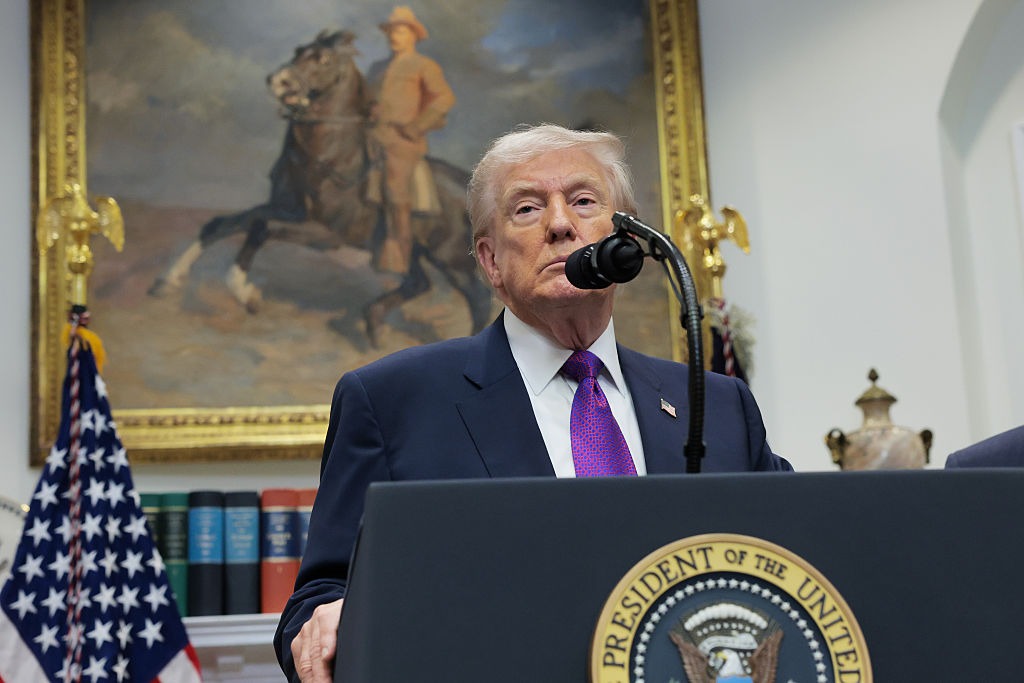
Interestingly, this same principle aptly captures the governing style of President Donald J. Trump. The president became a famous public figure many decades ago partly because of his penchant for going "bigly". He transformed dilapidated properties into prime real estate. He adorned building entrances in marble, crystal, and gold. He acquired historic architectural achievements and placed the Trump name atop them in bright lights for the whole world to see. Both in his real estate and reality television careers, Trump has long had a reputation for being bold, self-promoting, pugnacious, and ostentatious.
For his critics, showmanship and braggadocio are the limits of Trump's "bigness." They see a man who enjoys flattery, celebrity, and the sight of his own name towering high above city lights. What those critics miss is Trump's rather unique set of problem-solving skills that allow him to tackle complex problems in unorthodox ways.
Peace in Gaza. Peace in Ukraine. U.S. energy independence. U.S. trade parity with the rest of the world. Enhanced partnerships with Japan. Economic collaboration with Russia. Economic decoupling from China. Border walls. Immigration enforcement. Military supremacy. Technological superiority. Free speech. Nationalism. Panama. Venezuela. Cuba. Iran. Greenland. The list goes on and on. Although these might first appear as unrelated subjects, every single one is inextricably connected to the rest. Rather than treating them as distinct problems that must be navigated one at a time, Trump looks at them as valuable pieces of property on one big game board.
While the president makes nice with China's Xi Jinping and talks publicly about how China and the United States are economically tied together for the foreseeable future, he simultaneously destroys China's investments in Panama and energy partnerships in Venezuela and Iran. While the president sends emissaries Steve Witkoff and Jared Kushner to meet with Russian President Vladimir Putin and his representatives, he secures a strategic trade deal with Indian President Narendra Modi that could end India's importation of Russian oil.
While Trump is pushing Putin to halt his ongoing military offensive in Ukraine, Trump is threatening Russia's strategic partnership with Cuba by cutting off critical energy supplies to the communist island nation. While the president assures NATO allies that the American military is prepared to defend Europe from any perceived Russian threats, he also funds free speech initiatives to counter Europe's online censorship, maneuvers around Europe's "coalition of the willing" to negotiate an end to the war in Ukraine directly with Putin, and threatens European countries that get in the way of the United States's eventual acquisition of Greenland.
While Trump withdraws the U.S. from 31 United Nations entities and 35 other international organizations dedicated to "climate," "peace," and "social justice," he lays the foundations for a Board of Peace that might not only bring some stability to the Gaza Strip but also eventually supersede the UN as the most important institutional body working for broad international cooperation and lasting peace.
When Trump first introduced the framework for a Board of Peace to end bloodshed between Israel and Hamas, few could have guessed that he would use that framework as a hook for creating a potentially more consequential organization. By inviting geopolitical adversaries such as Putin and Belarusian President Alexander Lukashenko to join this incipient board, Trump is not only creating a new global institution but also forging partnerships among foes. By ensuring that everybody has "skin in the game," Trump seems to hope that national self-interest will promote regional stability.
When Trump first declared that he would achieve peace in Ukraine, few could have guessed that he might seek economic cooperation with Russia or set his sights on the islands of Greenland and Cuba as part of a "carrot and stick" approach for keeping both the European Council and Russia motivated to end the fighting. When the president signaled to the world that the United States would do whatever it could to avoid direct military confrontation with China, few could have guessed that he would cut off China's expanding tentacles in South and Central America and the Middle East. While returning America's focus to the Western Hemisphere and rededicating American resolve to upholding the Monroe Doctrine, Trump uses that focus and resolve to weaken both China and Russia. In addition, while focusing on security in the Western Hemisphere, he strengthens economic and military alliances with Israel, India, and Japan — indispensable allies whose help will be critical in containing Russia, China, and Iran.
Trump's critics see a distracted and mercurial mind unwilling to stay on subject. They portray him as an emotional loose cannon temperamentally unsuited for the obligations of his office. What they ignore is how much Trump relishes manufacturing and churning out chaos. For a man constantly in the public eye — especially a man whom the assorted members of the corporate news media love to hate — the appearance of chaos provides a cover of thick fog that keeps his enemies off balance and his critics guessing. This frenetic style represents a marked departure from typical White House operations of the past.
At least since the presidency of Franklin D. Roosevelt, White House staffs have prepared carefully tailored public messages. Communications experts occupy an entire suite of West Wing offices because their role in the modern political world is considered critical. For decades, those experts guided presidents how best to repeat important messages ad nauseam and how dexterously to minimize distractions.
President Lyndon B. Johnson's White House imprinted the "War on Poverty" upon Americans' minds. President Ronald W. Reagan's White House convinced Americans of the importance of the nation's "War on Drugs." Under President Barack H. Obama, White House staff fed young reporters a steady diet of stories on the virtues of Obamacare and the Iran "nuclear deal," while dismissing questions or concerns about most anything else. For modern White House staffs, staying "on message" is a "golden rule" for effective public communication.
Trump has his own "golden rules". He prefers to flood the media landscape with many subjects, themes, distractions, and objectives all at once. He might start the day with a message on his Truth Social platform warning Iran not to kill protesters in the streets of Tehran. Minutes later, he could point out to reporters that the U.S. Navy has "quarantined" vital shipping lanes around Cuba. While walking to Marine One, he might field 20 questions on the White House lawn about diverse, unrelated, and even contradictory subjects, including: why he should have been awarded the Nobel Peace Prize, why he might be forced to attack Iran, if he will join NATO partners in providing security guarantees in post-war Ukraine, and whether he will ignore the concerns of NATO partners and seize Greenland for the United States. Like a skilled juggler impressing his audience with how many lit Molotov cocktails, revving chainsaws, and live grenades he can keep in the air all at once, Trump makes it supremely difficult for any member of the press corps to prioritize one newsworthy story over the rest.
There is tremendous value in Trump's smorgasbord communication strategy. First, by discussing so many topics that are newsworthy, provocative, and important to the American people, the president prevents his fiercest critics in the press from focusing Americans' attention on any one story. A cable news channel that wishes to paint the president's capture of Venezuela's Nicolás Maduro as reckless or illegal finds it difficult to convince the American people of that thesis when Trump has already turned his sights toward Cuba, Iran, and Greenland. As much as any single reporter or news publication might prefer to highlight the broader issues related to any one White House policy, only so much time can be allocated to discrete stories when Trump is making news half a dozen times each day.
Second, by being an agent of chaos or the juggler-in-chief extraordinaire, Trump makes it clear that he alone decides executive policy. White House Press Secretary Karoline Leavitt plays a major role in faithfully articulating the president's daily messages, but nobody doubts that it is Trump's message being communicated. By affording the press so much personal interaction, Trump really is his own press secretary. The whole communications staff in the White House takes its cues from him, and those trusted staff members adjust their words to amplify his message accordingly. Anyone watching events unfolding on a video screen — whether a lawmaker on Capitol Hill, a prime minister in a foreign capital, a foreign national protesting his country's own rulers, or an ordinary American citizen at home — knows that "the buck stops with Trump" at all times.
Lastly, Trump's machine-gun fire approach to communication keeps America's competitors, adversaries, and enemies on their back feet. During the 2024 presidential campaign, Trump repeatedly promised that he would aggressively use tariffs to recalibrate America's trade position in the world. Prominent executives at Wall Street firms, members of European parliaments, and foreign heads of state disparaged Trump's plans and assured the public that they would never come to fruition. Nevertheless, in 2025, Trump and his economic advisors applied tariff leverage against both economic allies and foes to reorient the global system of trade toward America's advantage.
Seven and a half years ago, the German delegation to the UN General Assembly appeared to laugh at Trump when he suggested that they would regret being so dependent upon Russian energy. After Russia's 2022 invasion of Ukraine and the sabotage of the Nord Stream 2 pipeline used to transport natural gas from Russia to Germany, however, Europe's disregard for Trump's blunt warning proved to be hubristically dimwitted.
Similarly, when Trump publicly expressed interest in purchasing Greenland from Denmark back in 2019, Danish Prime Minister Mette Frederiksen dismissed Trump's offer as "absurd." Many Danish and European Union politicians scoffed at the notion, as well. Nobody doubts the seriousness of Trump's words today.
Late last spring, Trump repeatedly warned Iran's leaders to negotiate faithfully with the United States concerning the operation of its key nuclear enrichment facilities. When Iran's Supreme Leader Ali Khamenei and President Masoud Pezeshkian dismissed Trump's warnings as bluster, America's commander-in-chief sent stealth bombers into Iran and dropped "bunker buster" bombs on Iran's most important nuclear facilities just a few days into summer.
When the illegitimate Venezuelan president, Nicolás Maduro, refused Trump's offer of exile, America's elite Delta Force operators crashed through Maduro's fortress stronghold and flew the tyrant to New York to face a range of narco-terrorism charges in court.
In 2026, political and economic leaders around the world hang on Trump's every word. They know what he says shifts the direction of stock markets. They know his warnings are prescient. They know both his promises and threats are real. They also know that the president is willing to do unconventional things to achieve success for the United States. He is willing to offer friendship to enemies, and he is willing to handle friends sternly. He is capable of looking at protracted conflicts from many different angles. He is willing to throw out the customary playbooks and play by his own rules.
When necessary, Trump is quite comfortable employing the Eisenhower Principle by first making problems much bigger before their ultimate solutions come into clear focus. Then, when those solutions do appear, Trump swiftly acts.
JB Shurk writes about politics and society, and is a Gatestone Institute Distinguished Senior Fellow.
 Susan Warner