





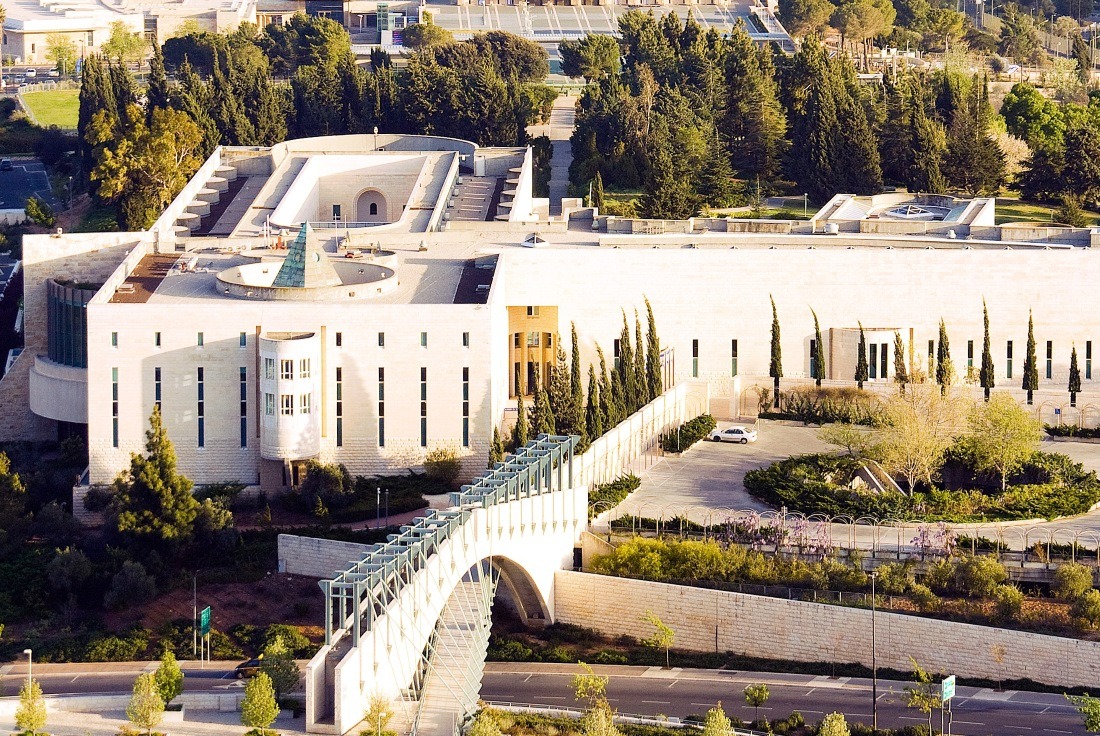
Well, it finally happened. The executive branch – Israel's government – has apparently had enough of the activist, self-selected Supreme Court endeavoring to micro-manage policy decisions that have nothing to do with it.
Just about every major government decision not to the court's liking appears to be barred from implementation. This leads to months, if not years, of appeals and counter-appeals, preventing the government from moving forward with its programs for the nation.
The government, as the executive, is a body elected by the people; the Supreme Court is not. It is therefore unaccountable to anyone except itself. In a normal democratic environment, the legislature enacts laws that are implemented as policy by the elected representatives of the people -- Israel's parliament, the Knesset -- or by the executive.
In case of disputed matters involving law, the courts make rulings to ensure justice. This is their role – to interpret and uphold the law through judicial decisions. It is not their function to make laws (the role of the legislature) or to determine policy (the role of the executive), which they appear to be doing by negating governmental implementation of executive decisions -- decisions that normally lie beyond the scope of judicial authority.
In the instance of Israel, the separation of powers doctrine, which determines the limitation of powers between each branch of government to avoid confusion and overlap, is obscured by the fact that, as in the United Kingdom, there are no clear guidelines defining the differing authority of three branches: the legislative, the judiciary and the executive.
This is due to two main factors -- the lack, as in the United Kingdom, of a written constitution delineating powers between the three branches, and the conflicted role of the attorney general, whose apparent mandate is not only to advise the government on legal matters, but also to represent it when necessary and to prosecute it when appropriate.
It was predictable that one day a serious, dramatic clash between the government and Israel's activist Supreme Court would lead to a constitutional showdown. This happened on July 5, 2026. For the first time in Israel's nearly 80-year history, the government announced it would not abide by a Supreme Court ruling.
The matter involved a blatantly wrong and openly slanted decision by the court to the effect that the Council of the Second Authority (Israel's regulatory body for commercial broadcasting) could continue to conduct operations notwithstanding the fact that the council legally lacked a quorum to do so.
According to the Times of Israel:
"[Communications Minister Shlomo] Karhi accused the judges of the High Court of being 'drunk with power,' and said their rulings could not override explicit provisions of the law."
Karhi added that, "The rule of law is not the rule of judges. Today, the government made it clear: When the High Court tramples the law, the state will not comply with it".
Quite so.
In support, Justice Minister Yariv Levin stated:
"In a democratic state, the Knesset legislates the law, and the court is obligated to apply it. When a ruling stands in direct contradiction to the wording of the law, this is not judicial review but rather a violation of the principle of the separation of powers."
To be expected, the opposition parties, scenting an opportunity to vilify the government for their own ends, together with Attorney General Gali Baharav-Miara and President Isaac Herzog, strongly criticized the government, accusing it of causing a constitutional crisis and of violating the rule of law.
In hand with the court, Baharav-Miara said that the government's declaration "undermines the fundamental principles of the rule of law." She no doubt looks forward to once again prosecuting members of the government for their decisions.
Among the opposition parties, the leftist Democrats party claims that the government's stance is an attempt "to weaken democracy and keep its grip on power even if it loses at the ballot box."
The reality, however, is that the Supreme Court is itself guilty of these allegations directed towards the government. The court has ignored existing law, for reasons of its own ideological persuasions, and has led the country to a constitutional crisis entirely of the court's own making.
This particular issue is but one of many such problems that Israel's elected government has had to face from the Supreme Court and the attorney general. It was probably inevitable that a government of integrity would one day resist the slew of biased Supreme Court decisions made against it in an attempt by the court to insert itself into the executive's policy-making function –- an action well outside the limit of judicial authority.
There is a long history to the stark polarization between the Supreme Court and Israel's conservative governments. Historically, the courts, legal system, government, and major public servants were composed of elitist-liberal-progressives. It was this way at the time of Israel's independence in 1948, and for the first 30 years of Israel's political life thereafter, the socialists were in power. For the last 50 years or so, however, on and off, the conservative Likud Party and its coalition partners have been elected to government and the die-hard institutional voters on the left have not stopped trying to frustrate their policies and return to political power.
Even so, the effect of a legal and political confrontation between an elected government and an unelected, activist judiciary has the potential to result in mass protests against, or for, those two branches of government. Unless this issue is resolved satisfactorily, social turbulence may follow -- which Israel's enemies would -- again -- undoubtedly misunderstand as a sign of the nation's weakness and vulnerability. Months of massive demonstrations – partially financed by the Biden Administration in the hope of dislodging Prime Minister Benjamin Netanyahu in order to replace him with someone more pliable -- indirectly led to the horrors of October 7, 2023.
Consequently, in the interest of social harmony, Israel's leaders would do well urgently to draft legislation clarifying the role and functions of the judiciary, as well as that of the attorney general. Perhaps the nation's enemies will then understand that the people of Israel stand together against their enemies as one.
Nils A. Haug is an Attorney, author and columnist. He is member of the International Bar Association, the National Association of Scholars, the Academy of Philosophy and Letters. Among degrees in Law, Philosophy, and English Literature, Dr. Haug holds a M.A.in Jewish Studies (cum laude) and Ph.D. in Apologetical Theology. He is author of 'Politics, Law, and Disorder in the Garden of Eden – the Quest for Identity'; and 'Enemies of the Innocent – Life, Truth, and Meaning in a Dark Age.' His work has been published by First Things Journal, The American Mind, Quadrant, Minding the Campus, Gatestone Institute, National Association of Scholars, Jewish Journal,James Wilson Institute (Anchoring Truths), Jewish News Syndicate, Tribune Juive,Document Danmark, Zwiedzaj Polske,Schlaglicht Israel, The Australian Jurist, and others.
 Harvey Radnor