








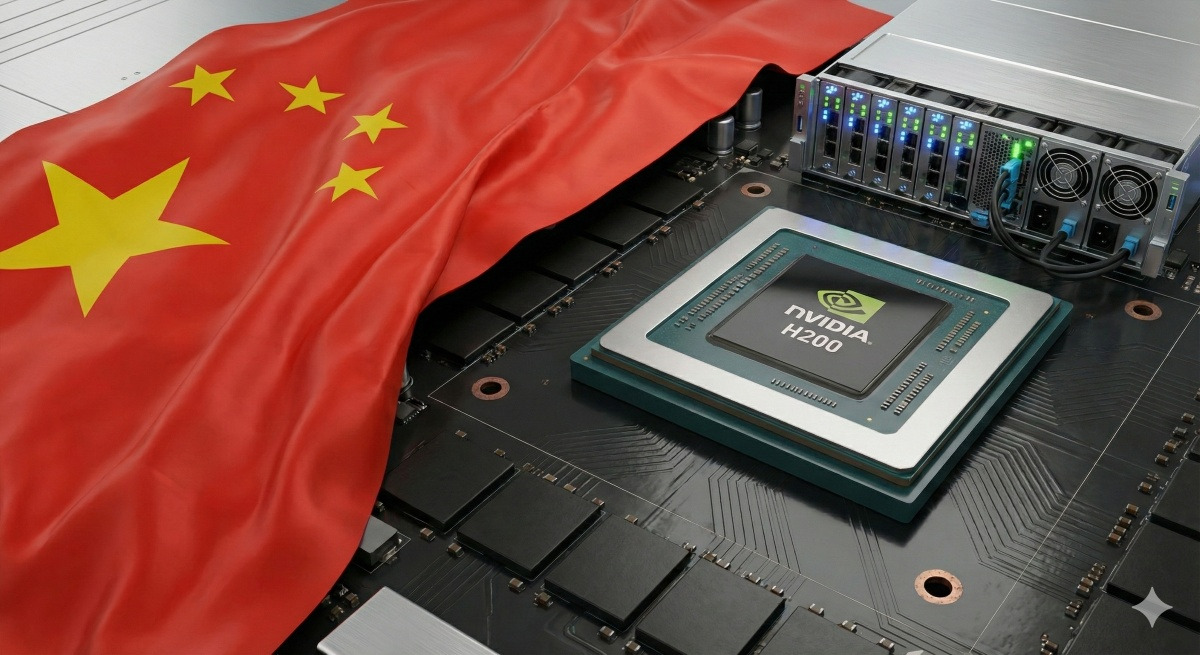
Nvidia has told Chinese customers that it can start shipping them its second-most powerful chip, the H200, before mid-February.
President Donald Trump's decision this month to reverse a Biden-era ban on the export to China of advanced chips and approve the sale of H200s is a grave mistake, wrong both strategically and morally.
Trump, keeping a pre-election promise to tech billionaires, is giving China the means to surpass the United States in the critical race to dominate Artificial Intelligence (AI). Moreover, China will almost certainly use the chip for military purposes.
Trump, in a December 8 Truth Social posting, announced he had informed Chinese leader Xi Jinping that he would approve the sale of the H200.
"We will protect National Security, create American Jobs, and keep America's lead in AI," Trump wrote.
It is hard to see how both the first and third statements are true.
Those who say the U.S. should sell advanced chips argue that the U.S., with those sales, can keep China addicted to the American technology stack. They apparently imagine that China will keep buying inferior American semiconductors and therefore will slow the development of the Chinese chip industry.
Dmitri Alperovitch, co-founder of cybersecurity firm CrowdStrike, correctly calls this argument "a dangerous myth."
"Rather than grow dependent, China will take Nvidia chips while they are available, use them to train models to compete with American frontier variants and continue to invest heavily in domestic alternatives like Huawei's Ascend chips," he wrote in a December 21 letter to the Wall Street Journal. "When those are good enough, the firms will drop Nvidia—and quickly."
What Trump is actually doing is helping China bridge a crucial gap.
Xi, for more than a decade, has been determined to rid China of American chips. Semiconductors, for instance, were included in his infamous Made in China 2025 initiative.
Alperovitch believes that America's only advantage in the AI race is its advanced chips. Trump, however, is giving the Chinese better chips than they now have.
"During the height of the Cold War, it was unthinkable for the U.S. to sell supercomputers to the Soviet Union, the equivalent of the GPUs today," Alperovitch writes, referring to Graphics Processing Units, the specialized chips at the core of AI infrastructure. "We've never won technological competitions by arming our competitors—we've prevailed by preserving a clear and enduring advantage."
Trump is giving that advantage away. "The move," Reuters reported, discussing the H200 decision, "represents a major policy shift from the Biden administration, which banned advanced AI chip sales to China citing national security concerns." President Joe Biden, beginning in October 2022, imposed those and other needed rules.
"President Trump has fundamentally shifted his stance on China since his first term in office," Brandon Weichert, the National Interest's senior national security editor, told Gatestone this week. "In the first term, he embraced a robust strategy of deterrence, containment, and resistance to China's aggressive rise. In the second term, Trump has opted for a more cooperative rather than competitive framework."
"There are real reasons Trump made the shift, including promises he made to the so-called 'Broligarchs' — those tech titans who switched sides from the Biden-Harris ticket to the Trump-Vance ticket last year and who favor trade rather than conflict with China," Weichert added.
Weichert's explanation also reveals why Trump has allowed Chinese companies to access Nvidia's most advanced chips, based on the Blackwell architecture, in offshore data centers. Chinese internet tech giant Tencent has been using those chips in a data center in Japan's Osaka. Chinese companies Alibaba and ByteDance have accessed advanced Nvidia chips in Singapore and Malaysia.
Trump's Commerce Department in May rescinded the Biden "AI Diffusion" rule, which would have, as a practical matter, stopped Chinese customers from accessing advanced U.S. chips in offshore data centers.
In short, Trump has taken a series of actions that permit China to win the AI race. As is often said, whoever wins AI wins the 21st century.
Whether or not Trump just gave away the century to China, he has definitely given the Chinese military better tools to kill Americans. Although the president in his Truth Social posting stated that licenses would be granted only for "approved customers," these chips will end up with military and other parties that threaten U.S. security. There is no way the U.S. can control their usage once they enter China. In China, Xi enforces "military-civil fusion," so the military has access to everything it wants.
The Trump administration is now conducting an interagency review — State, Energy, War, and Commerce — of the proposed sale of H200 chips to Chinese customers. We can only hope the review reverses an unjustifiable giveaway to China.
Gordon G. Chang is the author of Plan Red: China's Project to Destroy America, a Gatestone Institute distinguished senior fellow, and a member of its Advisory Board.
 John B Cook