








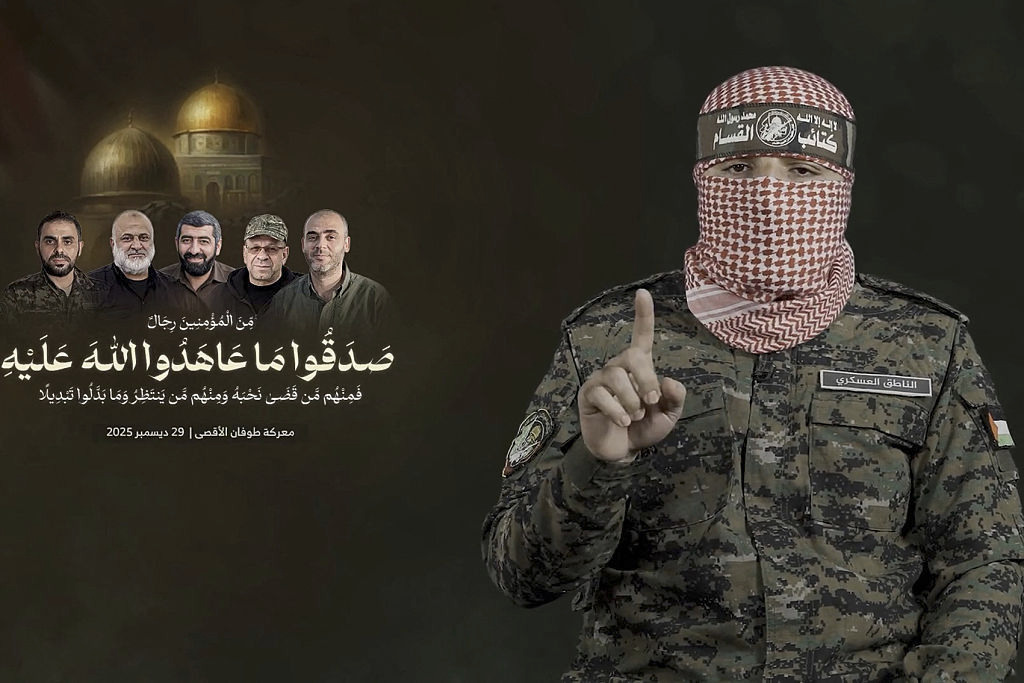
US President Donald Trump's demand that Hamas terrorists completely disarm will only happen if the White House is prepared to pressure countries such as Turkey, Qatar and Iran, which have historically backed the terror group, to force Hamas militants to lay down their arms.
Ever since Trump succeeded in implementing the first stage of his 20-point plan for ending the Gaza conflict, Hamas has received widespread backing from its supporters in Ankara, Doha, Islamabad and Tehran for ignoring demands to surrender its weapons.
Requiring Hamas to disarm and end its malevolent presence in Gaza was one of Trump's key stipulations when drawing up his peace plan, with the disarmament process expected to begin as soon as all the remaining Israeli hostages had been released in return for hundreds of Palestinian prisoners.
While the initial phase of Trump's peace plan has proved to be a success, with all but one of the fallen Israeli hostages being returned, Hamas has shown scant interest in complying with the disarmament requirement.
Back in August, when the Trump administration was working hard to implement its Gaza ceasefire plan, Hamas issued a statement rejecting the demand to disarm, insisting that it would only consider doing so once an "independent, fully sovereign Palestinian state with Jerusalem as its capital" was established.
The group has maintained this uncompromising position ever since, declaring in a rare interview with The Times of Israel earlier this month that the group will only agree to give up its weapons through negotiations that result in the establishment of a Palestinian state.
"This cannot be done by force or ultimatums. Israel used all of its military might for two years [to try and disarm Hamas], and it didn't work," the Hamas source said in a rare engagement with an Israeli media outlet.
Hamas's recalcitrance on the disarmament issue, moreover, has been reinforced by the support it has received from its backers in Turkey, Qatar, Pakistan and Iran to ignore the Trump administration's disarmament demand.
Israeli officials believe that Turkey, and Qatar, which does not have diplomatic relations with Israel, are instead working on alternative solutions that would not require Hamas to disarm. The Turks and Qataris have proposed that Hamas either transfer its weapons to the Palestinian Authority (PA), or to some kind of "secure storage under oversight." Behind both proposals lies the aim of preserving Hamas' influence in Gaza and ability to rearm. Israel insists, however, that Hamas must be weapons‑free.
At the same time, Iran, which is quietly continuing to build its nuclear and missile programmes after the devastating setback it suffered during last summer's military confrontation with Israel and the US, is reportedly maintaining its military and financial support for Hamas's terrorist infrastructure.
Hamas's refusal to disarm, which has been strengthened by the support it has received from its regional backers, certainly poses a significant obstacle for Trump and his efforts to make sure his ceasefire plan for Gaza survives.
Israel has indicated its willingness to resume the war if the Palestinian terror group does not give up its weapons, while Hamas's refusal to disarm has discouraged a number of pro-Western Arab governments, such as Jordan, from supporting Trump's plan to create an "international stabilization force" (ISF) to keep the peace in Gaza while peace talks continue.
In August 2024, Jordan, Qatar and Saudi Arabia were approached about joining the planned ISF in Gaza, but solidly rebuffed the idea.
Jordan's King Abdullah II has been particularly outspoken about contributing to the force so long as Hamas retains its terrorist infrastructure. He warned in a recent BBC interview that, "If we're running around Gaza on patrol with weapons, that's not a situation that any country would like to get involved in."
In such circumstances, it is hardly surprising that Trump is losing patience with the Hamas leadership, warning that there would be "hell to pay" if it does not disarm within a "very short period".
Trump issued his warning following talks with Israeli Prime Minister Benjamin Netanyahu at the president's Mar-a-Lago resort in Florida, insisting that Hamas "will be given a very short period of time to disarm...If they don't disarm, as they agreed to do... then there will be hell to pay for them."
If Trump is really serious about getting Hamas to disarm, then he needs to forget about the terror group's key backers -- most notably Turkey, Qatar and Iran, as well as Pakistan, who clearly will never actually force Hamas to fulfil its disarmament commitments. Instead, all of Hamas's backers -- as well as the Palestinian Authority waiting in the wings to displace the group -- continue playing their dangerous double game of trying to be allies of both the Trump administration and Hamas's terrorist leadership at the same time.
A good way to pressure Turkey to play a more constructive role in persuading Hamas to disarm, instead of endlessly trying to devise ways for the terror group to hold on to its weapons, would be for the White House to suspend its controversial plan to sell F-35 stealth fighters to Ankara.
Unfortunately, that sale could easily incentivise Turkey to agree to a deal in order to acquire the aircraft; then, when "stabilising" Gaza, simply look the other way at Hamas violations, or even assist the terrorist group -- possibly after the F-35s have been safely delivered to Ankara.
Similarly, Trump could increase the pressure on Qatar to play ball by threatening to rescind the executive order he signed in September committing the US to protect the Gulf state. Entitled "Assuring the Security of the State of Qatar", the order recognizes the "enduring alliance" between the US and Qatar and provides Qatar an explicit security guarantee in the event of "external attack," stating that:
"[T]he United States shall take all lawful and appropriate measures—including diplomatic, economic, and, if necessary, military—to defend the interests of the United States and the State of Qatar and to restore peace and stability."
However, after Qatar's exorbitant generosity to the US – pledged investments of $1.2 trillion as well as a $400 million 747-jumbo jet -- the probability of Trump's exerting any pressure on Qatar to do anything is likely close to zero.
Pakistan, teeming with jihadi organisations, has steadfastly refused even to recognise Israel, unless there is a Palestinian state with East Jerusalem as its capital and unless Israel withdraws to the indefensible 1949 armistice line.
As for Iran, both Trump and Netanyahu made it abundantly clear during their Mar-a-Lago summit that they were fully prepared to undertake further military action against the ayatollahs if they persisted with their nuclear activities as well as other "weapons." If Iran wants to avoid further humiliation at the hands of the US and Israel, it would be well-advised not to interfere in Trump's peace efforts in Gaza.
In addition, Turkey, Qatar, Iran and Pakistan have never designated Hamas as a terrorist organisation – and believe that it is entitled to continue its "resistance" -- meaning terrorism –- against Israel.
As for the Palestinian Authority, it supports Phase II of Trump's 20-point plan, most likely because Hamas has been its rival, even violently ousting the PA from Gaza in 2007. However, not only are the PA's security forces evidently involved in terror, but for decades, its senior officials and leading figures have openly said that Israel has no right to exist (such as here, here, here and here). In July, the Qatari government daily Al-Sharq was obliquely careful to quote a Palestinian journalist as saying that by 2027, Israel will cease to exist.
Trump may think that threatening Hamas directly will help him to achieve his goal of forcing the terror group to disarm. His efforts, however, are far more likely to succeed if, as he stated on December 30, Hamas does not follow his recommendation to disarm by a certain date. It is commendable that the US president, rather than acting rashly, has continually offered adversaries -- such as Russia, China and Iran -- time to consider his requests. Hamas's allies, however, including the Palestinian Authority in its current form, have little incentive ever actually to comply with Trump's demands.
Con Coughlin is the Telegraph's Defence and Foreign Affairs Editor and a Distinguished Senior Fellow at Gatestone Institute.
 Sandra Smith