








US President Donald J. Trump's plan for ending the Israel-Hamas war should have included a provision to stipulate the need for a different regime in Iran. That is the fastest, best and, unfortunately, the only way to eradicate Hamas and destroy "[a]ll military, terror, and offensive infrastructure, including tunnels and weapon production facilities" not only in the Gaza Strip, as stated in Trump's 20-point plan, but also the Middle East.
Trump's plan exposes the elephant in the room: the Iranian regime. Without Iran's support, Hamas would not have been able to transform the Gaza Strip into a large base for Jihad (holy war) against Israel. Without Iran's support, the terror group would not have been able to overthrow the Palestinian Authority in 2007 and seize full control of the entire Gaza Strip. Without Iran's political, financial, and military aid, Hamas would not have been able to carry out its October 7, 2023 attack on Israel, murder more than 1,200 Israelis and foreign nationals and wound thousands more. Without Iran's support, Hamas also would not still be in control of much of the Gaza Strip more than two years after launching its war on Israel.
Without Iran's support, there also would be no proxies – such as the Houthis, Hezbollah and Venezuela -- nor their alliances with Russia and China.
The Iranian regime is not, of course, the only party that has been propping up Hamas for the past three decades. Qatar and Turkey, longtime supporters of Hamas, have also been reinforcing the terror group with money and diplomatic backing. Both Qatar and Turkey -- followers, like Hamas, of the Muslim Brotherhood -- continue to host senior Hamas officials and operatives. That is why it does not seem a prudent decision on the part of Trump to have included Qatar and Turkey on his "Board of Peace" to oversee the postwar management of the Gaza Strip. In addition to Qatar and Turkey, Egypt, and Britain – which, sadly, has not been a dependable friend to Israel -- were appointed as members of the newly established Executive Committee of the Board of Peace, chaired by Trump himself.
Pakistan, a virtual hub of terrorism, has been invited to serve on the Board of Peace but, as of this writing, has not yet replied.
Providentially, the United Arab Emirates, which, despite extensive turbulence, has been an unwavering supporter of Trump, the US and the West, also serves on the Executive Committee.
Like Iran, Qatar and Turkey have an interest in preserving Hamas's presence both as a political and military entity. The Qataris and Turks may play a role in the reconstruction of the Gaza Strip, but they are totally unlikely to participate in any effort to disarm Hamas or demilitarize the territory. The danger is that after Trump leaves office, these countries -- no friends of Israel --will be irresistibly positioned to attack it.
According to Israeli officials, Qatar and Turkey are now "working to extract Hamas from the requirement to disarm." They are reportedly offering alternatives, such as Hamas giving up its weapons to the Palestinian Authority, or having the weapons transferred to some kind of "secure storage" under supposed "oversight."
"Behind both proposals," the officials said, "lies the aim of preserving Hamas's influence in Gaza."
Notably, no Arab or Islamic country has so far expressed the slightest readiness to play any role in forcing Hamas and other Palestinian terror groups to surrender their weapons. Arab and Muslim leaders are likely afraid of facing a backlash from their own people, many of whom sympathize with Hamas and the Palestinian "resistance" -- meaning terrorism -- against Israel. After all, so long as terror attacks are directed only against Israel, Hamas and other terror groups in Gaza do not pose a direct threat to their regimes.
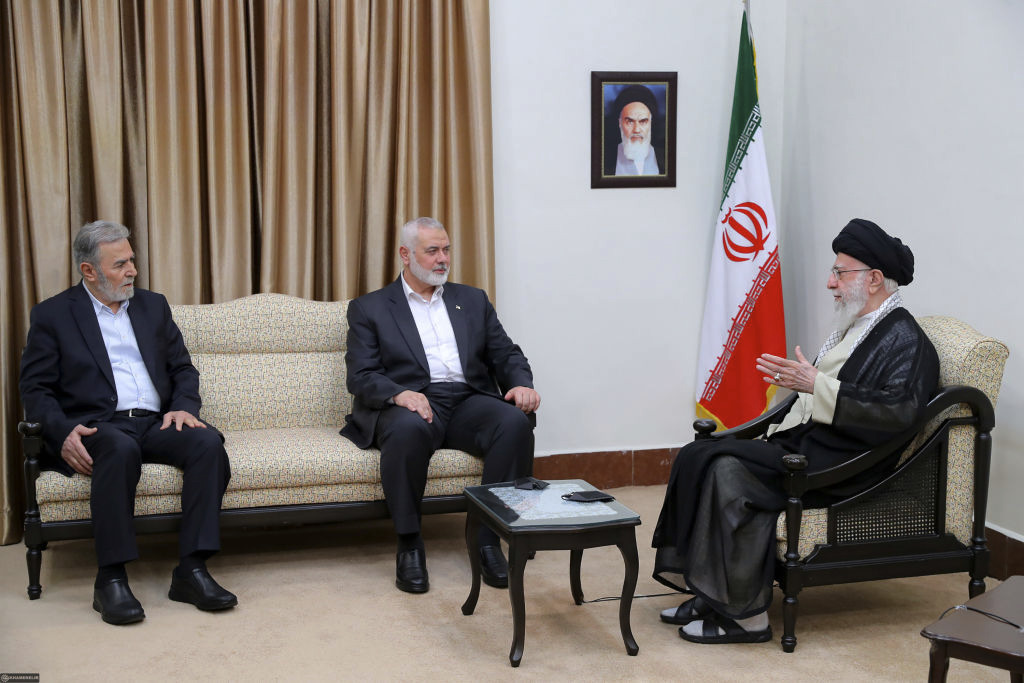
Since the early 1990s, the mullahs' regime in Tehran has been sponsoring Hamas with military aid, as well as training and financial aid. Iran has remained a key patron of Hamas, and provided the terror group with funds, weapons, and training.
In addition, since 2006, the Iranian regime has been supporting Hamas with $350 million annually as part of the mullahs' plan to strengthen their "axis of resistance," which includes other Iran-backed terror proxies such as Lebanon's Hezbollah and Yemen's Houthi militias. With the mullahs still in place, there is every reason to believe that the strategic alliance within the "axis of resistance" -- Iran, Russia, China -- will also stay in place.
"Iran," according to slain Hamas leader Yahya Sinwar, the mastermind of the October 7 massacre, and known for his close ties to the Iranian regime, "is the "biggest supporter of the movement, financially and militarily."
Another slain Hamas leader, Ismail Haniyeh, was quoted as saying:
"I extend my thanks to those who provided money and weapons to the valiant resistance. Iran has not been stingy in supplying the resistance with money, weapons, and technology."
"Iranian officials have since boasted about their role in developing Hamas's military capabilities," the Saudi Center for Media Studies noted.
"The commander of the Iranian Revolutionary Guard's Air Force, Amir Ali Hajizadeh, stated that "all the missiles in Gaza and Lebanon were made with Iran's support. Iranian-backed militias across the region also expressed strong support and offered military assistance to Hamas."
If Trump wants his Gaza peace plan – and his "Donroe Doctrine" revitalization of the Western Hemisphere -- to succeed, he should make every effort to help the Iranian people regain their freedom from this regime as soon as possible.
If the mullahs' regime stays in power, the chances of removing Hamas and demilitarizing the Gaza Strip for any length of time will be zero.
For decades, Tehran's mullahs have posed a direct threat not only to Israel and the US, but also to the security and stability of Arab countries, including Saudi Arabia, the United Arab Emirates, Bahrain, Kuwait, Yemen, Egypt and Iraq. The current anti-regime protests in Iran should be fully supported not only by the Trump administration, but all Western countries, as well as Arabs and Muslims.
If Hamas remains standing, Hezbollah, the Houthis and other Iran-backed Islamist terror groups will also continue to rearm, regroup and plan for more terrorism and bloodshed in the region. Trump, to succeed, needs to expand the mandate of his Board of Peace to include seeing to it that the Iranian regime departs as expeditiously as possible.
Iran's proxies may not disappear immediately, but, if and when the Iranian regime is gone, they will be significantly weakened. The removal of the mullahs would mean their eventual removal as well.
Hamas still uses Iran for its weapons, military training and technology. Although Iran is reportedly bankrupt, the mullahs will continue to pour millions of dollars on Hamas and Hezbollah. Iran cannot afford to lose its two main proxies in the Middle East.
It is crucial at this juncture to free the Palestinians from the boot of Hamas and the Iranians from the boot of the mullahs. The disappearance of both would do Trumpian wonders for the entire planet.
Khaled Abu Toameh is an award-winning journalist based in Jerusalem.
 tiki
tiki