








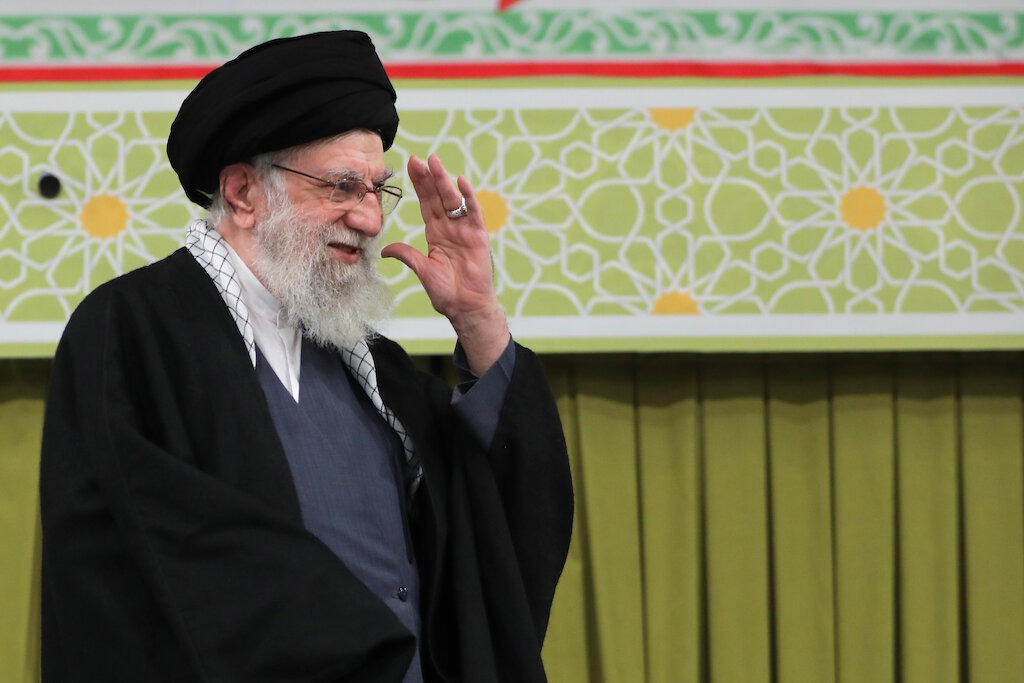
After weeks of tergiversation caused by military threats from the US and Israel and unprecedented nationwide protests, Iran's "Supreme Guide" Ali Khamenei has returned center stage to reaffirm his resolve to make absolutely no concessions to domestic opponents or foreign foes.
The defiant message came last Wednesday as the regime organized marches to mark the anniversary of the 1979 Islamic Revolution.
To be sure, this year's marches lacked the density, let alone the passion, of previous years and in some cities were too obviously contrived to appear genuine. In some cases, the official media had used photos and clips from previous years to heighten the narrative.
The Islamic Revolutionary Guard Corps' Tasnim News site used a single photo to illustrate what it reported as rallies in 21 out of 31 provinces.
Nevertheless, there is little doubt that Khamenei has absorbed the multiple shocks of recent events and intends to remain on the course he set for Iran more than three decades ago.
His main message, reaffirmed again last week, is that there will be no major change in the Islamic Republic's policies and behavior either at home or on the international stage.
Khamenei's renewed defiance is inspired by four conclusions he has drawn from the latest events.
The first is that neither the United States nor its regional ally Israel would risk a new military confrontation with Iran if only because the element of surprise they benefited from last June is no longer there.
The second conclusion is that almost all regional powers oppose regime change in Iran, at least for the time being, making it more difficult for the US to contemplate a Lone Ranger operation.
The third conclusion is that regime opponents, though manifestly stronger than ever in terms of their respective popular bases, have detailed plans for what to do after toppling the regime but no strategy for achieving power to implement their desiderata.
The fourth conclusion is that the most imminent threat to the system may come from disparate groups of malcontents collectively labeled the "pro-reform" faction.
This includes many former top officials, both political and military, along with scores of academics, civil society figures, clerics, celebrities, writers, and journalists. The concern felt in Khamenei's circle is that the "pro-reform" faction may make a deal with the Trump administration in Washington to arrange a Venezuela-style double-barrel change at the top while retaining the trunk of the regime.
To forestall such a scheme, a campaign against "pro-reform" figures was launched a few days ago with the arrest of several activists in Tehran and the provinces. The "Supreme Guide" no longer needs the "pro-reform" narrative to give his regime a veneer of plurality. The "pro-reform" faction was useful as long as there was no chance of it being upgraded from faux Catiline to a real threat.
More importantly, perhaps, an official nomenclature list approved by the House of the Leader ("Beit-e-Rahbar") shows who is being retained as the real McCoy and who is excluded.
It was published by the official news agency IRNA as a list of personalities who led the revolution anniversary marches.
The list contains the names and offices of 118 personalities that the Beit-e-Rahbar regards as the hardcore of loyalist factions. Absent from the list are three former presidents of the Islamic Republic, three former commanders of the Islamic Revolutionary Guard Corps, two former foreign ministers and half a dozen clerics in various key positions.
Perhaps inspired by the Leninist motto "better fewer but better," the "Supreme Guide" seems determined to work with a more compact group of no-questions-asked loyalists on a platform of revolutionary defiance moderated by cosmetic gestures he calls "heroic flexibility".
A key example of that flexibility is his readiness to authorize the resumption of indirect talks with the US, the second round of which is expected to be held before the Iranian New Year on 21 March in a regional capital.
The hope in Tehran is that Trump will agree to limit the talks to levels of uranium enrichment by Iran and the transfer of part of the already enriched uranium stockpiles to Russia for safekeeping.
The talks could be prolonged for weeks if not months, and end granting Trump another "diplomatic victory" on the eve of midterm elections in the US. Slowing down uranium enrichment until Trump becomes a lame duck or ends his term will give the "Supreme Guide" enough time to reassert his authority and perhaps work out his succession.
In the meantime, some sweets are distributed to attenuate the bitterness felt throughout the country after the recent crushing of nationwide protests.
Government employees and members of military and security apparatuses are to receive the largest New Year bonus ever granted since the revolution. Minimum wages are to be increased by between 20 and 30 percent.
Last Wednesday, over 2,000 prisoners were released on Khamenei's orders, partly because space was needed to keep new prisoners arrested during the January uprising.
A new wave of retirements in the IRGC and other security apparatuses gives the "Supreme Guide" an opportunity to promote a new generation of officers who have risen from the ranks entirely under his leadership. Almost all the commanders who had a revolutionary resume dating to the 1980s will be sent home by the Iranian New Year.
According to some reports, as yet hard to confirm, the "Supreme Guide" has also ordered a reshuffling of the administration to allow younger and more ambitious cadres to rise in a system dominated by men whose average age is 65 years, in a country where two-thirds of the population were not born when the revolution happened.
The "Supreme Guide" has also restarted his old "exporting the revolution" project in a low- key mode designed to keep the embers burning without raising a fire alarm. His priority now is to propel one of Iran's tested allies into the premiership of Iraq while supplying enough aid to the Houthis in Yemen to hold their own until better days return.
Lebanon, however, is given up for lost for the time being, although "committed allies" in all sects remain on the payroll.
The message from Tehran this week is that news of the regime's demise was exaggerated and that he is determined to hang on at any cost. Will the gambit work?
We shall see.
Amir Taheri was the executive editor-in-chief of the daily Kayhan in Iran from 1972 to 1979. He has worked at or written for innumerable publications, published eleven books, and has been a columnist for Asharq Al-Awsat since 1987.
Gatestone Institute would like to thank the author for his kind permission to reprint this article in slightly different form from Asharq Al-Awsat. He graciously serves as Chairman of Gatestone Europe.