








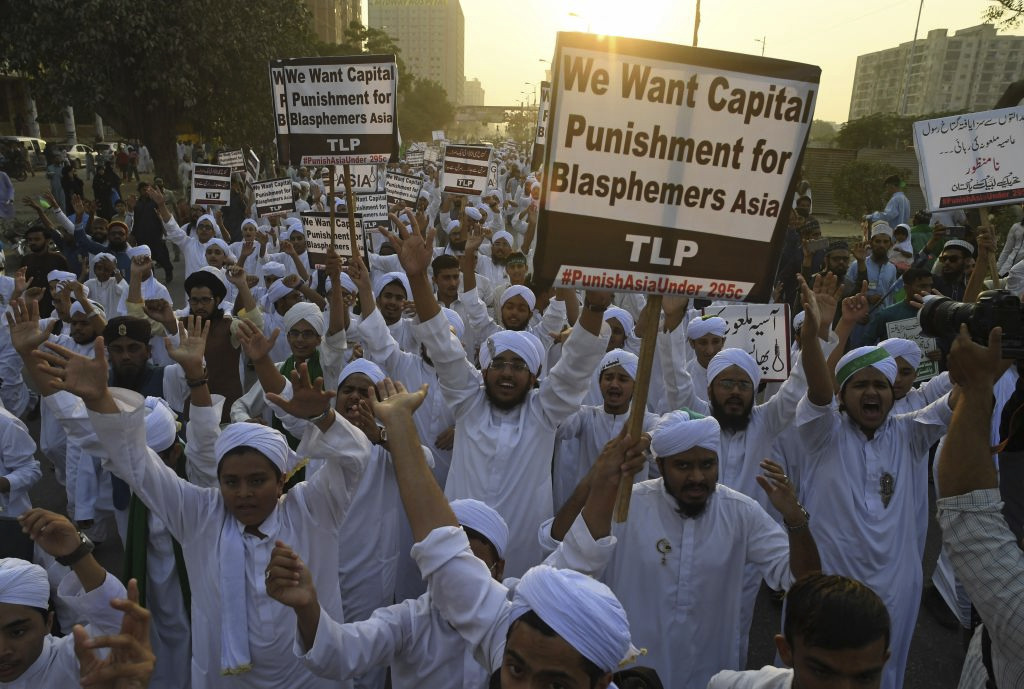
Pakistan, included by US President Donald J. Trump in his "Board of Peace" for the Gaza Strip, nevertheless continues to be one of the most dangerous countries for Christians and other non-Muslims. International watchdog organizations continue to rank Pakistan among the most difficult countries for Christians.
On Open Doors' 2026 World Watch List, which assesses persecution faced by Christians worldwide, Pakistan again ranks eighth. The report cited systemic discrimination, mob violence, forced conversions, bonded labor, and gender-based abuses, noting that perpetrators often act with impunity.
According to a 2025 report by the organization "Voice of Pakistan Minority":
"The year 2025 was marked by a deepening crisis for religious minorities in Pakistan, characterized by entrenched legal discrimination, rising mob violence, and a climate of near-total impunity for perpetrators.
"Christians, Hindus, and other non-Muslim minorities faced a combination of physical attacks, forced displacement, and structural exclusion. The Christian community remained particularly vulnerable to accusations of blasphemy that rapidly escalated into collective punishment, with mobs burning churches, targeting homes, and destroying livelihoods in affected neighborhoods. Hindus and smaller communities continued to report forced conversions, abductions, and coerced marriages of women and girls, often in contexts where access to effective legal remedies was severely constrained by corruption, intimidation, and bias."
On March 4, a 21-year-old Christian farmworker in Pakistan's Punjab Province, Marcus Masih, was tortured to death by his Muslim employers, who then tried to stage the murder scene as a suicide by hanging, the victim's brother said.
The same day Masih was murdered, United States Commission on International Religious Freedom (USCIRF) thankfully issued its 2026 report, in which it urged the US government to redesignate Pakistan as a "Country of Particular Concern" (CPC), under the International Religious Freedom Act of 1998, over systematic and ongoing violations of religious freedom.
USCIRF also called for lifting an existing waiver that exempts Pakistan from penalties available with the designation. In addition, USCIRF calls for targeted sanctions on Pakistani officials and government agencies responsible for severe violations of religious freedom by freezing those individuals' assets and/or barring their entry into the US under human rights-related financial and visa authorities, citing specific religious freedom violations.
USCIRF additionally called for holding accountable individuals who incite or participate in vigilante violence, targeted killings, forced conversion, and other religiously based crimes. It noted:
"The U.S. Congress should incorporate religious freedom concerns into its larger oversight of the U.S.-Pakistan bilateral relationship through hearings, letters, resolutions, and congressional delegations and advocate for the release of FoRB [Freedom of Religion or Belief] prisoners in Pakistan."
The Christian Daily International reported that Marcus Masih's murder reflects broader vulnerabilities faced by religious minorities in Pakistan. The country's stratified social system confines Christians, Hindus, and other religious minorities to low-wage and dangerous jobs in informal sectors. In recent years, several high-profile cases have underscored these concerns.
In February 2025, Christian laborer Wasif George was abducted by Muslim landowners, humiliated and paraded on a donkey after being accused of stealing wood. Images and videos of the assault circulated widely on social media. Despite pleas from his family, none of the main perpetrators was arrested.
In March 2025, Zohaib Iftikhar, a Muslim, slit the throat of his coworker, Waqas Masih, a 22-year-old Christian, after accusing him of committing blasphemy by touching an Islamic textbook with "unclean hands."
In May 2025, Christian laborer Kashif Masih was tortured to death by a group of Muslims, including a former police officer, over an unproven allegation of theft. The murder sparked outrage among minority-rights groups, who criticized authorities for failing either to prevent or promptly prosecute such crimes.
In June 2024, 18-year-old Catholic worker Waqas Salamat was tortured to death by his Muslim employer and others for allegedly leaving his job without permission. His family said he was subjected to hours of eventually fatal electric shocks.
USCIRF said in its latest report:
"In 2025, religious freedom conditions in Pakistan continued along a troubling trajectory. The government continued to enforce its strict blasphemy law, impacting people of all faiths, including religious minorities. Increasing vigilante attacks and mob violence targeting religious minorities, specifically Ahmadiyya Muslims and Christians, contributed to an intensified climate of fear and intolerance.
"Authorities continued to wield the blasphemy law and its death penalty provision to punish those deemed to have insulted Islam."
In January 2025, four individuals were sentenced to death for allegedly posting blasphemous content on social media.
Also, a mentally challenged Christian man, Farhan Masih, was imprisoned on charges of blasphemy and terrorism. Despite being acquitted, he could not return to his village due to fear for his safety.
In March 2025, the Lahore High Court removed from its case list Junaid Hafeez's appeal hearing related to charges of blasphemy. Hafeez — a former visiting lecturer at the Department of English Literature of the Bahauddin Zakariya University — was arrested by police in 2013, and his trial started in 2014. Authorities have held Hafeez in solitary confinement since 2014. He was sentenced to death in 2019 on blasphemy charges. His appeal against the sentence has been pending since 2020.
In October, a high court finally acquitted Christian pastor Zafar Bhatti of blasphemy charges after 13 years in prison. Days after his release, after years of medical neglect, Bhatti succumbed to cardiac arrest.
Violent attacks against religious minorities continue with impunity. Days after a Christian man's throat was slit over a false blasphemy allegation arising from his refusal to renounce his faith, a Hindu man, Nadeem Naath, a 56-year-old Hindu, was shot to death in Peshawar by a Muslim, Muhammad Mushtaq, after refusing to convert to Islam, on March 29.
Last September, two gunmen attacked Christian pastor Kamran Naz as he traveled to Islamabad to lead a church service. He had previously received death threats and was accused of "proselytizing among Afghan refugees."
Reports of forced conversions among Hindu and Christian girls in Punjab and Sindh Provinces persisted throughout 2025.
In February, a 12-year-old Christian, Saba Shafique, was reportedly abducted in Sindh Province, forcibly converted to Islam, and married to a 35-year-old man, Muhammad Ali.
In July, the Sindh Human Rights Commission expressed concern about the abduction and forced conversion to Islam of a 15-year-old Hindu girl, Shahneela. Her uncle said in a police report that two armed men had forcibly entered the family's home in Matli and kidnapped Shahneela.
Additionally, although Pakistan's constitution establishes Islam as the state religion, a 1974 amendment declared Ahmadis as non-Muslims, thereby excluding them from political representation and equal voting rights.
In 2025, USCIRF reported:
"Throughout Pakistan, authorities continued to impose restrictions on Ahmadiyya Muslims' ability to practice their faith and allowed for assaults against Ahmadiyya mosques. In February, a mob of TLP members destroyed minarets of an Ahmadiyya mosque in Sialkot without police intervention. In October, three gunmen attacked an Ahmadiyya mosque in Rabwah, wounding six worshipers. No group claimed responsibility for the attack.
"In March, authorities arrested dozens of Ahmadiyya Muslims, including children, for offering Friday prayers. Days later, police issued two First Instance Reports against two dozen Ahmadiyya Muslims, based on a complaint from TLP members that the community was sacrificing animals for Eid-ul-Adha.
"In April, a mob affiliated with the TLP stormed an Ahmadiyya mosque to prevent the community from offering Friday prayers. During the attack, the mob beat to death an Ahmadiyya man, Laeeq Cheema. Police allegedly did not intervene to stop the attack."
Christian community members criticized the Pakistani government for failing to deliver justice and accountability for the 2023 Jaranwala attacks, during which mobs destroyed homes belonging to Christians and churches, after allegations of blasphemy.
Last June, Christian communities accused authorities of ignoring evidence after a Pakistani court acquitted 10 Muslims involved in burning a church during the 2023 Jaranwala attacks. In August, victims of those attacks held protests to mark the two-year anniversary and repeated calls for government action.
In May, Pakistan's National Assembly unanimously passed the Islamabad Capital Territory Child Marriage Restraint Bill to curb child marriages and, by extension, the forced conversions of underage girls. Under this legislation, those who facilitate or coerce a child into marriage, including family members or clerics, can face up to seven years' imprisonment. The question remains: Will anyone actually enforce this law?
Pakistan's Council of Islamic Ideology strongly opposed the bill and declared it "un-Islamic" for not conforming with Islamic injunctions. Jamiat Ulema-i-Islam-Fazl (JUI-F) chief Maulana Fazlur Rahman called for rallies protesting the law. Leaders of the Mili Yakjethi Council (MYC) similarly condemned the bill, calling it "un-Islamic" and unconstitutional.
In 2025, several attacks or threats of violence against places of worship took place. In February, the US Embassy in Islamabad reported that Tehreek-e-Taliban (TTP) threatened to attack Faisal Mosque. In response, the embassy prohibited US employees from traveling to the area. In March, at least six people, including a chief clerk, were killed by a suicide attack after Friday prayers at an Islamic seminary in northern Pakistan.
Pakistan's estimated population is 252 million, of which 96.5% are Muslim (85-90% Sunni and 10-15% Shi'a) and 3.5% belong to other religious communities, including Christians and Hindus, and perhaps fewer than 200 elderly Jews, if that, who might try to pass as Parsis.
Pakistan would seem hardly the most helpful member for any real "Board of Peace."
Uzay Bulut, a Turkish journalist, is a Distinguished Senior Fellow at Gatestone Institute.
 af
af