








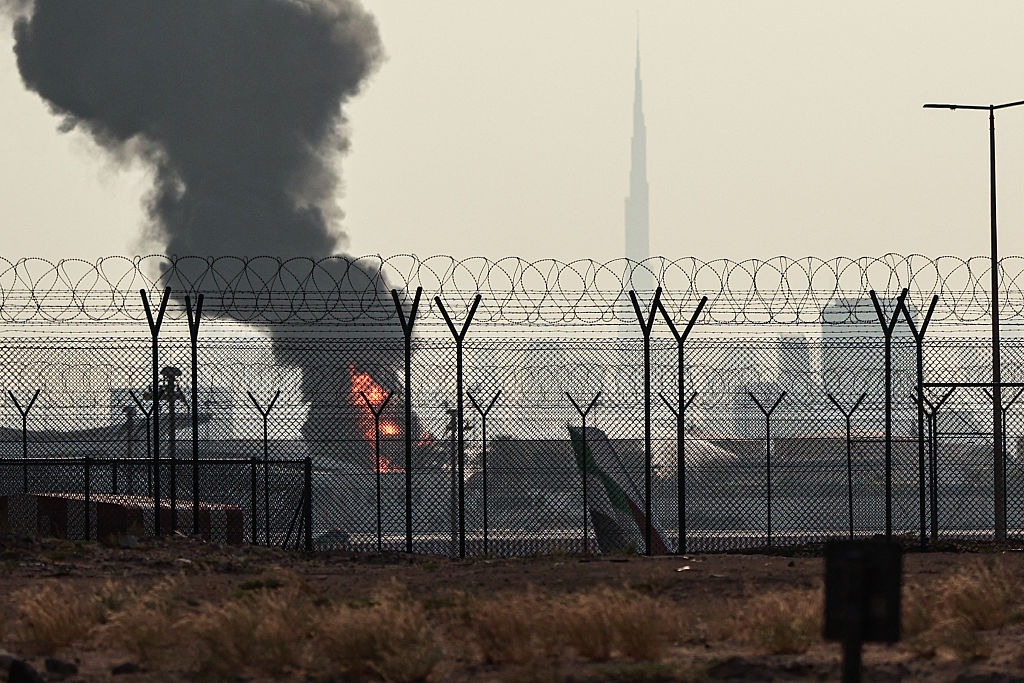
Recent Iranian missile and drone attacks on Gulf states – including Saudi Arabia, the United Arab Emirates (UAE), Bahrain, and Kuwait – have exposed a deep and widening rift within the Arab world.
While the Gulf states find themselves directly in the line of fire, their frustration is not directed only at Tehran, but increasingly at fellow Arab states whose response has been muted, symbolic, or absent altogether. As far as the Gulf states are concerned, the Arab response is just background noise.
For decades, the Arab world has been organized around a single political narrative: Israel is the central threat to regional stability. This narrative has shaped diplomacy, media, education, and public discourse across the Arab world. It has served Arab regimes as a tool of legitimacy and deflection – a way to redirect internal frustrations toward an external enemy.
The Arabs' failure to help the Gulf states appears to stem from a desire to continue depicting Israel, and not Iran, as the central political issue.
If Iran becomes the universally acknowledged primary threat, that narrative collapses. So, there is an underlying hesitation in some parts of the Arab world publicly to shift the spotlight away from Israel and redefine Iran as the main enemy. Acknowledging Iran as the primary threat carries political and ideological costs in the Arab world. Arab inaction is driven mainly by fear, weakness, and division, but it is reinforced by a lingering reluctance to fully abandon the old regional narrative centered on Israel.
If Arab states were to fully mobilize in defense of the Gulf against Iran – politically, militarily, and rhetorically – they would be forced to confront an uncomfortable truth: that the primary threat to Arab security no longer aligns with the anti-Israel narrative that has defined the region for generations.
Anwar Gargash, diplomatic adviser to UAE President Sheikh Mohamed bin Zayed Al Nahyan, recently criticized what he described as the failure of joint Arab and Islamic countries to respond effectively to escalating Iranian threats against Gulf states.
In a post on X, Gargash wrote that Gulf countries are facing repeated attacks from Iran, raising urgent questions about the effectiveness of institutions such as the 22-member Arab League and the Organization of Islamic Cooperation, the world's second-largest intergovernmental organization after the United Nations, with 57 member states across four continents.
He emphasized that any criticism of Western or US presence in the Middle East would be "unobjective" if Arab and Islamic countries themselves fail to act meaningfully in the face of such threats.
"With this [Arab and Islamic] absence and inability, it would not be acceptable later to talk about the decline of the Arab and Islamic role or to criticize the American and Western presence."
Gragash's remarks reflect growing frustration in Gulf states with what are perceived as largely symbolic or rhetorical reactions from Arabs and Muslims, which have often stopped short of implementing concrete measures or strategies for deterrence.
Gargash's criticism signals that the Arabs of the Gulf states have begun questioning the reliability of traditional Arab solidarity. That may well be why some have already begun adjusting by moving closer to security cooperation with non-Arab partners -- including the US and Israel -- considering more independent military responses, and preparing for a scenario where they must act alone.
For Gulf leaders watching their skies light up with incoming projectiles, the lack of a response from many Arab and Islamic countries to the Iranian attacks does not constitute an act of solidarity; it is abandonment and betrayal.
Beyond standard condemnations, broader Arab backing has been extremely limited.
While Gulf Cooperation Council (GCC) states have coordinated internally, pan-Arab mobilization has been largely absent. Arab responses, meanwhile, have largely consisted of statements condemning escalation, and calls for restraint and de-escalation.
What is missing from the Gulf perspective: military coordination, air defense integration beyond the GCC, and political alignment against the Iranian aggression.
Not all Arab states, however, see Iran as the primary threat.
For Gulf countries, Iran is an immediate, kinetic threat targeting their territory. Its actions threaten energy security and regime stability. Control over the Strait of Hormuz is an existential concern for the Gulf countries.
Other Arabs and Muslims do not seem to share this concern. For them, the Iranian regime is a secondary or manageable adversary.
For the Arabs and Muslims living outside the Gulf region, domestic priorities and internal stability take precedence. Many Arab and Islamic leaders face publics that oppose alignment with the US or Israeli military actions. They are also most likely afraid of Iranian retaliation.
These Arab and Muslim leaders worried that entanglement in the conflict could expand into a full-scale regional war that would pose a direct threat to their national security and regimes.
Muna Busamra, editor-in-chief of Al-Bayan, a Dubai-based Arabic-language newspaper, agreed with Gargash's criticism of the muted reaction of the Arabs and Muslims to Iran's attacks on the Gulf countries.
"Between silence and justification, Arab positions have redrawn the map of trust and partnership in the region," Busamra remarked.
"In the Iranian terrorist aggression against the Gulf states, the surprise lay not in the nature of the threat, but in the magnitude of the void exposed by the moment of truth. Claims crumbled, rhetoric faltered, and entire systems that had long spoken of 'solidarity' without demonstrating the ability to practice it when it became an obligation were uncovered.
"In light of this escalation, the event was not merely military, but a revealing moment for the reality of Arab and Islamic action. The question is no longer theoretical: Where are the institutions that were supposedly established for such situations? Where are the Arab League and the Organization of Islamic Cooperation? And where are the countries that have long been at the forefront with grand pronouncements about shared national security?...
"What is more dangerous is that some [Arab and Islamic] parties did not merely hesitate, but silently bet on a different outcome. They bet that the [Iranian] strike would be devastating, and that the Gulf states would enter a state of confusion that would reshape the balance of power in the region. This gamble was not innocent; rather, it reflects a profound misreading of reality, and perhaps an implicit desire to see a different scenario, even at the expense of the region's security....
The Gulf states, which have always been present in supporting their Arab surroundings—politically, economically and humanely—were not expecting anything in return, but they certainly did not expect that absence would turn into a stance, or that historical support would be met with cold silence at a moment of direct threat.
"This experience will reshape many assumptions. It will no longer be possible to treat the concepts of "partnership" and "brotherhood" superficially, and alliances will no longer be built on pleasantries, but rather on clear positions and converging interests. The region is moving toward a more frank phase... and one less tolerant of ambiguity...
"The Gulf states, which have proven their resilience and ability to manage crises effectively, will base their future choices on one principle: who was present when presence was required."
Mauritanian journalist Ould Salek, writing in the UAE's Al-Ain newspaper, also weighed in on the lack of Arab and Islamic backing for the Gulf states.
"Since Arab national security becomes meaningless if it does not include Gulf national security, citizens and residents of the Arab Gulf states have the right to ask with genuine concern: Where are the institutions of joint Arab and Islamic action, foremost among them the Arab League and the Organization of Islamic Cooperation, while the Gulf states are exposed to direct threats and repeated Iranian aggression?... Where are the major Arab and regional powers when the situation has become critical, and Gulf security is in the eye of the storm?...
"For decades, these [Gulf] countries opened their doors to millions of Arabs, who settled there, worked, built homes, raised children, and whose interests and lives became intertwined with the life of the Gulf itself. They were in a welcoming Arab space where they found dignity, opportunity, and stability.
"The role of the Gulf states was not limited to hosting and providing livelihoods; it extended to supporting their brethren in times of hardship. Foremost among these was the Palestinian cause, which, were it not for Gulf support, would have been lost. When Arab economies faltered, cities crumbled under the weight of war, or peoples sought a lifeline, the Gulf states were present, offering assistance, aid, relief, and economic and political support....
"But the current regional landscape reveals a reality that cannot be ignored: the Gulf states view Iran as the primary threat, due to geography, direct experience, and Iran's activities across multiple Arab arenas. Conversely, other Arab states consider Israel the most significant threat in their priorities....
"Ultimately, the most undeniable truth remains that Arab solidarity should not be selective, nor should it be based on double standards. Palestine has the right to receive support, but no one has the right to use it as a pretext to attack the Gulf and then demand Arab silence. Just causes do not justify injustice, grand slogans do not erase aggression, and those who attack the Gulf do not become friends simply because they raise the Palestinian flag."
For the people of the Gulf states, the conclusion is clear: When it matters most, Arab solidarity is unreliable, and, contrary to the political discourse in the Arab world, Israel is not the central threat to regional stability.
Khaled Abu Toameh is an award-winning journalist based in Jerusalem.
 Raymond Jardine