








It is time to think about the unthinkable.
For the sake of argument, let us consider a world where Donald J. Trump did not win the presidential election that returned him to the Oval Office in 2025 and, instead, Kamala Harris won that contest.
Given her progressive ideology, it is inconceivable that Harris would or could confront Iran's race to create a Middle East empire under their control, much less exert any American influence to restrain Iran's pursuit of nuclear weapons placed atop intermediate- and long-range ballistic missiles.
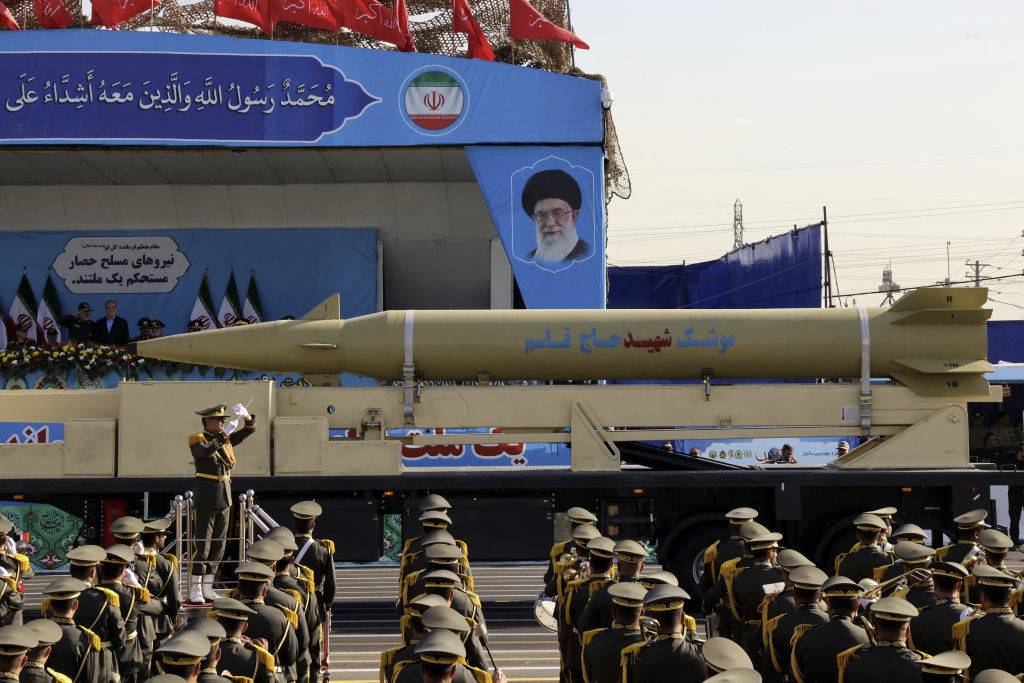
And that is where the nightmare emerges. Iran's intermediate-range ballistic missiles, such as the ones it launched in March at the joint US-UK military base on Diego Garcia, can already reach Rome, Athens and all of Eastern Europe. Imagine the following: Iran confirms a successful intercontinental ballistic missile test, its warhead capable of reaching all of Western Europe and the UK. Suddenly the strategic guardrails that have governed peace and security since the Cold War are gone.
However, having nuclear weapons and using them are two profoundly different issues.
So in our nightmare scenario, let us then consider the thinking of Iranian leadership that believes infidels reign in those targeted cities. Accordingly, it's time to go from threat to strike because they know a Harris Administration would be paralyzed when they do so. Not so the Israelis. So, while Tehran has sworn to destroy "the Zionist entity," they are not suicidal. That leaves them plenty of other targets in which a nuclear strike will tell the world Iran now owns the Middle East on its terms.
Let us assume they decide Athens will make a heart-stopping example of Iran's intent to change the international calculus through the use of nuclear weapons. Will that trigger a nuclear response from NATO? Would the Harris Administration have the moral courage to engage in a nuclear exchange, having seen Athens enveloped in a nuclear fireball?
Saudi Arabia, which has long signaled its intention to match any Iranian nuclear weapons capability, would likely reveal that it has atomic weapons hidden but is now prepared to strike. Egypt and the UAE would not be far behind.
For southern Europe, the loss of Athens in a mushroom cloud would be immense. Nations such as Spain and Italy are accustomed to thinking of these kinds of existential threats as remnants from the Cold War era. Where is the Harris Administration? Having never considered a preemptive military strike against Iran's nuclear infrastructure, it is left with few options, even if it had the wisdom and will to engage in any of them.
The most sobering lesson from this hypothetical scenario is that Trump did become president once more and recognized that Iran's drive for nuclear weapons and the means to deliver them could not be left to future administrations. It is a present emergency on our doorstep that exists today.
In time, history will record that Trump had the vision and the courage to commit our military to stopping Iran, and by doing so, protected our nation and all democracies from an unthinkable threat.
When one thinks about the unthinkable, one begins to appreciate that this conflict is not about oil. It's about survival.
Lawrence Kadish serves on the Board of Governors of Gatestone Institute.