








Iran has ostensibly agreed to a two-week ceasefire -- which, intentionally or not, it broke within minutes -- and to negotiations. At first glance, an agreement may seem a meaningful step. With the Islamic Republic of Iran, however, a ceasefire does not necessarily indicate a genuine shift in intent. As US President Donald J. Trump and his negotiators undoubtedly know, it more likely functions as a tactical pause to relieve pressure, rebuild capabilities, and buy time under the cover of diplomacy.
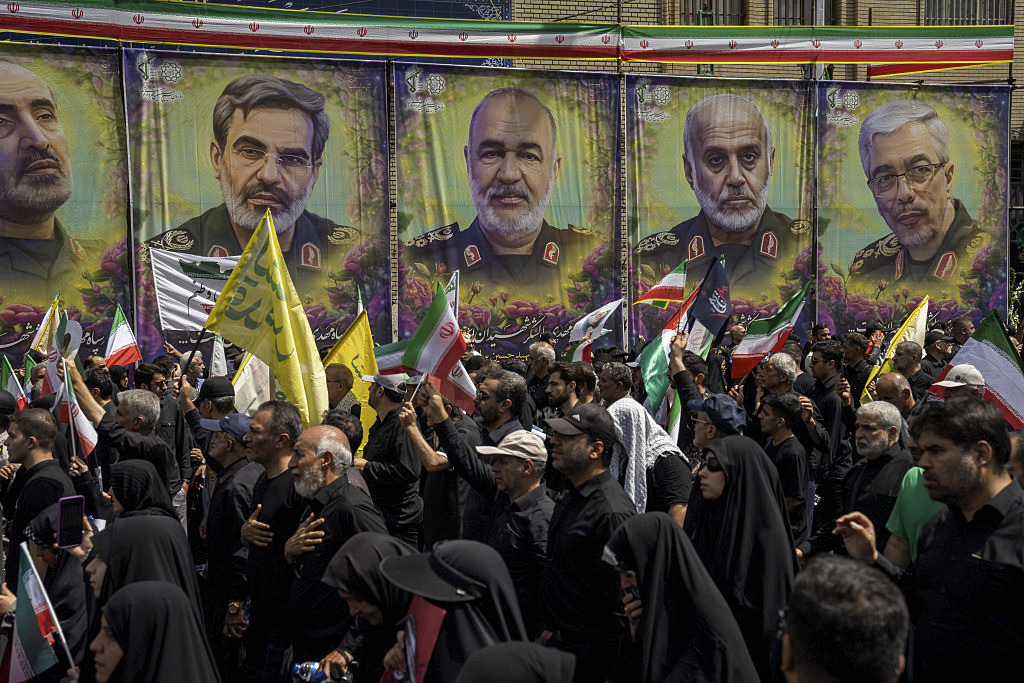
Unlike conventional states where elected officials or formal institutions hold ultimate decision-making authority, Iran operates through a deeply layered, often opaque power structure. On the surface, diplomats and politicians engage with the international community, projecting reasonableness, flexibility, and a willingness to compromise. Beneath this diplomatic façade, nonetheless, lies the true center of power: the Islamic Revolutionary Guard Corps (IRGC) and Iran's intelligence apparatus. These institutions are not merely influential — they are decisive. They shape national security policy, control key economic sectors, and determine the regime's strategic direction. Any negotiation that fails to account for this structure misunderstands who actually makes final decisions.
Iran's regime now must find itself under significant strain. Militarily, it has faced sustained pressure and blows; economically, it continues to struggle under sanctions and internal inefficiencies; politically, it must manage both domestic dissatisfaction and external threats. The regime therefore has strong incentives to de-escalate temporarily without conceding strategically. At such a moment, it may be willing to promise sweeping concessions and even alignment with international demands. Such signals, regrettably, must be interpreted not as evidence of change but as indicators of tactical adaptation. The central question is not whether the regime is willing to say the right things — it is whether it is able and willing to do them.
During previous rounds of negotiations, for instance, particularly in 2015 with then President Barack Obama's disastrous JCPOA "nuclear deal," Iran made commitments that looked comprehensive and verifiable. Concerns soon emerged, however, regarding undisclosed nuclear activities, continued technological development, and the limitations of monitoring mechanisms.
The Iranian regime's core objective is survival. Offering poison-pill demands, it has been rejecting any terms that might alter its behavior. Instead, it seems to be aiming to absorb shocks, outlast pressure, and wait for more favorable conditions. Usually this tactic -- if Islam even appears threatened -- includes a religiously required directive, taqiyya: deceit in the service of furthering Islam. The tactic also includes extending negotiations, limiting concessions, and avoiding actions that would provoke overwhelming retaliation, all while preserving its ideology. When Trump pursues a firm approach, the Iranian regime is incentivized to delay negotiations and diffuse pressure until the political dynamics shift. Negotiations become a tool of strategic patience rather than a genuine revision of intent.
Any agreement, therefore, needs to be built only on strict, enforceable verification mechanisms that impose tangible, irreversible consequences that eliminate the regime's ability to revert to previous behaviors. The enriched uranium stockpiles cannot be subjected to indirect monitoring, which, as recently revealed, can easily be circumvented. All uranium should instead be physically removed under the direct supervision of the US, and no hidden stocks may remain within the country.
All infrastructure for producing nuclear weapons and ballistic missiles needs to be fully dismantled or destroyed. Partial restrictions, temporary suspensions, or limitations that can be reversed are insufficient. Anything less creates a latent threat that can resurface at a moment of the regime's choosing.
There can be no Iranian support whatsoever for the terrorist proxies such as Hezbollah, Hamas, the Houthis, or Palestinian Islamic Jihad, among others.
Iranian state media have begun signaling that the regime expects compensation as part of any post-conflict arrangement. The demand, which seems to have been on an initial, discarded, "10-point plan," should, of course, be categorically rejected.
Above all, the Strait of Hormuz must remain a free and open international waterway, governed by established principles of maritime law rather than unilateral control. Any international monitoring force must include a permanent US presence to guarantee that the international forces remain effective. The UNIFIL peacekeeping forces in Lebanon apparently found it easier to be onlookers, complicit in ignoring all agreements. Ensuring open access is not simply a regional concern — it is a global imperative.
In addition, throughout the entire region, the aggressive dimension of Iran's regime must be seriously addressed. The persistent use of rhetoric such as "death to America" and "death to Israel" reflects a deeply embedded worldview that legitimizes hostility and frames confrontation as a moral imperative. As long as this ideological posture remains intact, any diplomatic agreement risks being undermined by the very narratives that sustain the regime's identity. A durable resolution in Iran -- as well as for other states such as Qatar -- requires not only behavioral change but also a shift away from the regime's rhetoric of aggression.
This is a regime whose leadership is divided between those who speak and those who decide. The politicians may negotiate, but the IRGC and intelligence apparatus ultimately determine the course of action.
In short, there can be no upfront relief granted to Iran, no phased easing based on promises, and no concessions granted in anticipation of compliance. Every aspect of the regime's commitments -- uranium removal, dismantlement of nuclear and missile infrastructure, and cessation of destabilizing activities -- must be fully verified. To relieve any pressure prematurely would be to give the regime exactly what it seeks: space to recover, regroup, and ultimately resume its previous trajectory.
Dr. Majid Rafizadeh, is a political scientist, Harvard-educated analyst, and board member of Harvard International Review. He has authored several books on the US foreign policy. He can be reached at dr.rafizadeh@post.harvard.edu
 tiki
tiki