








This month, an elderly Hindu couple in Bangladesh were murdered in their home, their throats slit. This week, an Islamist group targeted offices of India's High Commission in Bangladesh, causing India to suspend visa services there.
Bangladesh is standing at the edge of a historic transformation, and, sadly, Washington is taking a perilous gamble.
Instead of reinforcing the country's fragile democratic foundations or supporting groups resisting extremism, US officials have embarked on a sweeping outreach campaign to Bangladesh's most powerful Islamist movements -- groups long tied to violence, sectarian hatred, and the darkest chapters of the nation's past. The result is an emerging strategic catastrophe: the legitimization of a coalition that once presided over genocide and now seeks to impose a Taliban-style political order on the world's fourth-largest Muslim-majority nation.
In recent months, US diplomats in Dhaka and visiting delegations from Washington have dramatically intensified their engagement with Bangladesh's Islamist forces, most prominently the Jamaat-e-Islami. In early 2025, US Embassy officials traveled to Sylhet to meet local Jamaat leaders -- a party directly implicated in mass murders, systematic rape, and repression during the 1971 Liberation War.
This Sylhet visit, not an isolated incident, appears part of a sustained pattern of US interactions with Jamaat and its affiliates as Bangladesh approaches elections in February 2026 -- the first since the 2024 uprising that toppled the government that was headed by the Awami League.
With Islamists and their partners dominating the polls, these meetings amount to quiet recognition of a looming Islamist ascendancy.
Jamaat's long record leaves little room for doubt about its intentions. Its diaspora networks have supported extremist causes for decades; its senior leadership has publicly championed anti-Hindu, anti-Christian, and anti-Jewish rhetoric; and its notorious student wing, Islami Chhatra Shibir, was once ranked by Jane's Terrorism and Insurgency Centre as the world's third-most violent non-state armed group. Human rights reports from Australia and Canada have documented Jamaat-linked murders, petrol bombings, and sweeping attacks on Hindu neighborhoods.
Yet US engagement continues -- and is growing.
Throughout 2025, former ambassadors, senior US officials, and representatives of publicly-funded American institutions such as the International Republican Institute (IRI) and the National Democratic Institute (NDI) held repeated meetings with Jamaat leaders.
The involvement of the IRI and NDI -- two vehicles of the US political establishment -- marks a deeper policy continuity. For nearly two decades, these institutions have facilitated Western engagement with Islamist movements across the Middle East, North Africa, and now South Asia.
In March, a US delegation sat down with Jamaat's top brass at its headquarters. By June, the US Embassy had invited a formal Jamaat delegation for discussions on "internal democracy" and "minority rights" -- language astonishingly at odds with the group's ideological DNA.
In July, Tracey Ann Jacobson the US chargé d'affaires in Dhaka, paid a high-profile visit to Jamaat's leader, Shafiqur Rahman, a man who has called Jews "the enemy of humanity" and hailed Hamas commander Yahya Sinwar as a "hero". Months later, Rahman received a US visa to meet American Jamaat networks and reportedly engaged with both governmental and non-governmental actors across the United States.
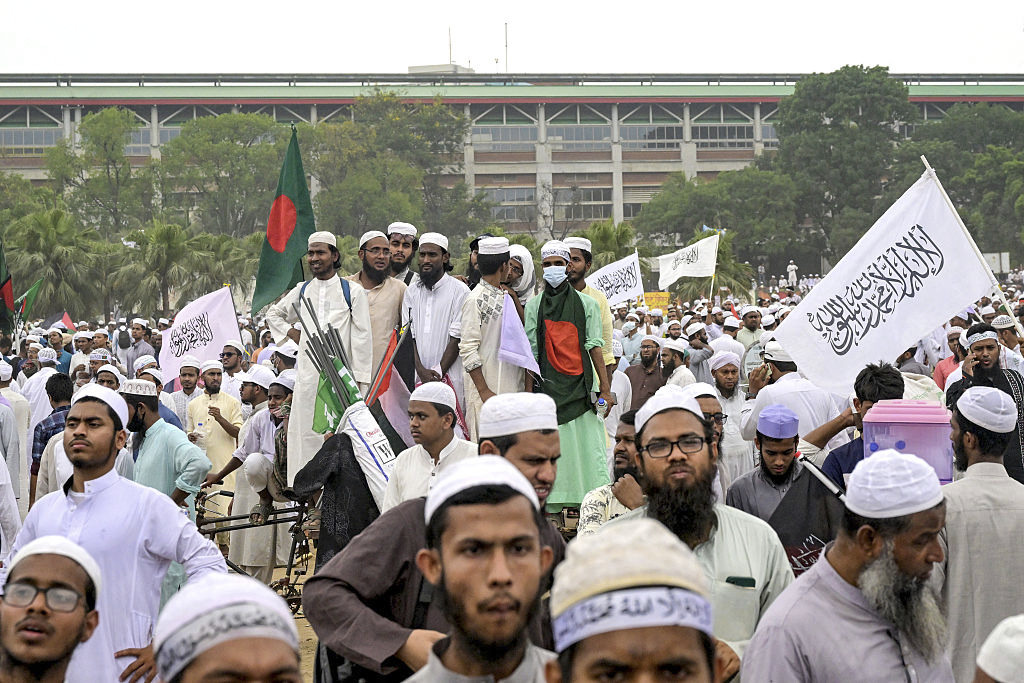
US diplomats have not limited their attention to Jamaat. US officials also met repeatedly with the hardline party Islami Andolan Bangladesh (IAB), which openly vows to enforce sharia law nationwide and says it admires the Taliban model. A coalition between Jamaat and IAB -- increasingly likely under the caretaker government -- would cement the Islamists' grip on the political order.
The Bangladesh Nationalist Party (BNP), itself long aligned with Jamaat, has participated in dialogues with American officials in London and Washington, while BNP-Jamaat lobbying expenditures in the US run into the millions.
From the early years of the "Arab Spring" to the rise of the 2012-13 Muslim Brotherhood regime in Egypt and the empowerment of Al-Islah in Yemen, Washington's faith in "moderating" Islamists has produced a trail of destabilized societies, collapsing pro-Western partners, and has emboldened extremist networks.
IRI staff have met Jamaat, BNP and IAB figures multiple times throughout 2025, including joint meetings with NDI personnel. These efforts coincide with the interim regime of Muhammad Yunus – a government openly favoring Islamist inclusion - and its attempts to cultivate Republican-aligned American institutions for international legitimacy.
A global race to court Jamaat
American overtures are part of a wider international scramble. Bangladeshi media report that in 2025 alone, diplomats from at least 35 nations - from the US and UK to China, Russia, Saudi Arabia, Turkey, Japan, and EU states - have sought meetings with Jamaat. Even the group's student wing is reportedly being introduced to Western delegations.
The message from foreign capitals appears clear: Jamaat may soon govern Bangladesh, and preparing for that eventuality has become a diplomatic priority.
An interim administration that enables extremism
The collapse of the Awami League government in 2024, after Jamaat-backed protests, opened the door for Islamist normalization. The Yunus-led interim administration has since allowed extremist actors to regain legitimacy while presiding over intensifying attacks on Hindus, Christians, political opponents, and independent journalists.
In August 2024, a report released by the United Nations, stated that BNP and "some members, supporters and local leaders" of Jamaat-e-Islami were found to have committed a series of violent attacks against political opponents as well as "members of the Hindu community".
UN reports continue to log rising Islamist violence, including BNP–Jamaat-linked assaults on minorities.
Bangladesh is being pushed toward a destiny shaped not by democratic consensus, but by militant pressure.
Washington's belief that Jamaat-e-Islami or its Islamist allies can evolve into "responsible stakeholders" mirrors the same strategic delusions that once empowered the Muslim Brotherhood in Egypt and Islamist factions from Yemen to Tunisia. The results of those experiments -- repression, sectarianism, and regional instability -- are now well documented, yet the United States appears ready to repeat history in Bangladesh, a country of 180 million people perched between South Asia's nuclear-armed rivals.
By legitimizing a theocratic alliance with a record steeped in blood, the US is not moderating Islamists; it is emboldening them. The question is no longer whether Bangladesh's future is at risk, but whether Western policymakers are willing to recognize the disaster they are helping to create before it is irreversible.
Salah Uddin Shoaib Choudhury is an award-winning journalist, writer, and editor of the newspaper Blitz. He specializes in counterterrorism and regional geopolitics. Follow him on X: @Salah_Shoaib
 Eliot Schickler